Exercises · IA-CHE-EXE-003

Dumbbell Floor Press

Learn a controlled dumbbell floor press with a floor-limited range and gradual loading guidance.

Browse Chest & Pecs
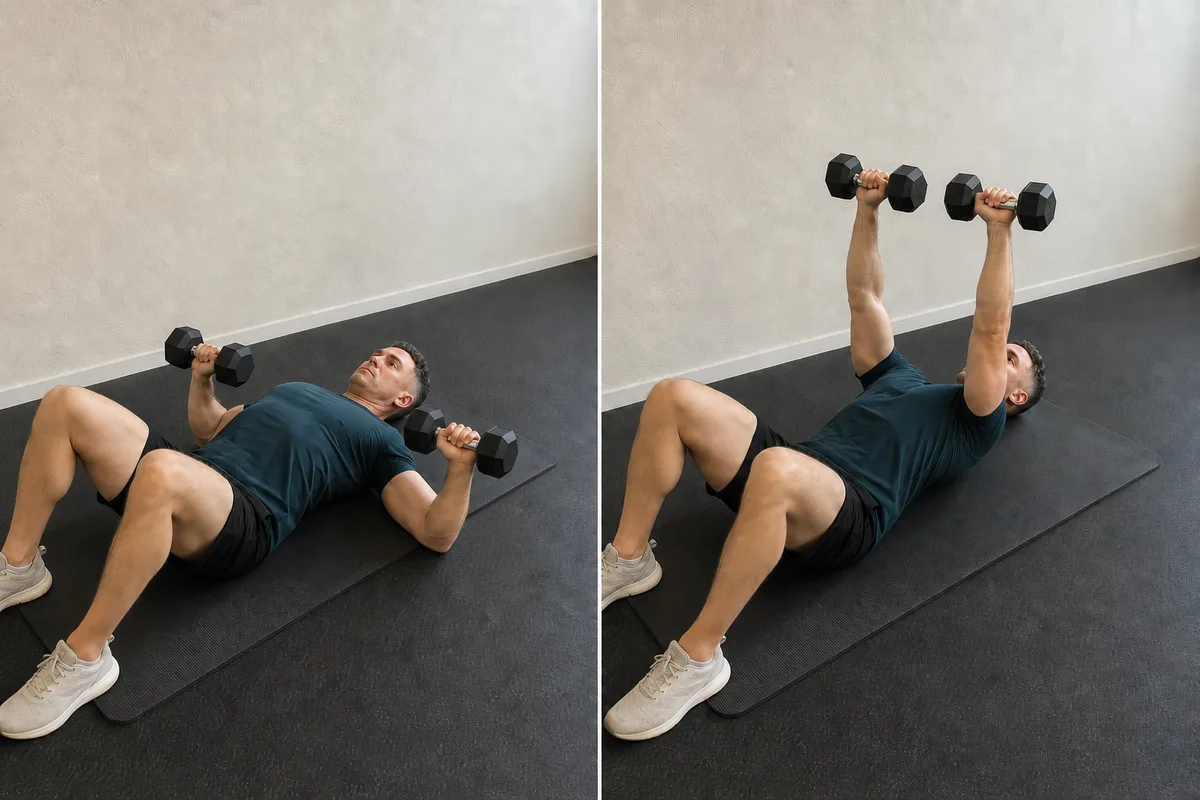
Start and finish demonstration of Dumbbell Floor Press
Start and finishUse the written steps below for the full technique and safety guidance.

At a glance

Exercise profile

Target muscles
Pectoralis major
Exercise type
Strength
Equipment
Two dumbbells, Exercise mat
Mechanics
Compound
Movement pattern
Push (bilateral)
Experience level
intermediate
Secondary muscles
Triceps brachii, Anterior deltoid

Floor-limited pressing strength

What this exercise works

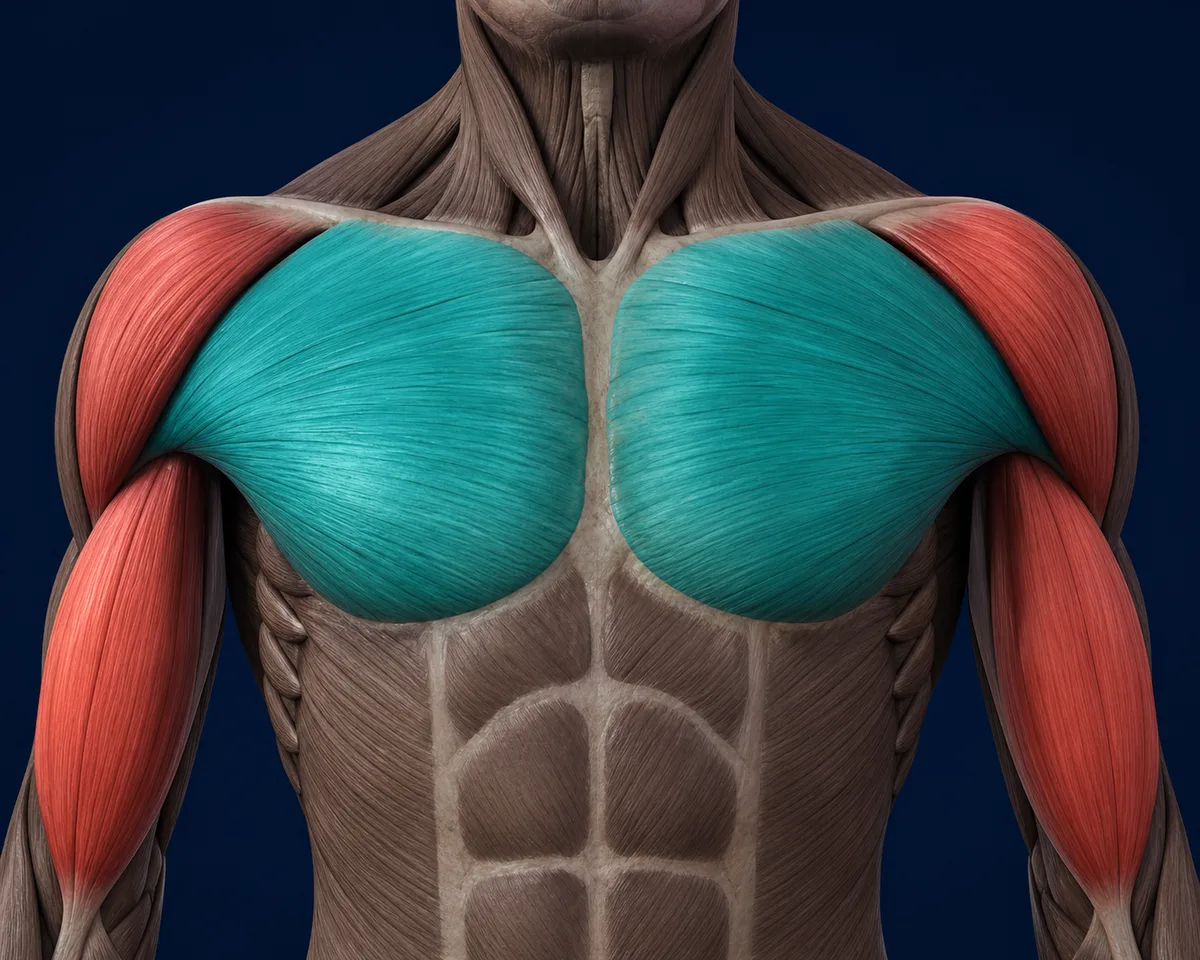
The chest provides the main pressing force while the triceps extend the elbows and the shoulder muscles guide each dumbbell.

Anatomy highlighting the structures involved in Dumbbell Floor Press
Teal — primary muscles doing most of the workRed — secondary muscles assistingGrey — stabilizers and surrounding anatomy

Primary emphasis

  • Pectoralis major

Secondary muscles

  • Triceps brachii
  • Anterior deltoid

Stabilizers

  • Rotator cuff
  • Serratus anterior
  • Abdominal wall

Movement and joint actions

  • Shoulder horizontal adduction
  • Elbow extension
  • Scapular control

Muscle contribution changes with position, range, resistance and individual technique.

Why it can help

Potential benefits and carryover

Benefits depend on technique, dosage, consistency and whether the exercise suits the person. Sport carryover means supporting the physical demands of the activity—not guaranteeing performance or preventing injury.

Everyday benefits

  • Builds chest and arm strength
  • Uses the floor to limit the bottom pressing range
  • Develops control while positioning independent weights
  • Allows each arm to contribute without a fixed bar

Training carryover

  • Supports progression toward dumbbell bench pressing
  • Builds pressing strength for push-ups
  • Develops triceps strength used in other upper-body presses

Sport carryover

  • Supports pushing demands in contact and grappling sports
  • Builds general pressing capacity for throwing-sport conditioning

Technique

Dumbbell Floor Press tips

Use these cues to keep the movement controlled and focused on its intended purpose.

  1. Choose weights you can position safely before lying back.
  2. Keep the elbows angled slightly toward the torso rather than flared sideways.
  3. Touch the upper arms to the floor gently without bouncing.
  4. Press both weights smoothly while keeping the ribs controlled.

Overview

The dumbbell floor press builds chest and triceps strength while the floor limits how far the upper arms travel behind the torso. It is a strength exercise, not an early test after an acute injury.

How to Do It

  1. Sit with two light dumbbells, then roll carefully onto your back with knees bent.
  2. Hold the weights above the chest with palms slightly turned inward.
  3. Lower slowly until the upper arms gently contact the floor.
  4. Pause without bouncing, then press upward until the arms are straight.
  5. Begin with 2 sets of 6–10 controlled repetitions.

What You Should Feel

Expect broad chest, triceps and front-shoulder effort. Stop for sharp pain, a tearing sensation or sudden loss of strength.

Common Mistakes

  • Starting with weights that are difficult to position safely
  • Bouncing the elbows off the floor
  • Flaring the elbows straight out
  • Increasing load before restoring comfortable pressing range

Progression

Build repetitions and tempo before adding small amounts of weight. A bench press has a larger range and should be a later, deliberate progression.

References

  • American College of Sports Medicine. "Progression Models in Resistance Training for Healthy Adults." Medicine & Science in Sports & Exercise. 2009;41(3):687-708. https://doi.org/10.1249/MSS.0b013e3181915670
This is general education, not a diagnosis. A recent pop, bruising, contour change or marked weakness requires assessment before loaded pressing.
Educational information only

This information does not diagnose an injury or replace care from a qualified healthcare professional.