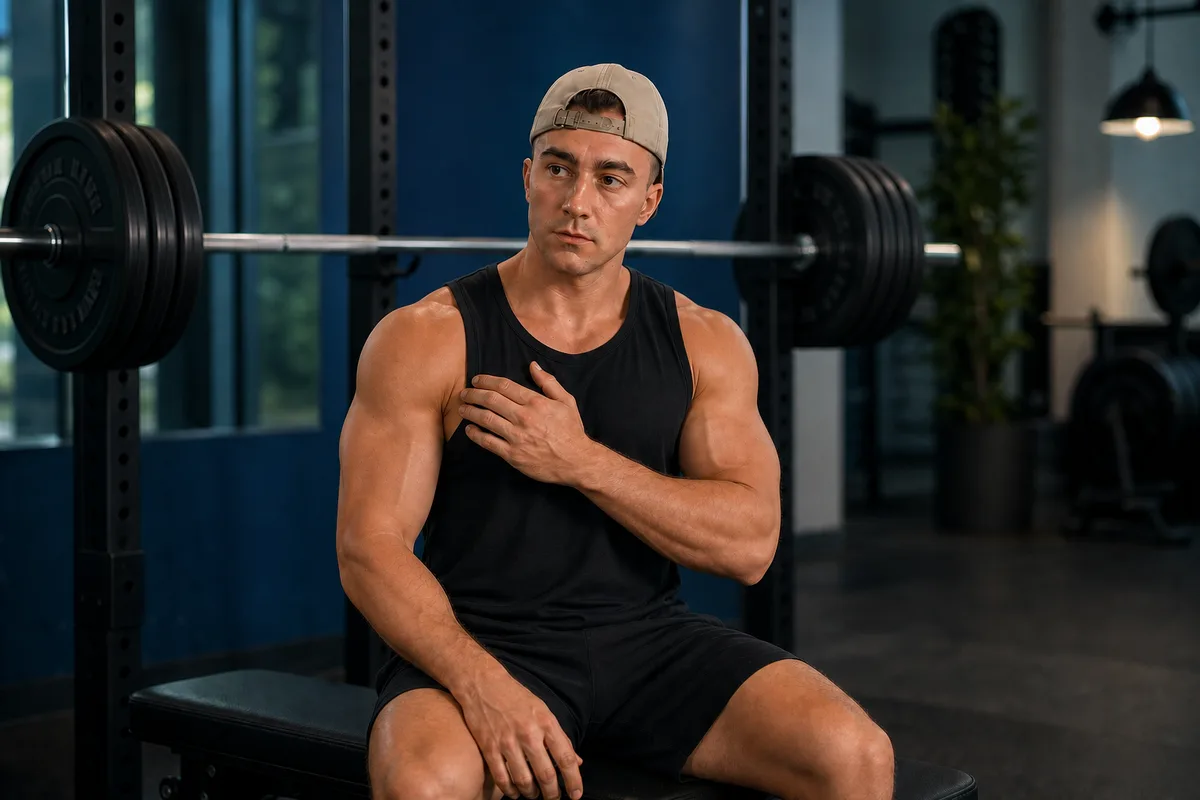
If your chest hurt suddenly during a bench press, push-up, dip or awkward reach, it is natural to wonder whether you strained your pec or tore it.
The wording is more confusing than it sounds. A strain is an injury to a muscle-tendon unit and can include a small or partial tear. When people say pec tear, they usually mean a more substantial partial tear or a complete rupture of the pectoralis major.
The biggest clues are not pain alone. A sudden pop, rapidly developing bruising, a visible change in the front of the armpit, or an immediate loss of pressing strength raises more concern for a significant tear. A milder injury is more likely when soreness develops without deformity and the arm still works reasonably well, but symptoms cannot reliably grade the damage at home.
The short answer
A mild pec strain usually involves pain and tenderness without a major change in the muscle’s shape or a dramatic loss of strength. A larger tear may produce a pop, swelling, bruising, weakness and a flattened or uneven anterior axillary fold, the front border of the armpit formed by the pectoralis major.
There is plenty of overlap. Some partial tears do not look dramatic, bruising can take time to appear, and pain may temporarily limit strength even when the tissue is still attached. If the injury was sudden and forceful, an assessment is more useful than repeatedly testing it with pressing movements.
What actually gets injured?
The pectoralis major is the large chest muscle that helps bring the arm across the body, rotate it inward and contribute to pressing movements. It has two main portions:
- The clavicular head, beginning along the collarbone
- The sternocostal head, beginning along the breastbone and upper ribs
Their fibres converge toward a tendon that attaches to the upper-arm bone near the bicipital groove. The broad muscle and tendon can be injured in several places:
- Within the muscle belly
- Where muscle transitions into tendon, the musculotendinous junction
- Within the tendon itself
- Where the tendon attaches to the humerus
Location matters. It affects what the injury looks like, which imaging is most useful and whether direct surgical repair is technically possible. It is also why “partial pec tear” is not a complete diagnosis by itself.
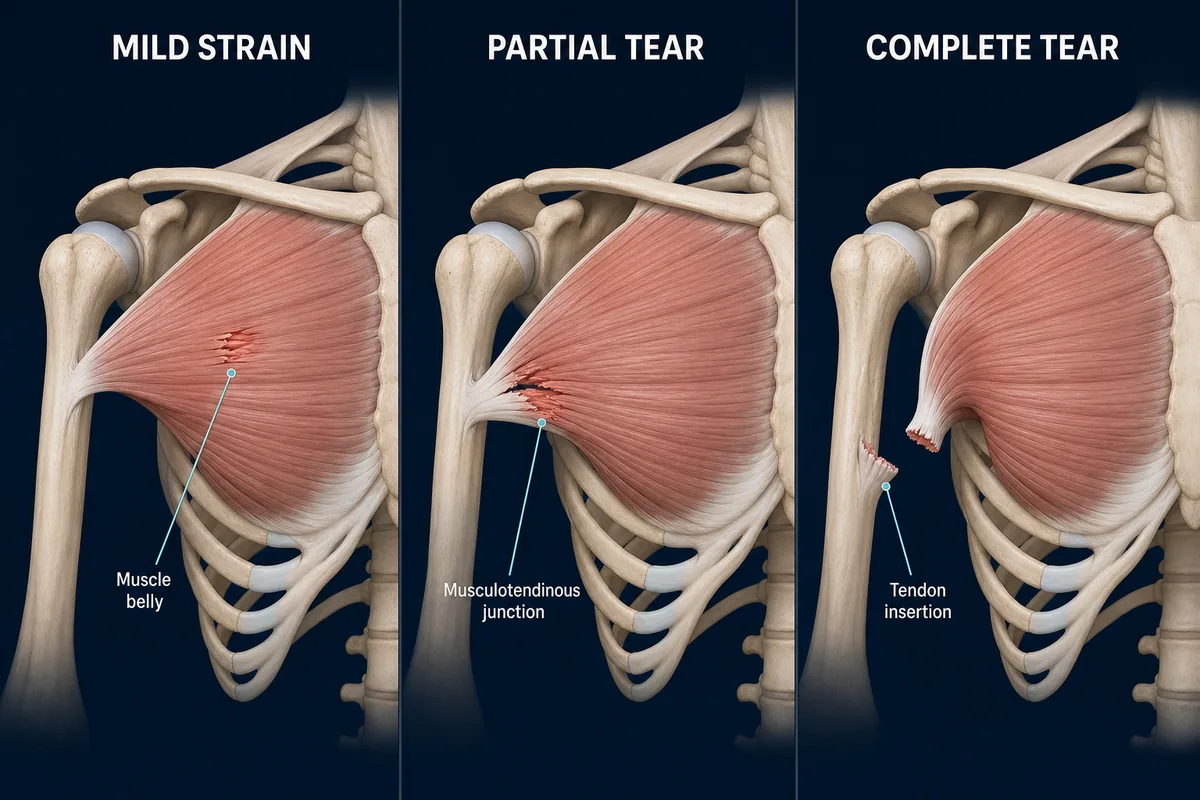
Pectoralis-major injuries can occur within the muscle, where muscle becomes tendon, or at the tendon’s attachment to the upper-arm bone. This illustration explains the spectrum; symptoms and examination are still needed to determine the actual injury.
Why pec injuries often happen during bench press
The classic mechanism is the lowering phase of a heavy bench press. As the bar approaches the chest, the arm moves outward and behind the body while the pectoralis major is producing force under increasing length.
That combination creates high eccentric loading. The lower fibres of the sternocostal head are particularly vulnerable as the arm moves into extension and external rotation.
Pec injuries can also happen during:
- Dips, push-ups or chest flyes
- Contact sports, wrestling or football
- A fall onto an outstretched arm
- Trying to catch or control a heavy object
- Water sports or forceful overhead activity
- A sudden stretch while the chest is contracting
The exercise itself is not automatically unsafe. Fatigue, load, technique, previous injury, training history and how quickly the workload increased all change the amount of stress the tissue can tolerate.
Signs that fit a milder pec strain
A mild or moderate strain may cause:
- Localized soreness in the chest or front of the shoulder
- Pain when pressing, bringing the arm across the body or reaching backward
- Tenderness over the muscle
- Mild swelling
- Strength that is uncomfortable but still present
- No obvious gap or major change in the front of the armpit
- Symptoms that settle when the provoking load is removed
This pattern can still involve disrupted fibres. “Strain” should not be interpreted as “nothing happened,” and continuing to test a painful heavy press can turn a manageable injury into a longer interruption.
Signs that raise concern for a larger tear
The following pattern deserves prompt assessment:
- A sudden pop, snap or tearing sensation
- Immediate pain during a forceful rep or impact
- Bruising across the chest, armpit or upper arm
- A visible hollow, bunching or asymmetry in the chest
- Loss or thinning of the front armpit fold
- Sudden weakness with pressing or bringing the arm across the body
- A palpable gap in the muscle or tendon
- One side of the chest moving differently when the hands press together
Not every complete tear produces every sign. Swelling can initially hide the deformity, and the remaining clavicular fibres may preserve some movement after a sternocostal-head tear.
Where the bruising appears can offer a clue
Bruising and swelling over the chest wall may occur with a muscle-belly or more proximal injury. Bruising closer to the armpit and upper arm can be seen when the distal tendon tears near its humeral attachment.
This is only pattern recognition, not a way to locate the tear with certainty. Blood can track away from the injured site, and partial tears may create surprisingly little bruising.
Is it a strain, partial tear or complete rupture?
These terms describe a spectrum:
Mild strain
A relatively small number of fibres are injured. Pain is present, but strength and the overall contour of the muscle are largely preserved.
Partial tear
More fibres are disrupted, but some portion of the muscle-tendon unit remains connected. Partial tears vary enormously: one may be a small intramuscular injury, while another may involve most of one head of the muscle.
Complete tear or rupture
The involved portion is fully disrupted. The tendon or muscle may retract, producing weakness and a visible contour change.
You cannot reliably assign a grade based only on pain intensity. A painful strain can feel severe, while a complete rupture may become less painful after the first few days even though the structural injury is more substantial.
Could the pain be coming from something else?
Yes. Pain near the upper chest and front of the shoulder may also involve:
- The long-head biceps tendon
- The rotator cuff or subacromial bursa
- The acromioclavicular joint
- The pectoralis minor
- The ribs or chest wall
- Referred pain from the neck
The biceps tendon, in particular, can hurt near the front of the shoulder during pressing. A pec injury is more likely when symptoms extend into the chest or front of the armpit and began while the muscle was forcefully loaded.
Chest discomfort with pressure, shortness of breath, sweating, nausea, faintness or pain spreading toward the jaw, back or arm should not be assumed to be muscular. Seek urgent medical care.
How a pec tear is diagnosed
A clinician will usually ask exactly how the injury happened, then compare the chest contour, bruising, anterior axillary fold, tenderness, range of motion and strength on both sides.
Ultrasound
An experienced musculoskeletal sonographer may use ultrasound to inspect the tendon dynamically and identify discontinuity or a hematoma. Its accuracy depends on the operator and the area being examined.
MRI
MRI can help show whether the injury is partial or complete, which portion is involved, where it occurred and how far the tissue has retracted. When a significant pectoralis-major injury is suspected, imaging should cover the chest and pectoralis muscle, not only a routine shoulder field of view.
MRI is useful, but it is not infallible. Research has found better agreement for complete tears than partial tears, and the final interpretation must still fit the examination and injury history.
What to do immediately after a suspected pec injury
If the injury was sudden:
- Stop pressing and do not perform one more rep to “check it.”
- Support the arm in a comfortable position.
- Use a wrapped cold pack briefly if it helps with pain.
- Avoid aggressive stretching, deep massage or repeatedly squeezing the chest.
- Arrange an assessment promptly if there was a pop, bruising, deformity or major weakness.
There is no need to keep the arm completely motionless after every mild strain. Comfortable hand, wrist and elbow movement is usually reasonable, but shoulder loading should match the suspected severity and clinical advice.
Does every pec tear need surgery?
No. Milder strains and many partial tears are managed without surgery using temporary load modification followed by progressive rehabilitation.
Surgical consultation becomes more relevant for a complete or high-grade tear in an active person who wants to restore pressing strength and chest contour. The decision also depends on:
- Tear location
- Which head and how much tissue is involved
- Retraction and tissue quality
- Time since injury
- Strength and cosmetic change
- Sport, work and training demands
- Health, goals and willingness to complete rehabilitation
Studies comparing treatment have generally found better strength, function and cosmetic outcomes after repair of substantial pectoralis-major tendon ruptures, but the evidence is mostly observational and surgery carries complications. Those findings should not be applied automatically to every partial or muscle-belly tear.
Muscle-belly and musculotendinous injuries deserve particular nuance. They are less common, imaging and operative findings may differ, and the published surgical evidence includes small series and case reports rather than strong comparative trials. A surgeon experienced with pectoralis injuries is better positioned to explain whether the tissue is repairable and what outcome is realistic.
We will cover that decision separately in Pec Tear Surgery vs No Surgery, including why a tear within the muscle belly is not the same problem as a tendon pulled away from bone.
What nonsurgical rehabilitation generally involves
Rehabilitation depends on the injury, but the broad sequence is usually:
Settle the initial irritation
Remove heavy pressing and movements that produce sharp pain. Maintain comfortable movement and train unaffected areas rather than repeatedly testing the injured tissue.
Restore motion
Gradually regain comfortable shoulder movement. Forcing a deep pec stretch early is rarely useful and can load healing tissue before it is ready.
Reintroduce strength
Loading may begin with gentle isometric contractions before progressing to controlled pressing and arm-across-body movements. The starting exercise and range should reflect the tear location and irritability.
Rebuild pressing capacity
Progress range, repetitions, sets and resistance one variable at a time. Machines, cables, push-ups or dumbbells may offer useful intermediate steps before heavy barbell pressing, but no single exercise is mandatory.
Return to demanding activity
Sport and heavy lifting require more than being pain-free at rest. Strength, control, confidence and tolerance to gradually heavier eccentric loading all matter.
Recovery does not follow one universal calendar. A mild strain and a repaired complete rupture belong on very different timelines.
When to get assessed
Arrange a prompt sports-medicine or orthopaedic assessment if:
- The injury happened suddenly during a heavy press, fall or collision
- You felt or heard a pop
- Bruising is spreading across the chest, armpit or upper arm
- The front armpit fold looks flattened or uneven
- There is a visible dent, bunching or change in chest contour
- Pressing or bringing the arm inward is suddenly much weaker
- You can feel a gap in the muscle
- Symptoms are not improving as expected
Earlier assessment matters when a complete tear is possible because the injury’s location, chronicity and retraction can affect the treatment options. Do not wait for all bruising and pain to disappear before seeking help.
Frequently asked questions
Can I move my arm if my pec is torn?
Often, yes. The shoulder has several muscles, and an intact portion of the pectoralis major may preserve movement. Being able to lift the arm does not rule out a significant tear.
Can a partial pec tear heal without surgery?
Many partial tears are treated nonsurgically, but “partial” covers a wide range of injuries. Location, percentage of tissue involved, deformity, weakness and activity goals all influence the recommendation.
How can I tell a pec tear from normal workout soreness?
Workout soreness usually develops gradually after training, is more diffuse and does not cause a pop, sudden weakness, bruising or a visible contour change. A focal injury that occurs during one repetition deserves more caution.
Should I stretch a strained pec?
Do not force an acute injury into a deep doorway stretch. Comfortable motion can be useful, but aggressive stretching may reproduce the same lengthened position that caused the injury. Stretching can be introduced later if it serves a clear purpose.
Is bruising always present with a pec tear?
No. Bruising may be delayed, subtle or absent, especially with some partial injuries. Its absence cannot rule out a tear.
Do I need an MRI?
Not for every mild strain. MRI becomes more useful when a substantial tear is suspected, the examination is unclear or the result would affect surgical planning. The requested study needs to include the pectoralis and chest wall.
How long before I can bench press again?
There is no safe universal date. Return depends on injury severity, treatment, restored movement, progressive strength and tolerance to pressing. A mild strain may be measured in weeks; a major rupture or surgical repair requires a much longer, clinician-guided progression.
Key takeaways
- A pec strain and pec tear are part of the same injury spectrum.
- A pop, bruising, deformity and sudden weakness are more concerning than pain alone.
- Tears can occur in the tendon, musculotendinous junction or muscle belly.
- Tear location and severity help determine whether imaging or surgical consultation is appropriate.
- Being able to move the arm does not rule out a substantial tear.
- Do not repeatedly test a suspected tear with heavy pressing.
- Significant acute injuries should be assessed promptly.
See it in 3D
Explore the clavicular and sternocostal portions of the pectoralis major and follow them toward their shared attachment on the upper-arm bone.
Explore the Pectoralis Major in 3D →
Continue learning
- Pectoralis Major Anatomy
- Pectoralis Minor Anatomy
- Pectoral Nerves
- Biceps Tendinitis and Front-of-Shoulder Pain
Educational information only
This article provides general education and does not diagnose an injury or replace personalized care from a qualified healthcare professional.
Sources: Long et al., “Injuries of the Pectoralis Major: Diagnosis and Management,” Orthopedic Reviews, 2022; Bodendorfer et al., “Treatment of Pectoralis Major Tendon Tears: A Systematic Review and Meta-analysis of Operative and Nonoperative Treatment,” Orthopaedic Journal of Sports Medicine, 2020; Yu et al., “High-resolution Ultrasound and MRI in the Evaluation of Pectoralis Major Injuries,” Journal of Ultrasonography, 2023; Chang et al., “Myotendinous Junction Tears of the Pectoralis Major Are Occurring More Frequently,” Journal of Shoulder and Elbow Surgery, 2024; ElMaraghy et al., “Accuracy of MRI in Predicting the Intraoperative Tear Characteristics of Pectoralis Major Ruptures,” Journal of Shoulder and Elbow Surgery, 2016; O’Connor et al., “Successful Surgical Repair of a Full-thickness Intramuscular Muscle Belly Rupture of Pectoralis Major,” International Journal of Surgery Case Reports, 2020.