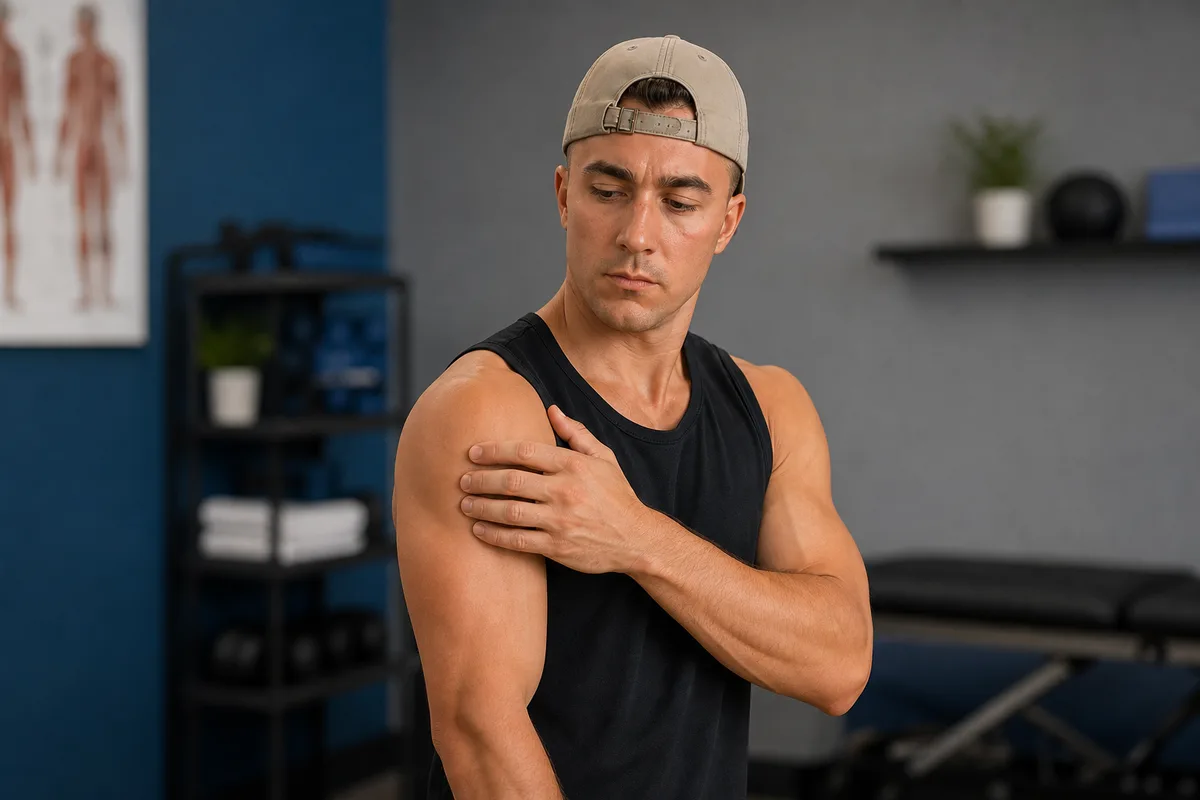
If the front of your shoulder aches during curls, pressing or overhead work, the long-head biceps tendon may be involved. This tendon starts near the top of the shoulder socket, crosses through the joint and runs down a groove at the front of the upper-arm bone.
That route helps explain why it can become sensitive, but it also explains why the diagnosis is rarely as simple as pointing to one sore spot. Biceps tendon pain often overlaps with rotator-cuff, labral and other shoulder problems. A painful curl or a positive home test cannot prove which structure is responsible.
The good news is that gradual-onset biceps tendon pain is usually managed without surgery. The practical goal is to calm the current flare-up without resting forever, then rebuild the shoulder and biceps so they can tolerate the work you want them to do.
What people mean by “biceps tendinitis”
The term usually refers to the long head of the biceps tendon at the shoulder, not the lower biceps tendon near the elbow.
“Tendinitis” suggests inflammation. That may describe an early reactive episode, but persistent tendon pain is often called biceps tendinopathy because longer-lasting symptoms can involve changes in tendon structure and load tolerance rather than inflammation alone.
You do not need to worry about choosing the perfect label yourself. The more useful distinction is between:
- Gradual pain that developed as training or activity exceeded the shoulder’s current tolerance
- A sudden injury with a pop, bruising, deformity or marked weakness
- Front-of-shoulder pain that is actually being driven by another nearby structure
Explore the long head of the biceps and its tendon sheath to see the route it takes through the shoulder.
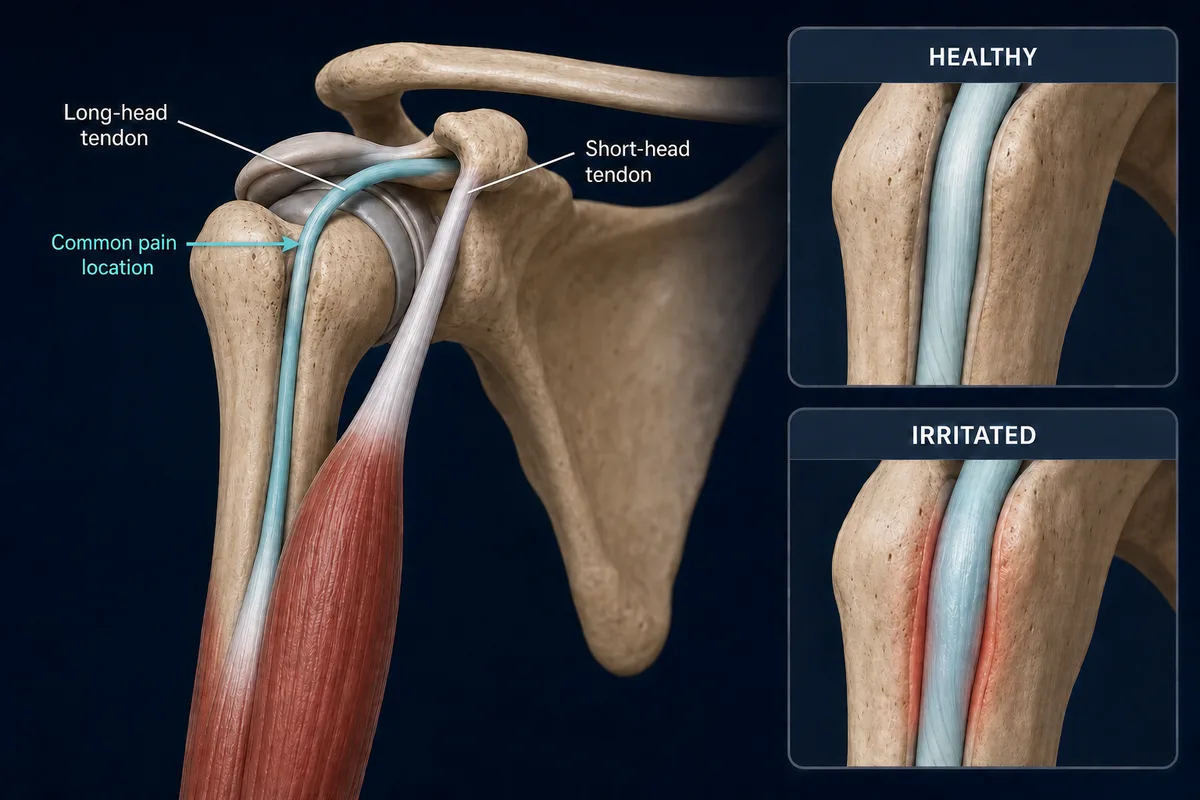
The short head attaches to the coracoid, while the long-head tendon crosses the shoulder joint and descends through the bicipital groove. The comparison illustrates irritation rather than a tear; symptoms and examination are still needed to identify the pain source.
What biceps tendon pain usually feels like
The most common pattern is a deep or localized ache at the front of the shoulder, sometimes extending a short distance down the upper arm.
It may be aggravated by:
- Curls, especially with the palm facing upward
- Pull-ups, chin-ups or heavy rows
- Bench press, dips or push-ups
- Reaching overhead or lifting in front of the body
- Carrying something with the elbow bent
- Throwing or repeated overhead sport
- Reaching behind the body
- Lying on the painful shoulder
The area may feel tender near the bicipital groove. Some people notice clicking at the front of the shoulder, although clicking alone does not diagnose tendon instability or a tear.
Why it often keeps coming back
Biceps tendinitis can seem unpredictable when the painful movement changes from one flare-up to another. Usually, the tendon is responding to the total amount and type of load, not one “bad” exercise.
Common contributors include:
- A sudden jump in pulling, pressing or arm-training volume
- Adding heavy curls after the biceps have already worked during back training
- Returning to lifting after time off at the old weights and volume
- Repeated overhead work or throwing without enough recovery
- Training frequently at long muscle lengths or near failure
- Continuing to test the same painful movement every session
- Reduced shoulder or rotator-cuff capacity
The long-head biceps tendon also commonly hurts alongside rotator-cuff or labral problems. Treating it as an isolated elbow-flexor issue may miss the rest of the shoulder system.
Is it really the biceps tendon?
Not necessarily. The front of the shoulder is crowded, and several problems can feel similar.
Rotator-cuff-related pain
Rotator-cuff irritation can cause pain at the front or outer shoulder, particularly when raising or lowering the arm. It frequently coexists with long-head biceps tendon changes.
Shoulder impingement or subacromial pain
Shoulder impingement is a broad label for pain involving the rotator cuff, bursa and surrounding tissues during movement. Its symptoms can overlap heavily with biceps tendinopathy.
Labral injury
The long-head biceps attaches near the top of the labrum. A SLAP or labral injury may be considered when deep pain and catching began after a traction injury, dislocation or forceful overhead movement. Symptoms alone still cannot confirm it.
Pectoralis-major or chest-wall pain
Pressing-related pain near the front of the armpit or chest may involve the pectoralis major rather than the biceps tendon. Sudden bruising, deformity or loss of pressing strength after a heavy rep deserves prompt assessment.
Neck-related pain
Neck and nerve problems can refer pain toward the shoulder or upper arm. Tingling, numbness, burning or symptoms that change clearly with neck movement make a broader assessment useful.
No single physical test is accurate enough to settle this by itself. Clinicians combine the history, pain location, strength, shoulder movement and a group of examination findings.
Does biceps tendinitis mean the tendon is torn?
No. Tendon pain does not automatically mean a tear, and a painful shoulder is not necessarily being damaged every time it moves.
A tear is more concerning when there is:
- A sudden pop or tearing sensation
- Immediate bruising or swelling
- A new “Popeye” bulge lower in the upper arm
- A visible change in the biceps contour
- Marked loss of strength turning the palm upward
- Sudden weakness after catching or lifting something heavy
A proximal long-head tear can sometimes leave surprisingly good overall function because the short head remains attached. It still deserves assessment, especially in a younger, active person or when the injury is sudden.
Pain and weakness at the front of the elbow point toward a different structure: the distal biceps tendon.
What to do during a flare-up
Start by changing the dose of the movements that repeatedly provoke the shoulder. This does not usually require stopping all training.
Reduce the irritating load
Temporarily adjust one or more variables:
- Use a lighter weight
- Stop a few repetitions farther from failure
- Reduce the number of sets
- Shorten the range that is sharply painful
- Train the movement less often
- Swap the grip or exercise variation
For example, a neutral-grip curl may feel better than a heavy supinated curl, and a dumbbell press may allow a more comfortable arm path than a fixed barbell. Those are options, not universal rules.
Keep comfortable movement
Complete rest can make it harder to judge what the shoulder can tolerate. Continue comfortable daily movement and train unaffected areas while the flare settles.
Use symptoms as feedback
Mild discomfort during an exercise may be acceptable when it stays manageable, does not climb through the set and settles afterward. Sharp pain, catching or clear worsening later that day or the next morning means the dose probably needs adjusting.
How to rebuild the tendon’s capacity
There is no single proven “best” biceps-tendinitis program. Current rehabilitation literature includes education, exercise, manual therapy and several modalities, but research has not established one standardized protocol.
A sensible progression often includes three parts.
1. Start with tolerable biceps loading
An isometric curl, holding the elbow still against light resistance, can be a comfortable entry point. It is not magic and does not need to eliminate pain immediately. Its purpose is to find a load the arm can tolerate.
You might begin with several short holds at a moderate effort, keeping the shoulder relaxed. Stop if the exercise produces sharp shoulder pain or leaves symptoms clearly worse.
2. Add controlled curls
Progress to slow elbow flexion with a light dumbbell, cable or band. A neutral grip may be easier initially; palm-up loading can be added as tolerance improves.
Keep the upper arm controlled instead of letting the shoulder roll forward. Build repetitions before making large jumps in weight.
3. Restore the whole shoulder
Because biceps tendon pain often overlaps with broader shoulder problems, rehabilitation may also include:
- Rotator-cuff strengthening
- Shoulder-blade control and rowing patterns
- Gradual pressing and pulling
- Controlled overhead work
- Sport- or job-specific loading
The five rotator-cuff exercises article provides general shoulder-strengthening options, but the right starting point depends on what currently aggravates your symptoms.
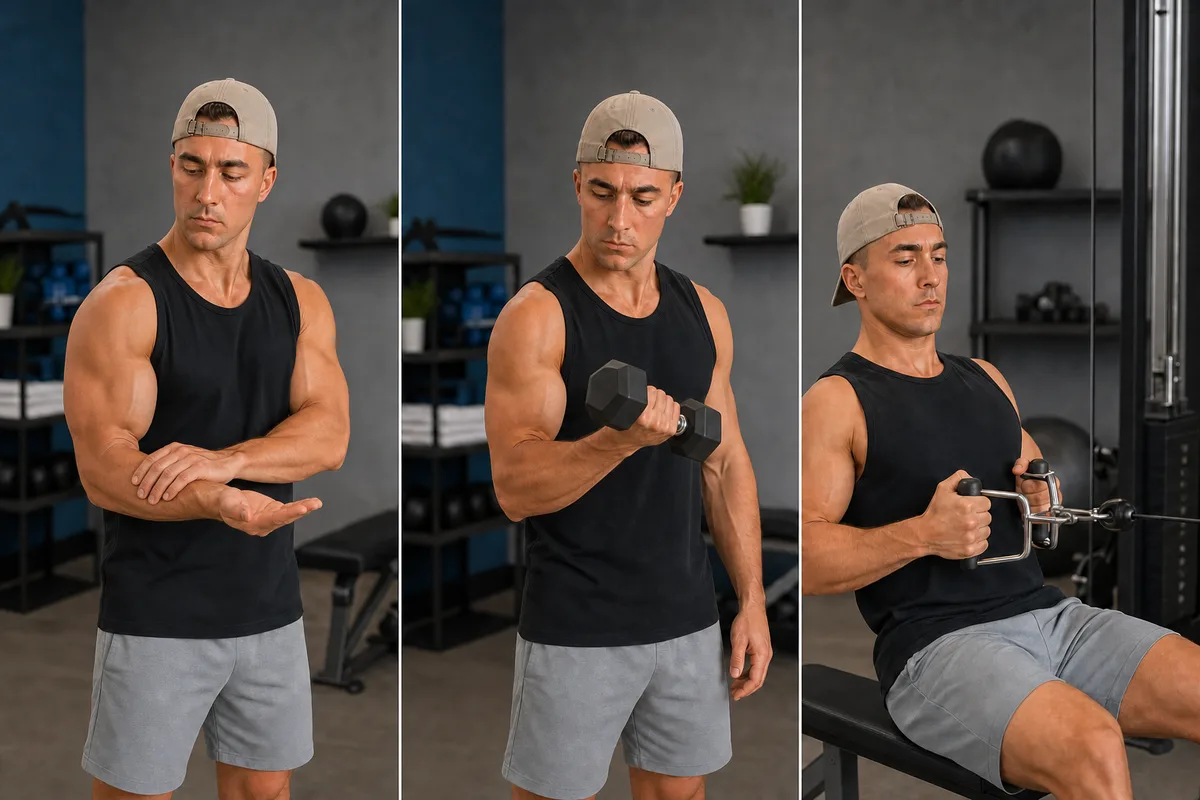
A progression may move from tolerable isometric loading to controlled curls and then back to larger pulling patterns. The appropriate starting point and pace are individual.
What helped me when it kept coming back
Two things stood out from my own experience with repeated flare-ups.
The first was eccentric biceps curls. I focused on the lowering portion of the curl, using a manageable weight and lowering it slowly instead of letting it drop. This gave me a way to load the biceps without immediately returning to the heavier curls that had been aggravating it.
Eccentric work is one useful form of tendon loading, but it is not the only one. Isometric, concentric and eccentric exercise may all have a place in rehabilitation. The right load matters more than forcing one supposedly perfect method.
The second was a hands-on technique my physiotherapist showed me. After identifying the tender structure at the front of my shoulder, they taught me to apply pressure and move my fingers gently across it. This is often described as cross-fibre friction or deep transverse friction massage. It gave me noticeable short-term relief.
I used to think it worked simply by bringing more blood to the tendon. The research does not give us a confident explanation. Friction massage may change pain sensitivity or how the tissue feels temporarily, but evidence for tendon healing or increased local blood flow is uncertain. It should be treated as an optional symptom-relief tool, not a replacement for progressive loading.
This is my experience, not a recommendation to dig deeply into every painful shoulder. The front of the shoulder contains several closely packed structures, and tenderness there does not prove the biceps tendon is the source. If you want to try a hands-on technique, have a physiotherapist identify the area and show you how much pressure to use. Stop if it causes sharp pain, tingling, bruising or worsening symptoms.
Returning to curls, pressing and pull-ups
Do not wait for the shoulder to feel absolutely perfect before rebuilding. Instead, progress when the current workload is controlled and symptoms return to their usual baseline by the next day.
Change one variable at a time:
- Improve control and find a comfortable range.
- Add repetitions.
- Add a set.
- Increase resistance slightly.
- Reintroduce harder grips, longer ranges or faster movements.
For pressing, avoid letting fatigue repeatedly pull the shoulder forward at the bottom of the rep. For curls, resist the urge to add body swing as soon as the biceps tires. For pull-ups, reduce assistance gradually rather than jumping straight back to high-volume bodyweight work.
The goal is not to protect the tendon from all stress. It is to expose it to enough appropriate stress that it becomes more capable.
Things to avoid
- Repeatedly pressing the sore spot to see whether it still hurts
- Testing heavy curls every few days during a flare-up
- Stretching aggressively into sharp front-of-shoulder pain
- Assuming a positive Speed’s test proves biceps tendinitis
- Adding sets, weight, frequency and range at the same time
- Treating the biceps without considering the rotator cuff and shoulder blade
- Using pain relief as proof that the tendon is ready for maximal loading
When to get it assessed
Arrange an assessment if:
- Pain began with a sudden pop, tearing sensation or heavy lift
- You developed bruising, a new biceps bulge or a visible contour change
- Strength is clearly reduced or getting worse
- The shoulder catches, slips or feels unstable
- Pain regularly disrupts sleep or daily activities
- You cannot raise the arm normally
- Numbness, tingling or neck-related symptoms travel into the arm
- Sensible training changes and progressive loading are not helping
Seek urgent care after a significant injury if the shoulder or arm is deformed, the hand becomes cold, pale or numb, or you cannot move the arm. Shoulder or arm pain with chest pressure, shortness of breath, sweating or faintness also needs urgent medical attention.
Frequently asked questions
Can I still work out with biceps tendinitis?
Often, yes, but the painful workload may need to change temporarily. Train around sharp or escalating pain, keep movements you tolerate, and rebuild the provocative exercises gradually.
Should I stop doing curls?
Not always. Reducing weight, volume, range or frequency may be enough. If every curl variation sharply aggravates the shoulder, pause direct curls briefly and get help choosing a more tolerable starting point.
How long does biceps tendinitis take to settle?
There is no reliable universal timeline. A mild recent flare may improve over several weeks, while persistent symptoms can take months of progressive rehabilitation. The duration, associated shoulder problems and activity demands all matter.
Should I stretch the biceps?
Gentle movement may feel good, but forcing the arm behind the body can compress or tension the front of an irritable shoulder. Stretching is optional; it should not be treated as a test of toughness.
Do I need an MRI?
Usually not at the beginning of gradual-onset symptoms. Imaging becomes more relevant after significant trauma, when a tear is suspected, when substantial weakness persists, or when the result would change treatment. MRI is also imperfect for partial long-head biceps tears and tendinopathy, so it must be interpreted with the clinical picture.
Is a cortisone injection the answer?
An injection may be considered in selected cases, but it does not rebuild the tendon’s capacity and carries risks. Its location matters because medication should not be injected into the tendon itself. Discuss the likely benefit, risks and alternatives with a qualified clinician.
Is surgery common?
Most gradual biceps tendinopathy is initially managed without surgery. Procedures such as tenodesis or tenotomy may be considered for severe structural injury or persistent symptoms that have not improved with appropriate nonsurgical care.
Key takeaways
- “Biceps tendinitis” usually refers to the long-head biceps tendon at the front of the shoulder.
- Front-of-shoulder pain does not prove the biceps tendon is the only painful structure.
- Biceps tendon problems often overlap with rotator-cuff, labral and subacromial pain.
- A sudden pop, bruising, deformity or major loss of strength is more concerning for a tear.
- Gradual symptoms usually improve through sensible load modification and progressive strengthening rather than endless rest.
- Return to curls, pressing and overhead work by changing one training variable at a time.
See it in 3D
Follow the long head of the biceps from its attachment near the top of the shoulder socket, through the joint and into the bicipital groove at the front of the upper arm.
Explore the Long Head of the Biceps in 3D →
Continue learning
- Biceps Tendinopathy
- Long Head of the Biceps
- Biceps Tendon Sheath
- Rotator-Cuff Tendinitis
- Labral Tear and SLAP Lesion
- Why Does My Shoulder Pop or Click?
Educational information only
This article provides general education and does not diagnose an injury or replace personalized care from a qualified healthcare professional.
Sources: McDevitt et al., “Physical Therapy Interventions Used to Treat Individuals With Biceps Tendinopathy: A Scoping Review,” Brazilian Journal of Physical Therapy, 2024; McDevitt et al., “Physical Therapy Interventions for the Management of Biceps Tendinopathy: An International Delphi Study,” International Journal of Sports Physical Therapy, 2022; Joseph et al., “Deep Friction Massage to Treat Tendinopathy: A Systematic Review,” Journal of Sport Rehabilitation, 2012; Nho et al., “Long Head of the Biceps Tendinopathy: Diagnosis and Management,” Journal of the American Academy of Orthopaedic Surgeons, 2010; Almeida et al., “Diagnostic Performance of Long Head of Biceps Tendon Tears on MRI: A Systematic Review and Meta-analysis,” European Radiology, 2024; AAOS, Biceps Tendinitis.