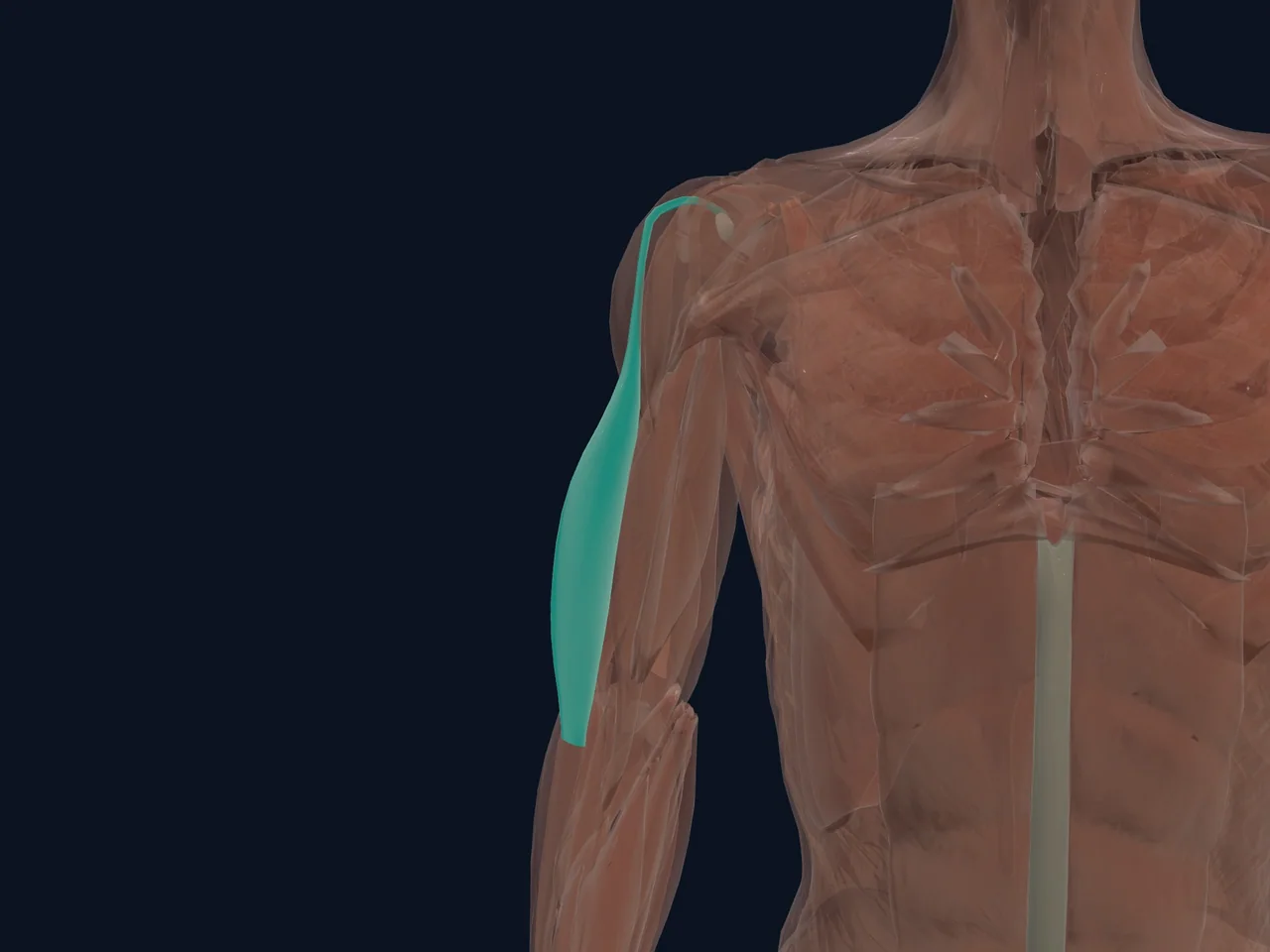
Overview
The biceps brachii is the muscle on the front of your upper arm most people know for making a "flex" bulge, but its long head — one of its two starting tendons — actually begins deep inside your shoulder joint. This long, thin tendon travels through a bony groove at the top of your upper arm bone and anchors inside the shoulder socket itself. Because it crosses both the shoulder and the elbow, it's involved in shoulder problems more often than most people realize.
Location
- Originates deep inside the shoulder joint, at the top rim of the shoulder socket
- Travels through the bicipital groove (also called the intertubercular groove), a bony channel between the two bumps at the top of the upper arm bone
- Continues down the front of the upper arm, joining the short head of biceps to form the main biceps muscle belly
- Crosses two joints total — the shoulder and the elbow — which is unusual for a muscle this size
Origin, Insertion, Nerve Supply, and Action
- Origin (long head): Supraglenoid tubercle, a small bump at the top rim of the glenoid (shoulder socket), where it blends with part of the glenoid labrum
- Insertion: Radial tuberosity of the radius (forearm bone), after joining with the short head to form the main biceps tendon at the elbow
- Nerve supply: Musculocutaneous nerve (spinal nerve roots C5–C6)
- Action at the shoulder: Assists shoulder flexion (raising the arm forward) and helps stabilize the humeral head in the socket, especially resisting upward sliding; its main actions at the elbow are forearm flexion and supination (turning the palm upward)
In plain English: while most people think of the biceps as an elbow muscle for bending the arm, its long head tendon actually starts inside the shoulder joint and helps keep the ball of the shoulder centered in its socket, especially during overhead lifting (Cleveland Clinic: Bicep Tendonitis).
Function
- Assists in stabilizing the humeral head within the shoulder socket, particularly during overhead and lifting activities
- Contributes a small amount to shoulder flexion (raising the arm forward)
- At the elbow (its more well-known role), it bends the elbow and rotates the forearm to turn the palm upward
Structures It Connects To
- Glenoid labrum — the long head tendon blends directly with the top of this cartilage ring
- Scapula (shoulder blade) — via the supraglenoid tubercle, its origin point
- Humerus (upper arm bone) — travels through the bicipital groove on its way down the arm
- Subscapularis and supraspinatus tendons — run close to the bicipital groove and can influence biceps tendon stability
- Transverse humeral ligament — helps hold the tendon in place within the bicipital groove
Movements It Assists
- Shoulder flexion (raising the arm forward), as a secondary contributor
- Stabilization of the shoulder socket joint, especially during overhead lifting
- Elbow flexion and forearm supination (its primary actions, at the elbow rather than the shoulder)
Common Injuries
- Biceps tendinopathy — irritation or degeneration of the long head tendon, often from repetitive overhead use or rubbing within the bicipital groove
- Biceps tendon instability/subluxation — the tendon can slip partially out of the bicipital groove, often linked to a subscapularis tear
- Biceps tendon rupture — the tendon can tear at the shoulder, sometimes causing a visible "Popeye" bulge in the upper arm as the muscle belly retracts downward
- Often occurs alongside rotator cuff tear, since the two share overlapping anatomy at the front of the shoulder
Pain Referral Patterns
- Pain is typically felt at the front of the shoulder, often spreading down the front of the upper arm toward the elbow
- Overhead reaching, lifting, and carrying tend to worsen the pain
- A deep, aching quality is common, sometimes with a catching or popping sensation if the tendon is unstable in its groove
Clinical Relevance
Because the long head of biceps tendon sits so close to the rotator cuff and shares space with it at the front of the shoulder, problems here are often found alongside — and sometimes mistaken for — rotator cuff issues (Cleveland Clinic: Bicep Tendonitis). Clinicians often test for tenderness directly over the bicipital groove and use specific movement tests to help tell biceps tendon problems apart from other shoulder conditions.
Interesting Facts
- The long head of biceps is one of the few tendons in the body that travels through a joint capsule before reaching its bony attachment, making its course unusually complex for a muscle mostly known for elbow bending.
- A complete rupture of this tendon at the shoulder often causes surprisingly little disability, because the short head of biceps and other elbow-flexing muscles largely compensate — though it does typically leave a visible "Popeye" bulge lower in the arm.
- Its close relationship with the glenoid labrum means labral tears (like a SLAP lesion) and biceps tendon problems frequently occur together.
Related Anatomy
- Proximal humerus — the bicipital groove that guides this tendon is located here
- Glenohumeral joint — the long head tendon originates from inside this joint
- Subscapularis — runs close to the bicipital groove and affects biceps tendon stability
- Rotator cuff overview — shares overlapping anatomy and is often involved together with biceps issues
Related Injuries
References
- Cleveland Clinic. "Bicep Tendonitis: Pain, Causes, Side Effects & Treatment." https://my.clevelandclinic.org/health/diseases/bicep-tendonitis
- Semantic Scholar. "Management of proximal biceps tendon pathology." https://pdfs.semanticscholar.org/8adb/102bdbed88040c42614b96671ad853d87d87.pdf
- StatPearls (NCBI Bookshelf). "Anatomy, Shoulder and Upper Limb, Biceps Muscle." https://www.ncbi.nlm.nih.gov/books/NBK519538/
- Physiopedia. "Biceps Brachii." https://www.physio-pedia.com/Biceps_Brachii