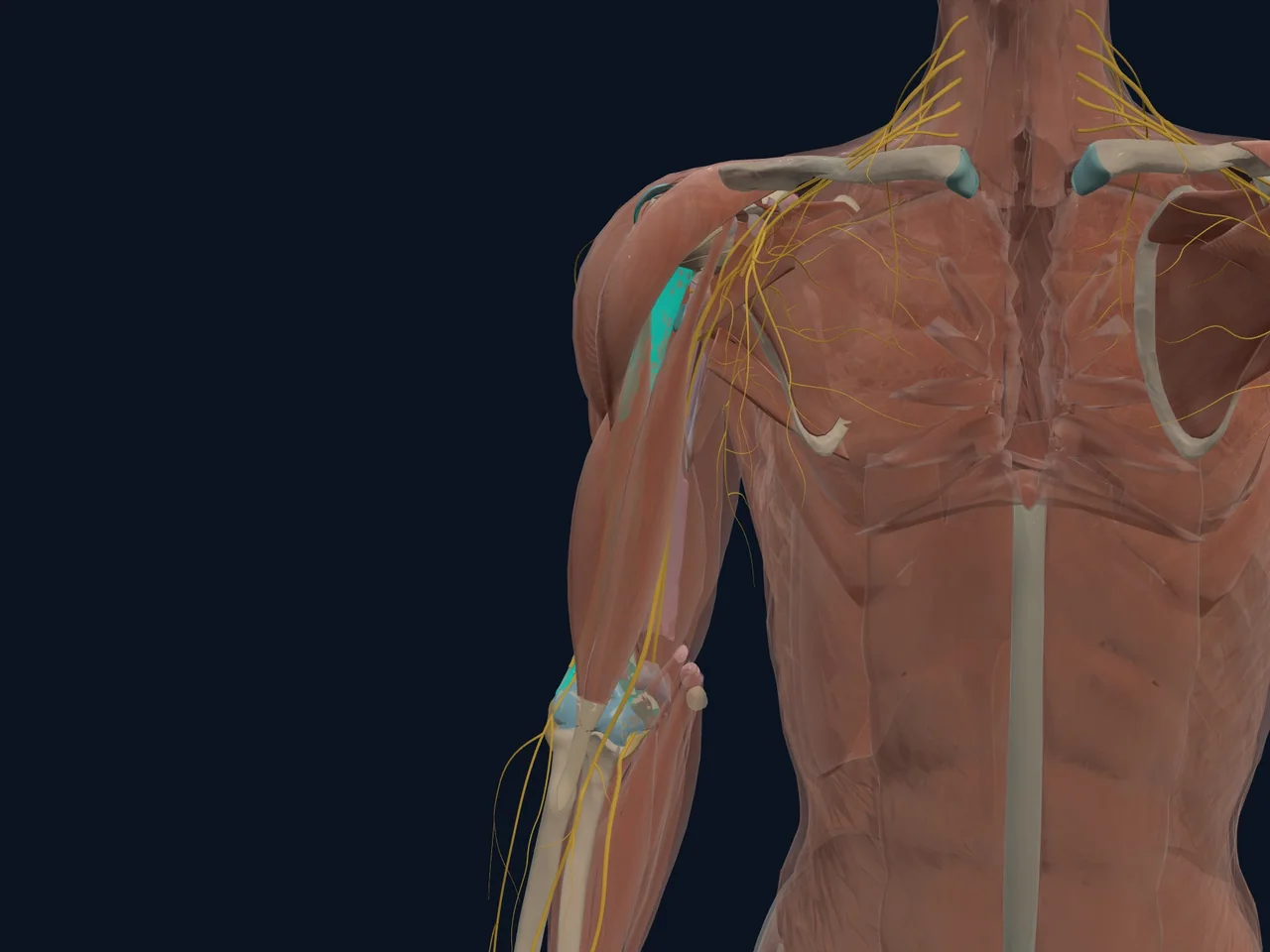
Overview
The proximal humerus is the shoulder end of your humerus (upper arm bone) — the rounded top portion that fits into your shoulder socket. Picture a golf ball sitting on a golf tee: the rounded "ball" is the top of the humerus, and the shallow socket on the shoulder blade is the "tee." This design gives your shoulder incredible range of motion, but it also means the joint relies heavily on surrounding muscles and ligaments for stability, rather than bone alone.
Location
- Forms the top (proximal) end of the humerus, the long bone that runs from the shoulder to the elbow
- Sits within the shoulder socket, held there by the surrounding capsule, ligaments, and rotator cuff muscles
- Positioned just below the acromion (the bony roof of the shoulder blade) and just lateral to (outside of) the collarbone
Key landmarks on the proximal humerus include the humeral head (the rounded ball that sits in the socket), the greater tuberosity and lesser tuberosity (two bony bumps that serve as attachment points for rotator cuff muscles), and the surgical neck (a narrower region just below the head that's a common fracture site, especially in older adults) (StatPearls: Humerus).
Function
- Forms the "ball" half of the shoulder socket joint (ball-and-socket joint)
- Provides bony attachment points for all four rotator cuff muscles, letting them lift, rotate, and stabilize the arm
- Transfers force generated by the shoulder and arm muscles down the length of the arm to the elbow and hand
- Allows the enormous range of motion that lets you reach in almost any direction — more than any other joint in the body
Structures It Connects To
- Scapula (shoulder blade) — via the glenohumeral (shoulder socket) joint
- Rotator cuff muscles — supraspinatus and infraspinatus attach to the greater tuberosity; subscapularis attaches to the lesser tuberosity; teres minor also attaches near the greater tuberosity
- Deltoid muscle — attaches partway down the shaft, at a landmark called the deltoid tuberosity
- Biceps brachii (long head) — its tendon runs through a groove between the two tuberosities called the bicipital groove (or intertubercular groove)
- Joint capsule and ligaments — wrap around the humeral head to help hold it in the socket
The top of the humerus is essentially a meeting point for the rotator cuff, the deltoid, and the biceps tendon, all converging on a small area of bone.
Movements It Assists
- Arm flexion (raising the arm forward)
- Arm abduction (raising the arm out to the side)
- Internal and external rotation of the arm
- Arm extension (moving the arm backward)
- Circumduction (making a full circular motion with the arm)
Common Injuries
- Proximal humerus fracture — common after a fall, especially in older adults with weaker bone (Proximal humerus fracture)
- Injuries linked to the greater tuberosity, where the rotator cuff attaches, such as rotator cuff tear
- Shoulder dislocation — the humeral head can slip partly or fully out of the socket
- Biceps tendinopathy — can involve irritation of the biceps tendon as it runs through the bicipital groove
- Shoulder osteoarthritis — wear-and-tear changes affecting the joint surface of the humeral head
Pain Referral Patterns
- Fractures typically cause pain throughout the whole shoulder and upper arm, often worse with any movement
- Rotator cuff-related pain at the greater tuberosity is often felt on the outer side of the upper arm, sometimes described as a deep ache
- Biceps groove irritation tends to cause pain at the front of the shoulder that can travel down the front of the upper arm
- Dislocation causes sudden, severe pain throughout the shoulder, often with a visible change in shoulder shape
Clinical Relevance
Because the proximal humerus is where so many important structures meet — the joint surface, the rotator cuff attachments, and the biceps tendon groove — injuries here are assessed carefully with imaging (X-ray or MRI) to understand exactly which structures are affected (StatPearls: Humerus). In older adults, a fall onto the shoulder is one of the most common ways to fracture this area, and bone density (affected by conditions like osteoporosis) plays a big role in fracture risk.
Interesting Facts
- The head of the humerus is only in contact with about a third of the shoulder socket's surface at any given time — the socket is shallow on purpose, trading some stability for a huge range of motion.
- The bicipital groove that guides the biceps tendon is sometimes called the "intertubercular groove" because it runs between the greater and lesser tuberosities.
- Proximal humerus fractures are the third most common fracture in adults over 65, after hip and wrist fractures (StatPearls: Humerus).
Related Anatomy
- Glenohumeral joint — the shoulder socket joint formed by the humeral head and the scapula's glenoid
- Scapula — provides the socket that the humeral head sits in
- Rotator cuff overview — the four muscles that anchor onto the proximal humerus
- Biceps brachii (long head) — its tendon runs through the bicipital groove on the proximal humerus
- Deltoid — attaches to the humeral shaft just below the proximal region
Related Injuries
- Proximal humerus fracture — a break at the shoulder end of this bone, common in older adults after a fall
- Rotator cuff tear
- Shoulder dislocation
- Biceps tendinopathy
- Shoulder osteoarthritis
References
- StatPearls (NCBI Bookshelf). "Anatomy, Shoulder and Upper Limb, Humerus." https://www.ncbi.nlm.nih.gov/books/NBK537056/
- OrthoInfo (AAOS). "Shoulder Anatomy." https://orthoinfo.aaos.org/en/diseases--conditions/shoulder-anatomy/
- Kenhub. "Arm and shoulder anatomy: Bones, muscles and nerves." https://www.kenhub.com/en/library/anatomy/arm-and-shoulder-anatomy