Overview
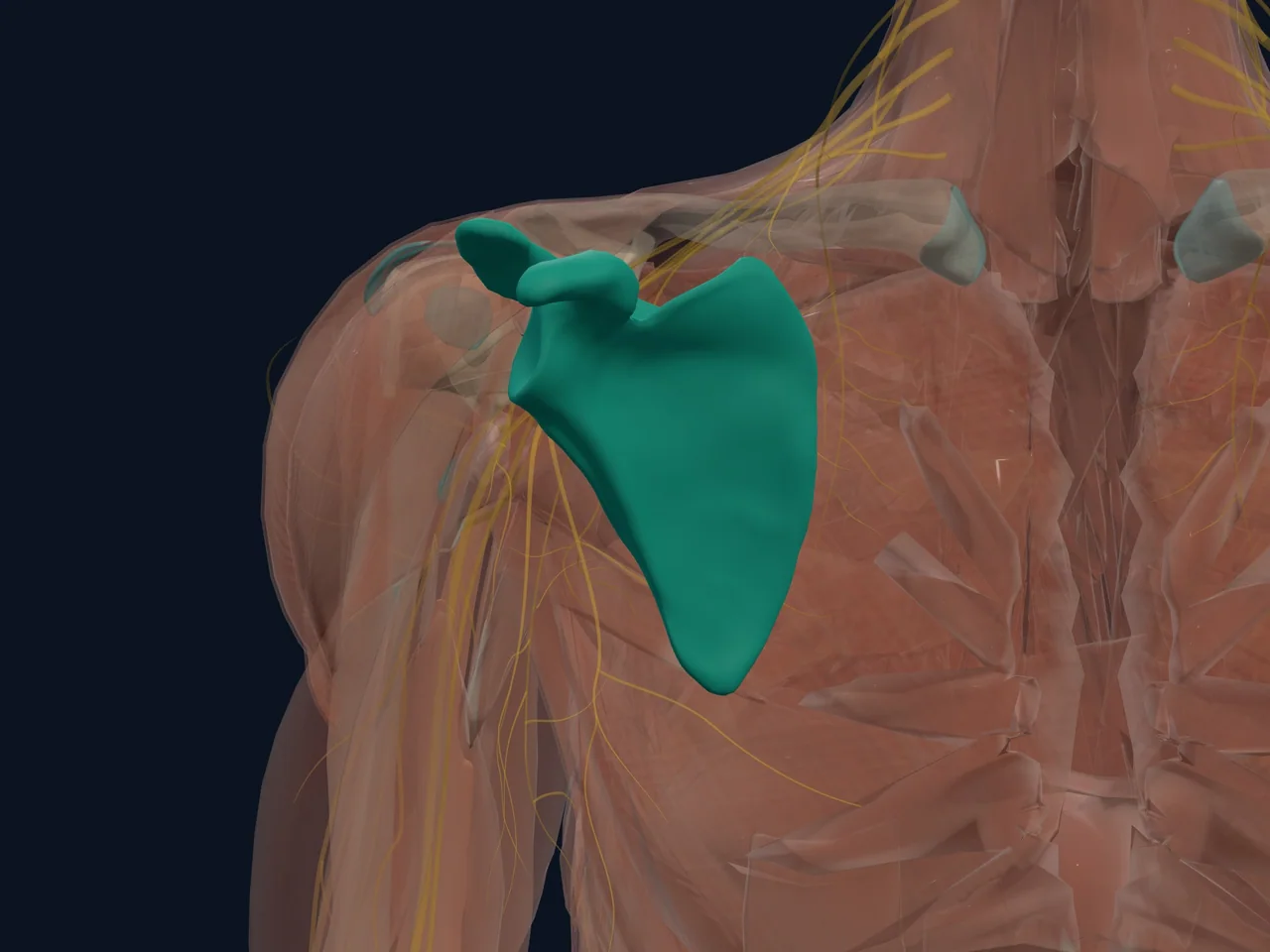
Your scapula (shoulder blade) is the flat, triangle-shaped bone that sits on the back of your ribcage, just under your shoulder muscles. It's the anchor point for most of the muscles that move your shoulder and arm, and it glides smoothly over your ribcage every time you reach, lift, or throw. Because so many muscles attach to it, the shoulder blade is central to almost every shoulder movement and a common site of muscle imbalance and pain.
Location
- Sits on the back (posterior) surface of the upper ribcage, roughly between the second and seventh ribs
- Glides along a cushion of muscle over the ribcage rather than connecting to it with a true joint
- Its only bony joint connections are to the collarbone (at the top) and, indirectly, to the upper arm bone at its outer corner
The shoulder blade has several distinct landmarks that clinicians and anatomists refer to often: the acromion (the bony bump you can feel on top of your shoulder), the coracoid process (a hook-shaped projection you can feel just below your collarbone), the glenoid (a shallow, cup-like socket that holds the top of the upper arm bone), and the scapular spine (a ridge of bone running across the upper back surface) (StatPearls: Scapula).
Function
- Provides the socket (glenoid) for the shoulder socket joint, letting the arm move in almost every direction
- Acts as the attachment base for 17 different muscles, more than any other bone in the body
- Glides, tilts, and rotates over the ribcage to extend your arm's reach far beyond what the shoulder socket joint alone could achieve
- Helps position the shoulder socket optimally as the arm moves, keeping the joint stable through a full range of motion
Because the shoulder blade moves as the arm moves — rotating upward as you raise your arm overhead — it effectively adds extra range of motion on top of what the shoulder socket joint itself provides. This coordinated motion is called scapulohumeral rhythm.
Structures It Connects To
- Clavicle (collarbone) — at the acromioclavicular joint
- Humerus (upper arm bone) — indirectly, through the glenohumeral (shoulder socket) joint
- Ribcage — via the scapulothoracic joint, a muscle-cushioned gliding surface rather than a true joint
- Muscle attachments: rotator cuff muscles (supraspinatus, infraspinatus, teres minor, subscapularis), deltoid, trapezius, rhomboids, levator scapulae, serratus anterior, biceps brachii, triceps brachii, and more
The shoulder blade is a true anatomical hub — nearly every muscle that moves your arm or shoulder either starts or ends on it.
Movements It Assists
- Arm elevation overhead (via upward rotation)
- Shoulder blade retraction and protraction (pulling shoulder blades together or spreading them apart)
- Shoulder blade elevation and depression (shrugging up or pulling down)
- Arm rotation, by repositioning the socket as the arm moves
- Stabilizing the arm during pushing, pulling, throwing, and lifting
Common Injuries
- Scapular fracture — uncommon, usually from high-force trauma such as a car accident or a hard fall
- Winged scapula — the shoulder blade sticks out abnormally, often from nerve damage (commonly the long thoracic nerve) or muscle weakness
- Snapping scapula syndrome — a grinding or snapping feeling as the shoulder blade moves over the ribcage
- Muscle-related pain around the shoulder blade linked to rotator cuff tear or rotator cuff tendinitis, since many rotator cuff muscles attach here
Pain Referral Patterns
- Pain is often felt as a deep, dull ache between or around the shoulder blades
- Problems with rotator cuff muscles attaching to the scapula can cause pain that spreads to the front or side of the shoulder, or down the outer upper arm
- Nerve irritation near the scapula (such as suprascapular nerve issues) often causes a deep ache at the back of the shoulder that's hard to pinpoint
- Postural strain (common with desk work) tends to cause a burning or tight ache along the top of the shoulder blade and into the base of the neck
Clinical Relevance
Clinicians often watch how the shoulder blade moves during arm-raising to check for abnormal patterns, sometimes called scapular dyskinesis — when the shoulder blade doesn't glide smoothly or symmetrically. This can be both a cause and a result of shoulder pain, since poor shoulder blade control changes how force travels through the rotator cuff and other structures (Physiopedia: Scapula). Rehabilitation for many shoulder conditions specifically targets the muscles that control the shoulder blade (like the serratus anterior and lower trapezius), not just the muscles of the arm itself.
Interesting Facts
- The scapula is sometimes nicknamed the "wing bone," and normal winging can sometimes just reflect a temporary muscle imbalance rather than serious nerve damage.
- It's the attachment site for 17 separate muscles — more attachments than almost any other bone in the human body (StatPearls: Scapula).
- The shoulder blade doesn't form a true joint with the ribcage at all — it "floats" over the back of the ribcage, held in place entirely by muscles, which is part of why the shoulder has such an enormous range of motion compared to other joints in the body.
Related Anatomy
- Clavicle — connects to the scapula at the acromioclavicular joint
- Glenohumeral joint — the shoulder socket joint, formed partly by the scapula's glenoid
- Scapulothoracic joint — the gliding connection between the shoulder blade and ribcage
- Rotator cuff overview — all four rotator cuff muscles originate on the scapula
- Trapezius — a major muscle controlling shoulder blade position
- Suprascapular nerve — runs through notches in the scapula to reach two rotator cuff muscles
Related Injuries
- Rotator cuff tear — involves muscles that attach to the scapula
- Rotator cuff tendinitis — inflammation of tendons anchored to the scapula
- Shoulder impingement syndrome — often linked to poor shoulder blade positioning
References
- StatPearls (NCBI Bookshelf). "Anatomy, Thorax, Scapula." https://www.ncbi.nlm.nih.gov/books/NBK538319/
- Cleveland Clinic. "Scapula (Shoulder Blade)." https://my.clevelandclinic.org/health/body/22412-scapula
- Physiopedia. "Scapula." https://www.physio-pedia.com/Scapula
- Kenhub. "Arm and shoulder anatomy: Bones, muscles and nerves." https://www.kenhub.com/en/library/anatomy/arm-and-shoulder-anatomy