Overview
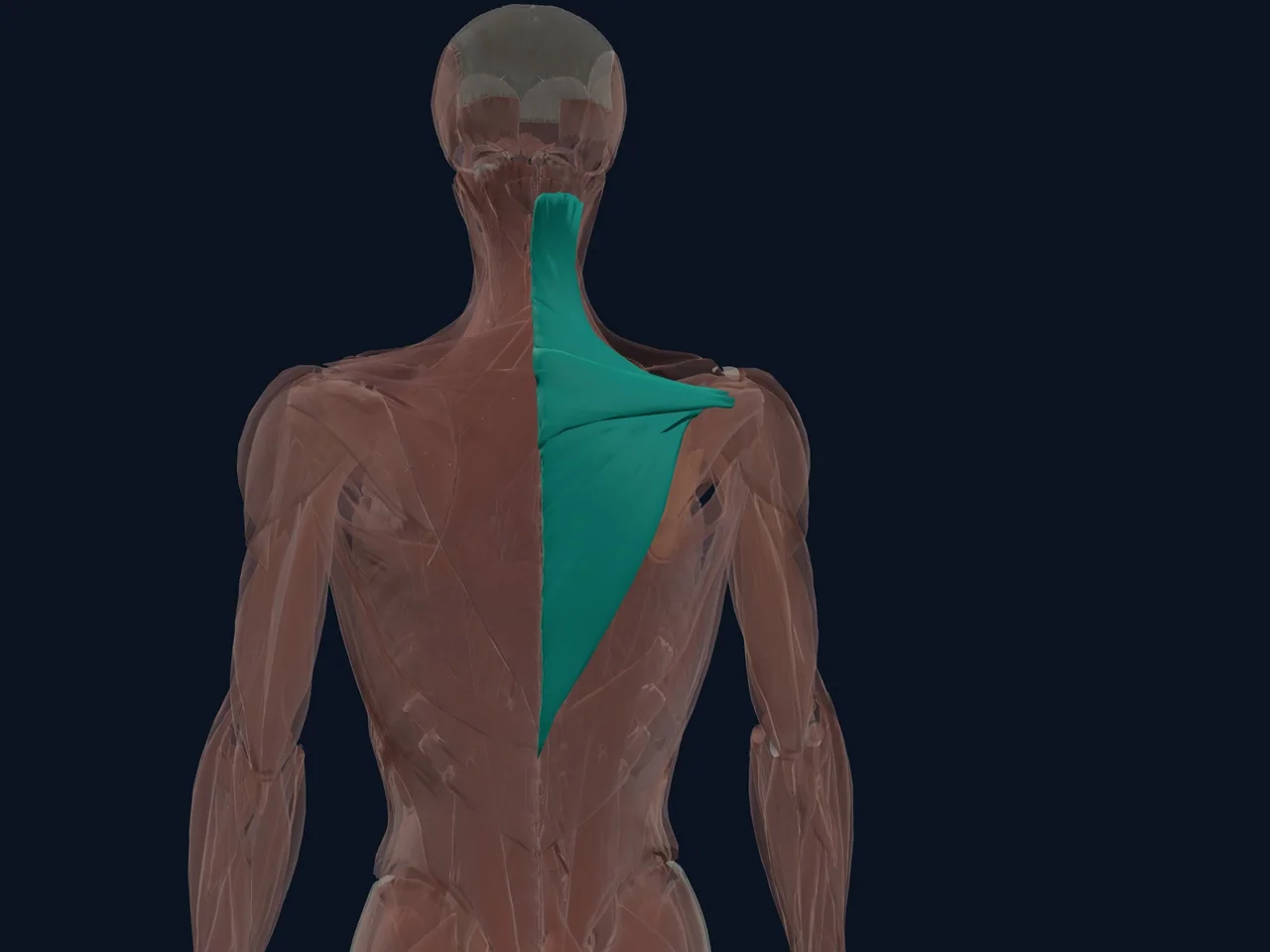
The trapezius is the large, kite-shaped muscle that spans from the base of your skull down to the middle of your back, and out to both shoulder blades. It's one of the main muscles controlling your shoulder blade's position, and it's also one of the most common sources of everyday muscle tension, especially for people who spend long hours at a desk. Because it's so large and covers so much territory, it's often described in three separate parts based on the direction its fibers run.
Location
- Spans a wide area: from the base of the skull and neck, across the upper back, down to about the middle of the spine
- Attaches out to the collarbone and shoulder blade on both sides
- Sits just under the skin, making it one of the more easily felt muscles in the upper back and neck
The trapezius is commonly divided into three functional sections: the upper fibers (running from the neck to the outer collarbone), the middle fibers (running horizontally to the shoulder blade), and the lower fibers (running upward from the lower back to the shoulder blade) (Cleveland Clinic: Trapezius Muscle).
Origin, Insertion, Nerve Supply, and Action
- Origin: Base of the skull and the spinous processes of the neck and upper-to-mid back vertebrae
- Insertion: Outer third of the clavicle (collarbone), the acromion, and the spine of the scapula (shoulder blade)
- Nerve supply: Spinal accessory nerve (cranial nerve XI), with sensory contributions from the cervical plexus (C3–C4)
- Action: Upper fibers elevate the shoulder blade (shrugging) and help tilt the head; middle fibers retract the shoulder blade (pulling it toward the spine); lower fibers depress and help rotate the shoulder blade upward during overhead reaching
In plain English: think of the trapezius as having three separate "jobs" depending on which part is working — the top part shrugs your shoulders up, the middle part pulls your shoulder blades together, and the bottom part pulls your shoulder blades down and helps rotate them as you reach overhead (Kenhub: Shoulder muscles).
Function
- Controls shoulder blade position during almost all arm and shoulder movements
- Supports the weight of the arm when it hangs at the side, preventing the shoulder blade from drooping
- Assists in tilting and rotating the head and neck
- Works with the serratus anterior to rotate the shoulder blade upward during overhead reaching
Structures It Connects To
- Skull and spine — origin points along the base of the skull and the vertebrae of the neck and back
- Clavicle (collarbone) — insertion point for the upper fibers
- Scapula (shoulder blade) — insertion point for the middle and lower fibers, at the acromion and scapular spine
- Spinal accessory nerve — supplies motor signals to the whole muscle
- Rhomboids and levator scapulae — work alongside the trapezius to control shoulder blade position
Movements It Assists
- Shoulder blade elevation (shrugging the shoulders up) — upper fibers
- Shoulder blade retraction (pulling shoulder blades together) — middle fibers
- Shoulder blade depression and upward rotation (pulling shoulder blades down, assisting overhead reaching) — lower fibers
- Head and neck tilting and rotation, as a secondary function
Common Injuries
- Trapezius strain — overstretching or tearing of muscle fibers, often from sudden heavy lifting or a whiplash-type injury
- Myofascial trigger points (muscle knots) — very common in the upper trapezius, often linked to prolonged desk work or stress-related muscle tension
- Trapezius weakness, especially in the lower fibers, is a common contributor to poor shoulder blade control and shoulder impingement syndrome
- Spinal accessory nerve injury (rare) — can cause trapezius weakness and a drooping shoulder appearance
Pain Referral Patterns
- Upper trapezius tension classically causes pain and tightness across the top of the shoulder and into the base of the skull, sometimes contributing to tension-type headaches
- Middle and lower trapezius issues tend to cause a dull ache between the shoulder blades or across the upper back
- Trapezius-related pain often worsens with prolonged sitting, computer work, or carrying a bag on one shoulder
Clinical Relevance
Weakness or poor endurance in the lower trapezius fibers is commonly linked to abnormal shoulder blade movement patterns, which in turn can contribute to shoulder impingement-type pain over time (Physiopedia: Trapezius). Because of this, many shoulder rehabilitation programs specifically target lower trapezius strengthening, not just the more commonly noticed upper trapezius tightness. Clinicians also distinguish trapezius muscle tension (very common and usually benign) from nerve-related trapezius weakness (rarer, and often needs more specific investigation).
Interesting Facts
- The trapezius on both sides together forms a shape like a diamond or kite spanning the whole upper back — its name comes from "trapezium," referring to this four-sided shape.
- It's one of the few muscles supplied by a cranial nerve (the spinal accessory nerve, cranial nerve XI) rather than a nerve arising directly from the arm's nerve network, which is unusual for a muscle that moves the shoulder blade.
- The upper trapezius is one of the most common sites in the entire body for myofascial trigger points ("knots"), largely because it's almost constantly active any time we hold our head up or use our arms.
Related Anatomy
- Scapula — a major insertion point for the trapezius
- Clavicle — insertion point for the upper trapezius fibers
- Scapulothoracic joint — the trapezius is a key muscle controlling this joint's motion
- Acromioclavicular joint — the trapezius crosses over this joint region
Related Injuries
References
- StatPearls (NCBI Bookshelf). "Anatomy, Back, Trapezius." https://www.ncbi.nlm.nih.gov/books/NBK518994/
- Cleveland Clinic. "Trapezius Muscle." https://my.clevelandclinic.org/health/body/21669-trapezius-muscle
- Physiopedia. "Trapezius." https://www.physio-pedia.com/Trapezius
- Kenhub. "Shoulder muscles: Anatomy and functions." https://www.kenhub.com/en/library/anatomy/shoulder-muscles