Overview
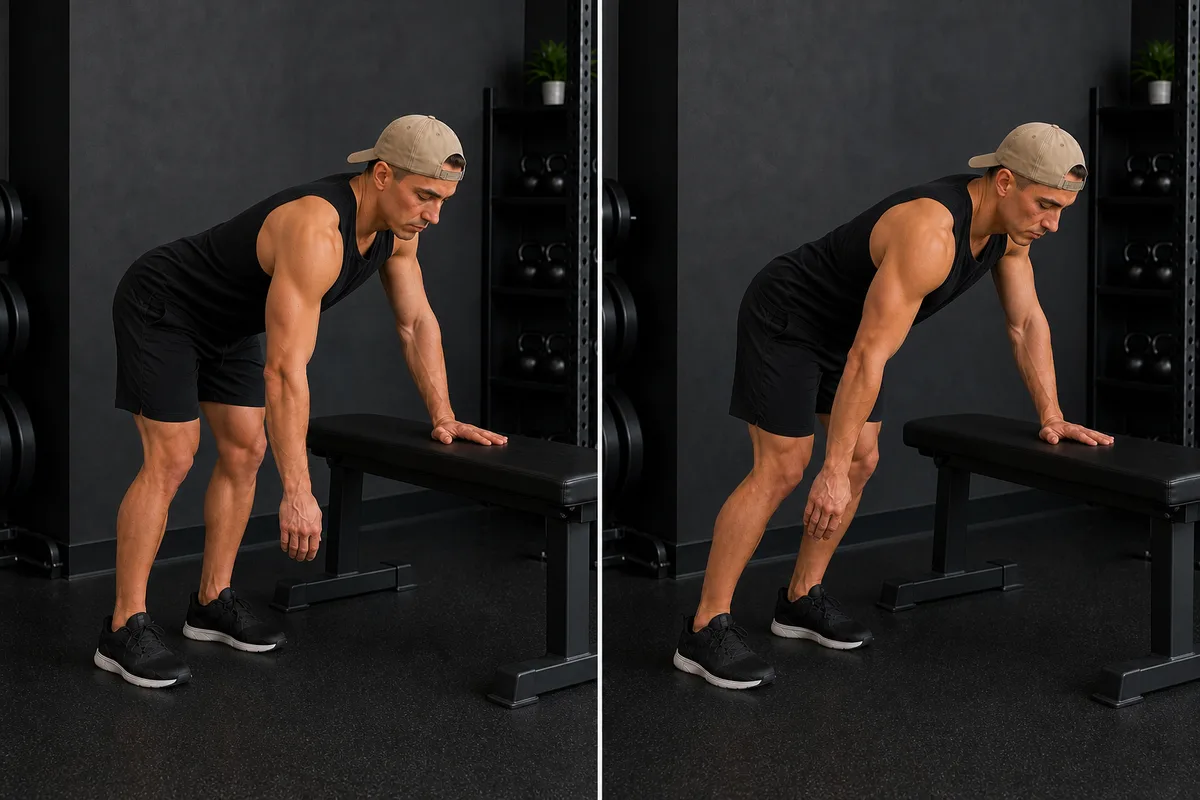
The pendulum exercise (also called the Codman exercise, named after the surgeon who first described it) is one of the gentlest shoulder movements in rehab. You let your arm hang loosely and use your body's own sway to create small swinging motions, without ever tensing your shoulder muscles. It's often the very first exercise given after a shoulder injury or surgery because it moves the joint without asking any muscle to work.
Exercise Name
Pendulum Exercise (Codman Exercise)
Primary Purpose
- Gently move the shoulder socket joint (glenohumeral joint) using gravity, not muscle effort
- Reduce stiffness and encourage the joint's natural lubricating fluid to circulate
- Ease pain by keeping the shoulder moving in a low-stress way early after injury or surgery
This exercise uses momentum and gravity instead of muscle contraction. Because your rotator cuff and other shoulder muscles stay relaxed the whole time, it's considered one of the safest ways to introduce motion into a painful or recently injured shoulder.
Target Muscles
- No muscles are actively working — this is a passive movement
- Very light, involuntary activity may occur in the rotator cuff muscles simply to keep the arm loosely connected to the socket
- Deltoid — stays relaxed but is stretched gently as the arm swings
The whole point of the pendulum exercise is that your muscles stay "turned off." You're using the natural weight of your arm and a slight body sway to create movement, which is why it feels so gentle even on a sore shoulder.
Difficulty Level
Beginner
Equipment Required
- None required
- Optional: a light hand weight (0.5–1 kg / 1–2 lb) once your clinician says it's okay, to add gentle traction
Who Should Perform This
- People in the early days or weeks after a shoulder injury, such as a rotator cuff tear or shoulder dislocation
- People recovering from shoulder surgery, once cleared for passive motion by their surgeon or physiotherapist
- Anyone with a stiff, painful shoulder from adhesive capsulitis (frozen shoulder), especially in the early "freezing" stage
- Older adults who find standing exercises easier to tolerate than more demanding shoulder movements
Who Should Avoid This
- Anyone with an unhealed fracture around the shoulder, collarbone, or upper arm
- People who are less than a few days post-surgery without clearance from their surgical team
- Anyone with a recent, unstable shoulder dislocation where the joint has not yet been assessed
- People with an active infection in or around the shoulder joint
- Anyone experiencing severe, sharp pain at rest — check with a health professional first
Step-by-Step Instructions
- Stand and lean forward slightly, supporting yourself with your unaffected hand on a table, chair, or counter.
- Let your affected arm hang straight down and completely relax it — imagine it's a heavy rope, not a muscle you're controlling.
- Gently shift your body weight to create a small swinging motion in your arm — forward and back first, keeping the swing small (about 15–20 cm / 6–8 inches).
- Continue for 30 seconds to 1 minute, then switch to side-to-side swings for the same amount of time.
- Finish with small clockwise circles for 30 seconds, then small counter-clockwise circles for 30 seconds.
- Keep your shoulder muscles relaxed throughout — the movement should come from your body swaying, not your shoulder pushing the arm.
- Repeat this sequence 2–3 times per session, 3–5 times per day, or as recommended by your physiotherapist.
Common Mistakes
- Actively swinging the arm with shoulder muscles — this defeats the purpose. The movement should come from your legs and trunk swaying, not your shoulder muscles pushing.
- Making the circles or swings too large — big movements can cause pain or strain, especially early in recovery. Keep them small and controlled.
- Standing upright instead of leaning forward — without the forward lean, your arm can't hang freely away from your body, which limits the gentle traction effect.
- Holding your breath — this often happens when people brace against discomfort. Breathe normally throughout.
- Rushing through it — this is a slow, calming exercise, not a fast one.
Progressions
- Add a very light hand weight (0.5–1 kg / 1–2 lb) once cleared, which increases gentle traction on the joint
- Gradually increase the size of the swing as pain and stiffness improve
- Progress toward active-assisted movements, such as using your other arm or a wand to help move the affected shoulder, once tolerated
- Move on to active range-of-motion exercises like wall slides once your clinician says you're ready
Easier Alternatives
- Perform the exercise lying face-down on a bed with your arm hanging over the edge — this removes the need to balance while leaning forward, which helps people with back pain or poor balance
- Reduce the swing size even further, focusing on just a few centimetres of motion, if any movement causes pain above mild
Related Injuries
- Rotator Cuff Tear — pendulum exercises are commonly used early after injury or surgical repair to maintain motion without straining the healing tendon
- Adhesive Capsulitis (Frozen Shoulder) — helps reduce stiffness in the early, painful stage of frozen shoulder
- Shoulder Impingement Syndrome — gentle motion can calm irritated tissue under the shoulder blade's bony roof
- Subacromial Bursitis — passive motion helps reduce pain from an inflamed bursa (fluid-filled cushion) without compressing it
- Shoulder Dislocation — used later in recovery, once cleared, to restore gentle motion
Related Anatomy
- Glenohumeral Joint (Shoulder Socket Joint) — the joint being gently mobilized
- Rotator Cuff Overview — the muscle group that stays relaxed during this exercise
- Subacromial Bursa — the cushioning structure that benefits from gentle, non-compressive motion
- Deltoid — the muscle draped over the shoulder that gets a passive stretch during the swing
References
- Physiopedia. "Codman Pendulum Exercises." https://www.physio-pedia.com/Codman_Pendulum_Exercises
- Healthline. "Pendulum Exercises: For Shoulder Rehab." https://www.healthline.com/health/fitness-exercise/pendulum-exercises-for-shoulders
- Cleveland Clinic. "Frozen Shoulder (Adhesive Capsulitis)." https://my.clevelandclinic.org/health/diseases/12138-frozen-shoulder
- OrthoInfo — American Academy of Orthopaedic Surgeons. "Rotator Cuff and Shoulder Conditioning Program." https://orthoinfo.aaos.org/en/recovery/rotator-cuff-and-shoulder-conditioning-program/
This information is for education only and is not a medical diagnosis. InjuryAtlas does not replace an assessment by a qualified health professional. If you have severe pain, visible deformity, numbness, loss of function, or symptoms that are getting worse, seek medical care promptly.