Overview
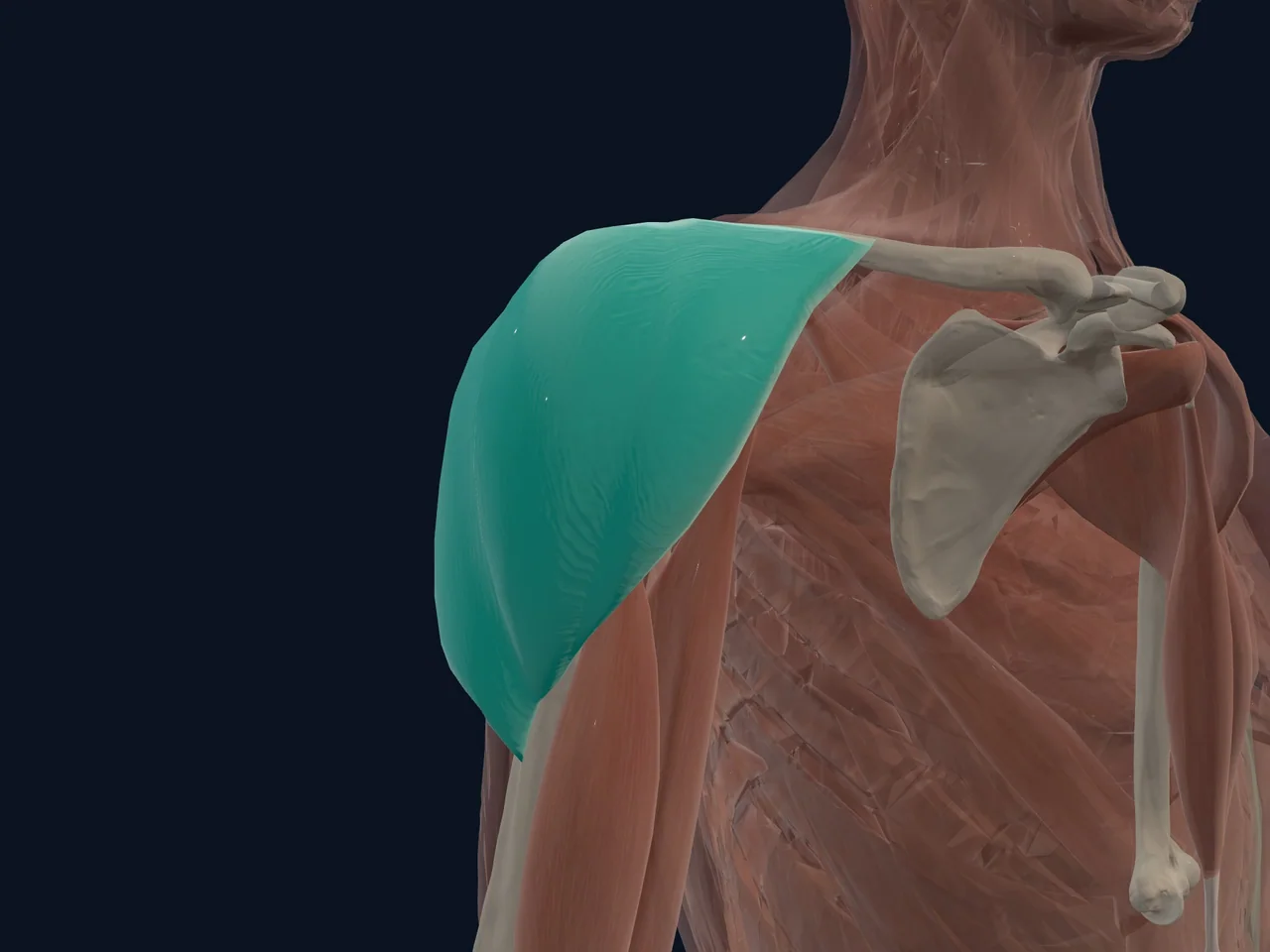
The deltoid is the thick, triangular muscle that caps the top of your shoulder, giving it its rounded shape. It's the main muscle responsible for lifting your arm out to the side and overhead, and it's one of the most powerful muscles in the upper body. Unlike the smaller rotator cuff muscles that focus mostly on stability, the deltoid is built for strength and big, sweeping arm movements.
Location
- Covers the top and outer sides of the shoulder, from the collarbone and shoulder blade down to the upper arm bone
- Easily visible and easy to feel — it's the rounded muscle bulk you see at the top of the shoulder
- Made up of three sections, or "heads": the anterior (front) deltoid, the middle (lateral) deltoid, and the posterior (back) deltoid
Origin, Insertion, Nerve Supply, and Action
- Origin: Anterior fibers from the outer third of the clavicle (collarbone); middle fibers from the acromion; posterior fibers from the scapular spine
- Insertion: Deltoid tuberosity, a roughened area partway down the shaft of the humerus (upper arm bone)
- Nerve supply: Axillary nerve (spinal nerve roots C5–C6)
- Action: Anterior fibers flex and internally rotate the arm; middle fibers abduct the arm (lift it out to the side); posterior fibers extend and externally rotate the arm
In plain English: the deltoid has three separate sections that can each move the arm in a different direction, which is why it's involved in almost every arm movement, from raising your arm forward to reaching backward (StatPearls: Deltoid Muscle).
Function
- Powers the bulk of arm-raising movements out to the side and overhead, especially after the initial 15 degrees started by the supraspinatus
- Provides the strength for lifting, throwing, and pushing movements involving the arm
- Gives the shoulder its rounded, capped shape and contributes to overall shoulder stability by covering the joint
Structures It Connects To
- Clavicle (collarbone) — origin point for the front fibers
- Acromion (scapula) — origin point for the middle fibers
- Scapular spine — origin point for the back fibers
- Humerus (upper arm bone) — insertion point at the deltoid tuberosity
- Axillary nerve — supplies motor signals and runs just beneath the muscle around the surgical neck of the humerus
- Subacromial bursa — sits underneath the deltoid, cushioning the rotator cuff tendons as the deltoid contracts
Movements It Assists
- Shoulder abduction (raising the arm out to the side) — the middle fibers' main job
- Shoulder flexion (raising the arm forward) — mainly the front fibers
- Shoulder extension (moving the arm backward) — mainly the back fibers
- Assisting internal and external rotation, depending on which fibers are active
Common Injuries
- Deltoid strain — overstretching or tearing of muscle fibers, usually from overuse or a sudden forceful movement
- Axillary nerve injury — since this nerve wraps around the humerus right beneath the deltoid, it can be affected by shoulder dislocation or proximal humerus fractures, leading to deltoid weakness
- Deltoid involvement is common alongside rotator cuff problems, since the two work so closely together — see rotator cuff tear
- Intramuscular injection-related issues can occasionally occur here, since the deltoid is a common injection site
Pain Referral Patterns
- Pain is usually felt over the top or outer side of the shoulder, sometimes spreading partway down the upper arm
- Deltoid strains often cause pain that worsens specifically with lifting the arm out to the side against resistance
- Weakness (rather than pain) affecting the whole deltoid can be a sign of axillary nerve involvement, often following a shoulder dislocation
Clinical Relevance
Because the deltoid sits directly over the rotator cuff and subacromial bursa, its size and strength can sometimes mask underlying rotator cuff weakness — a person with a rotator cuff tear may still be able to lift their arm using deltoid power alone, which can delay diagnosis (OrthoInfo: Rotator Cuff Tears). Clinicians check deltoid sensation and strength carefully after any shoulder dislocation, since a stretch injury to the axillary nerve is one of the most common nerve complications of that injury.
Interesting Facts
- The deltoid gets its name from the Greek letter "delta" (Δ), because its triangular shape resembles that letter.
- It's made of three separate sections that can work independently, which is unusual — most muscles act as a single functional unit, but each deltoid "head" can be activated somewhat separately depending on the movement.
- The deltoid is a common site for intramuscular vaccine injections because of its size, accessibility, and relatively low risk of hitting major nerves or vessels at the correct injection site.
Related Anatomy
- Rotator cuff overview — works closely with the deltoid, especially the supraspinatus
- Supraspinatus — initiates arm-raising before the deltoid takes over
- Axillary nerve — supplies motor signals to the deltoid
- Subacromial bursa — sits beneath the deltoid, cushioning the rotator cuff
- Proximal humerus — the deltoid's insertion point
Related Injuries
References
- StatPearls (NCBI Bookshelf). "Anatomy, Shoulder and Upper Limb, Deltoid Muscle." https://www.ncbi.nlm.nih.gov/books/NBK537055/
- Cleveland Clinic. "Deltoid Muscle." https://my.clevelandclinic.org/health/body/21918-deltoid-muscle
- OrthoInfo (AAOS). "Rotator Cuff Tears." https://orthoinfo.aaos.org/en/diseases--conditions/rotator-cuff-tears/
- Physiopedia. "Deltoid." https://www.physio-pedia.com/Deltoid