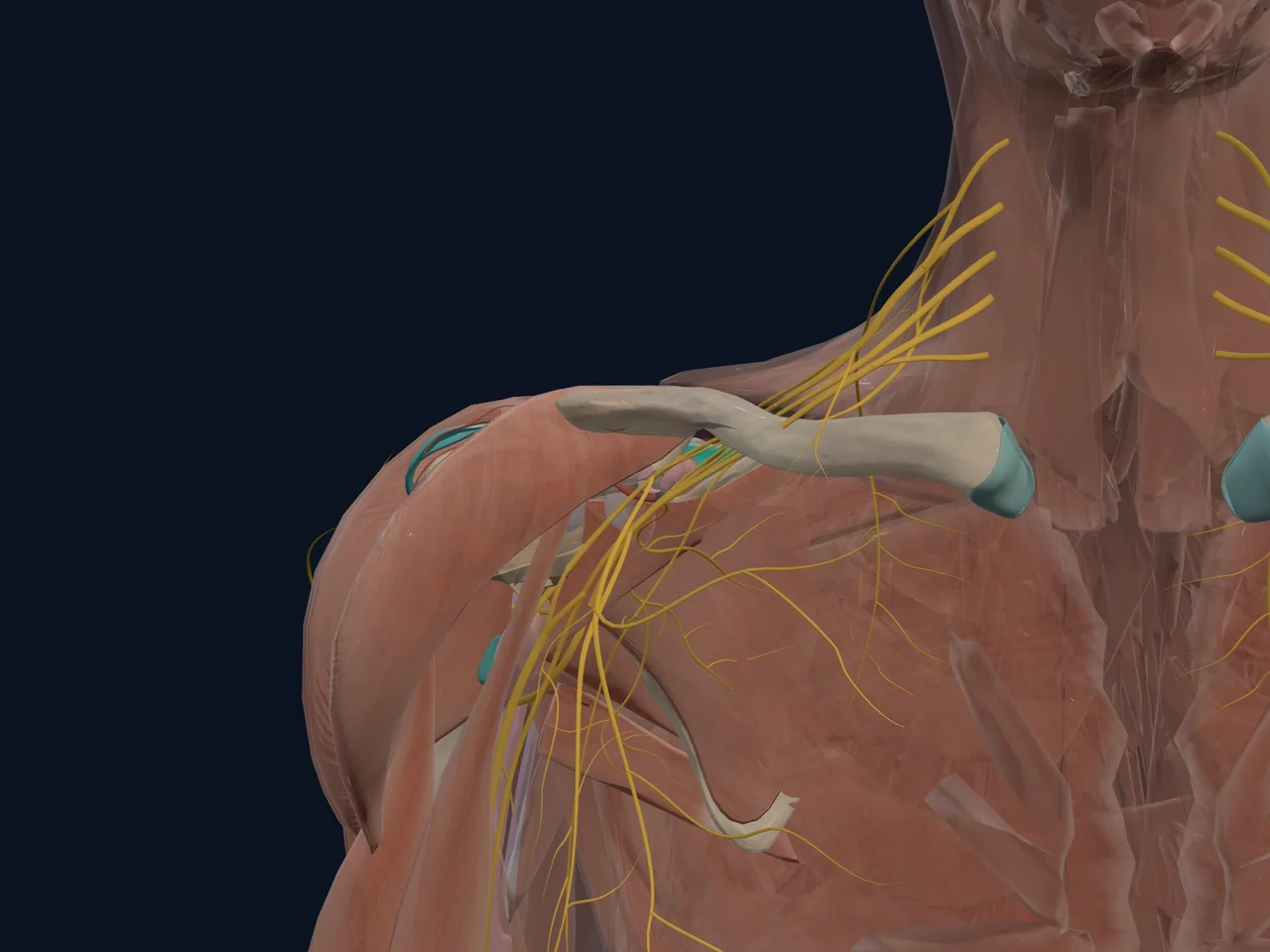
Overview
The supraspinatus is one of the four rotator cuff muscles — a group of small muscles that wrap around your shoulder joint and keep it stable while it moves. Its main job is helping start the motion of lifting your arm out to the side or overhead, and it works constantly in the background to hold the top of your upper arm bone snugly in its shallow socket. Because it gets squeezed through a tight space above the shoulder joint during overhead movement, it's the rotator cuff muscle most often affected by tendinitis or tears.
Location
- Sits on the back of the shoulder blade, filling the supraspinous fossa — a shallow groove above the scapular spine
- Its tendon travels under the acromion (the bony roof of the shoulder) before attaching to the top of the upper arm bone
- Lies deep to the trapezius muscle, so you can't feel it directly through the skin
Origin, Insertion, Nerve Supply, and Action
- Origin: Supraspinous fossa of the scapula (shoulder blade)
- Insertion: Top of the greater tuberosity of the humerus (upper arm bone)
- Nerve supply: Suprascapular nerve (spinal nerve roots C5–C6)
- Action: Initiates and assists arm abduction (lifting the arm out to the side), especially the first 15 degrees of the movement; helps hold the humeral head centered in the shoulder socket
In plain English: the supraspinatus is the muscle that gets your arm-raising movement started before the larger deltoid muscle takes over the bulk of the lifting. At the same time, it acts like a stabilizing strap, holding the ball of your upper arm bone snug against the socket so it doesn't shift out of place during movement (StatPearls: Scapulohumeral Rhythm).
Function
- Initiates the first 15 degrees or so of raising the arm out to the side, working alongside the deltoid for the rest of the movement
- Compresses and stabilizes the humeral head within the shallow shoulder socket during all arm movements
- Resists downward pull on the arm, helping support the weight of the arm even at rest
Structures It Connects To
- Scapula (shoulder blade) — its origin point
- Humerus (upper arm bone) — its insertion point on the greater tuberosity
- Acromion — the tendon passes directly beneath this bony roof
- Subacromial bursa — sits between the supraspinatus tendon and the acromion, cushioning the tendon during movement
- Other rotator cuff muscles (infraspinatus, teres minor, subscapularis) — work together as a functional team around the joint
Movements It Assists
- Shoulder abduction (raising the arm out to the side), especially the initial phase
- Stabilization of the glenohumeral (shoulder socket) joint during nearly every arm movement
- Assisting overhead reaching in combination with the deltoid and shoulder blade muscles
Common Injuries
- Rotator cuff tear — the supraspinatus tendon is the most commonly torn of the four rotator cuff tendons
- Rotator cuff tendinitis — irritation and inflammation of the tendon, often from repetitive overhead use
- Shoulder impingement syndrome — the supraspinatus tendon can get pinched between the humeral head and the acromion
- Subacromial bursitis — inflammation of the bursa that sits right next to this tendon, often occurring together with supraspinatus irritation
Pain Referral Patterns
- Pain is most often felt on the top or outer side of the shoulder, sometimes spreading down the outer upper arm
- Overhead activities and reaching to the side typically make the pain worse
- Night pain, especially when lying on the affected shoulder, is a very common complaint with supraspinatus problems
- A weak or painful "arc" of motion — pain specifically in the middle portion of raising the arm out to the side — is a classic pattern
Clinical Relevance
The supraspinatus tendon passes through a genuinely tight space between the humeral head and the acromion, sometimes called the "subacromial space." Because of this tight fit, it's especially vulnerable to being pinched or worn down over time, which is why it's the most frequently torn rotator cuff tendon (OrthoInfo: Rotator Cuff Tears). Clinicians often use specific tests, like the "empty can test," to check supraspinatus strength and reproduce symptoms during an exam.
Interesting Facts
- The supraspinatus does most of the work to get your arm moving away from your side, but the larger deltoid muscle actually takes over as the primary mover once the arm passes about 15 degrees — they function almost like a relay team.
- Because the tendon passes under the bony acromion, imaging studies have shown wear-related changes in this tendon are extremely common with age, even in people who have no shoulder pain at all.
- Ultrasound and MRI studies suggest supraspinatus tendon changes appear in roughly 1 in 3 people by their 60s, even without symptoms — a reminder that tendon "wear" doesn't always cause pain.
Related Anatomy
- Rotator cuff overview — the group of four muscles the supraspinatus belongs to
- Infraspinatus — works alongside the supraspinatus and shares the same nerve supply
- Scapula — the bone the supraspinatus originates from
- Subacromial bursa — sits directly next to the supraspinatus tendon
- Suprascapular nerve — supplies the supraspinatus muscle
- Deltoid — works together with the supraspinatus during arm-raising
Related Injuries
References
- StatPearls (Point of Care). "Anatomy, Shoulder and Upper Limb, Scapulohumeral Rhythm." https://www.statpearls.com/point-of-care/32424
- Cleveland Clinic. "What Is the Anatomy of the Rotator Cuff?" https://my.clevelandclinic.org/health/body/rotator-cuff
- OrthoInfo (AAOS). "Rotator Cuff Tears." https://orthoinfo.aaos.org/en/diseases--conditions/rotator-cuff-tears/
- Kenhub. "Shoulder muscles: Anatomy and functions." https://www.kenhub.com/en/library/anatomy/shoulder-muscles
- Physiopedia. "Rotator Cuff." https://www.physio-pedia.com/Rotator_Cuff