Overview
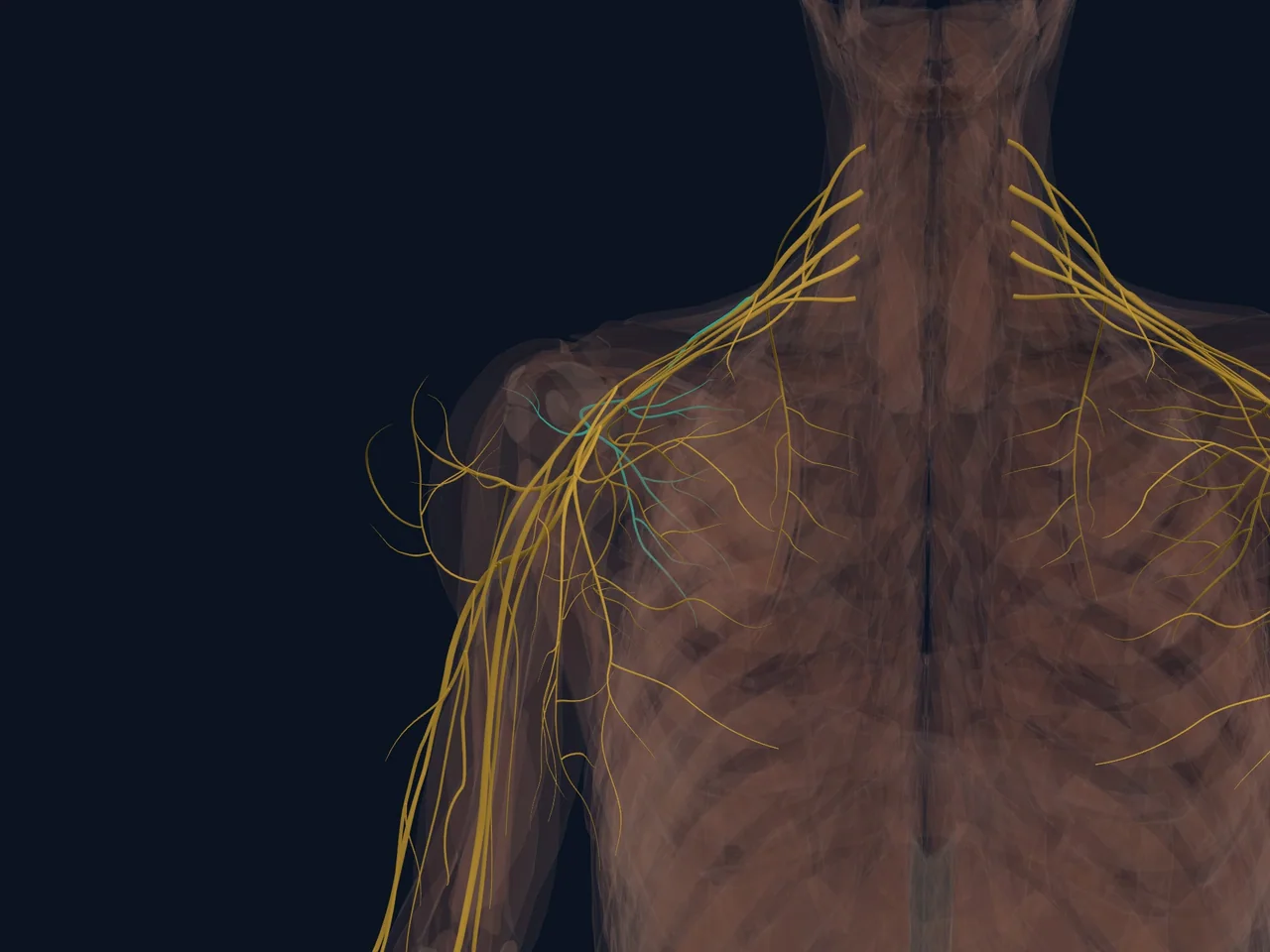
The suprascapular nerve is a small but important nerve that supplies two of your four rotator cuff muscles — the supraspinatus and infraspinatus. It travels a twisting path through two narrow bony tunnels on the shoulder blade, which makes it more vulnerable to getting pinched or compressed than most other nerves in the shoulder. When this happens, it can cause deep shoulder pain, weakness, and sometimes visible muscle wasting, especially in people who do a lot of overhead activity.
Location
- Branches off the upper trunk of the brachial plexus (the network of nerves supplying the arm), carrying fibers mainly from the C5 and C6 spinal nerve roots
- Travels behind the collarbone and across the top of the shoulder blade
- Passes through the suprascapular notch, a groove in the top of the shoulder blade covered by a ligament (forming a tunnel), before reaching the supraspinatus muscle
- Continues through a second narrow passage, the spinoglenoid notch, before reaching the infraspinatus muscle
Function
- Provides motor (movement) signals to the supraspinatus and infraspinatus muscles, both part of the rotator cuff
- Carries sensory signals from the shoulder socket joint and the acromioclavicular joint, contributing to your awareness of deep shoulder position and pain
- Contributes sensory fibers to the subacromial bursa and some shoulder ligaments
In plain English: this nerve is the "wiring" that tells your supraspinatus (which starts arm-raising) and infraspinatus (which turns your arm outward) muscles when to fire — without it working properly, those two muscles weaken even though they're otherwise perfectly healthy (Radiopaedia: Suprascapular nerve).
Structures It Connects To
- Brachial plexus — its origin, specifically the upper trunk
- Suprascapular notch — a bony groove on the scapula that the nerve passes through, alongside its own artery and vein
- Supraspinatus muscle — receives motor branches from this nerve
- Spinoglenoid notch — a second bony passage further along the nerve's path
- Infraspinatus muscle — receives motor branches from this nerve after it passes the spinoglenoid notch
- Glenohumeral and acromioclavicular joints — receive sensory branches from this nerve
Movements It Assists
- Shoulder abduction (raising the arm out to the side) — via its supply to the supraspinatus
- External rotation of the arm — via its supply to the infraspinatus
- Contributes indirectly to overall shoulder joint stability, since both muscles it supplies are part of the rotator cuff's stabilizing team
Common Injuries
- Suprascapular nerve entrapment/compression — most often at the suprascapular notch (affecting both supraspinatus and infraspinatus) or the spinoglenoid notch (affecting only infraspinatus), sometimes caused by cysts, repetitive overhead motion, or anatomical variations (PMC: Suprascapular Nerve Pathology)
- Can contribute to or complicate the picture of rotator cuff tear, since nerve-related weakness can look similar to tendon tear weakness
- Traction injury — can occur alongside significant shoulder trauma or dislocation
Pain Referral Patterns
- Pain from suprascapular nerve issues is typically felt as a deep, dull ache at the back or top of the shoulder, often poorly localized
- Compression at the spinoglenoid notch specifically can sometimes cause weakness without much pain at all
- Overhead athletes, particularly volleyball players, sometimes notice gradual weakness in outward arm rotation with minimal pain, a pattern that raises suspicion for this specific nerve issue
Clinical Relevance
Because suprascapular nerve compression can closely mimic a rotator cuff tear — both cause weakness in similar movements — clinicians use imaging (MRI or ultrasound) and sometimes nerve conduction studies to tell the two apart (PMC: Suprascapular Nerve Pathology). This distinction is clinically important because nerve compression, when caused by a cyst or other structural issue, may need a different treatment approach than a torn tendon. Suprascapular nerve blocks are also sometimes used clinically to manage shoulder pain, since this nerve carries a large share of the joint's sensory signals.
Interesting Facts
- Suprascapular nerve dysfunction is thought to contribute to shoulder pain in as many as one-third of overhead athletes with shoulder pain, according to some estimates, despite being a relatively obscure nerve to most people (StatPearls: Suprascapular Nerve Injury).
- The suprascapular notch comes in several different shapes across the population — some people have a shallow groove while others have a nearly enclosed tunnel — and this variation can affect how likely someone is to develop nerve compression here.
- This nerve is unusual in that it has almost no role in skin sensation (unlike most peripheral nerves) — its main jobs are muscle control and deep joint sensation, not surface touch.
Related Anatomy
- Supraspinatus — supplied by this nerve
- Infraspinatus — supplied by this nerve
- Scapula — contains the suprascapular and spinoglenoid notches this nerve passes through
- Brachial plexus (shoulder overview) — the nerve network this nerve branches from
- Glenohumeral joint — receives sensory branches from this nerve
Related Injuries
References
- StatPearls (NCBI Bookshelf). "Anatomy, Shoulder and Upper Limb, Suprascapular Nerve." https://www.ncbi.nlm.nih.gov/books/NBK557880/
- StatPearls (Point of Care). "Suprascapular Nerve Injury." https://www.statpearls.com/point-of-care/29748
- PMC (The Open Orthopaedics Journal). "Suprascapular Nerve Pathology: A Review of the Literature." https://pmc.ncbi.nlm.nih.gov/articles/PMC5366386/
- Radiopaedia. "Suprascapular nerve." https://radiopaedia.org/articles/suprascapular-nerve
- Physiopedia. "Suprascapular Nerve." https://www.physio-pedia.com/Suprascapular_Nerve