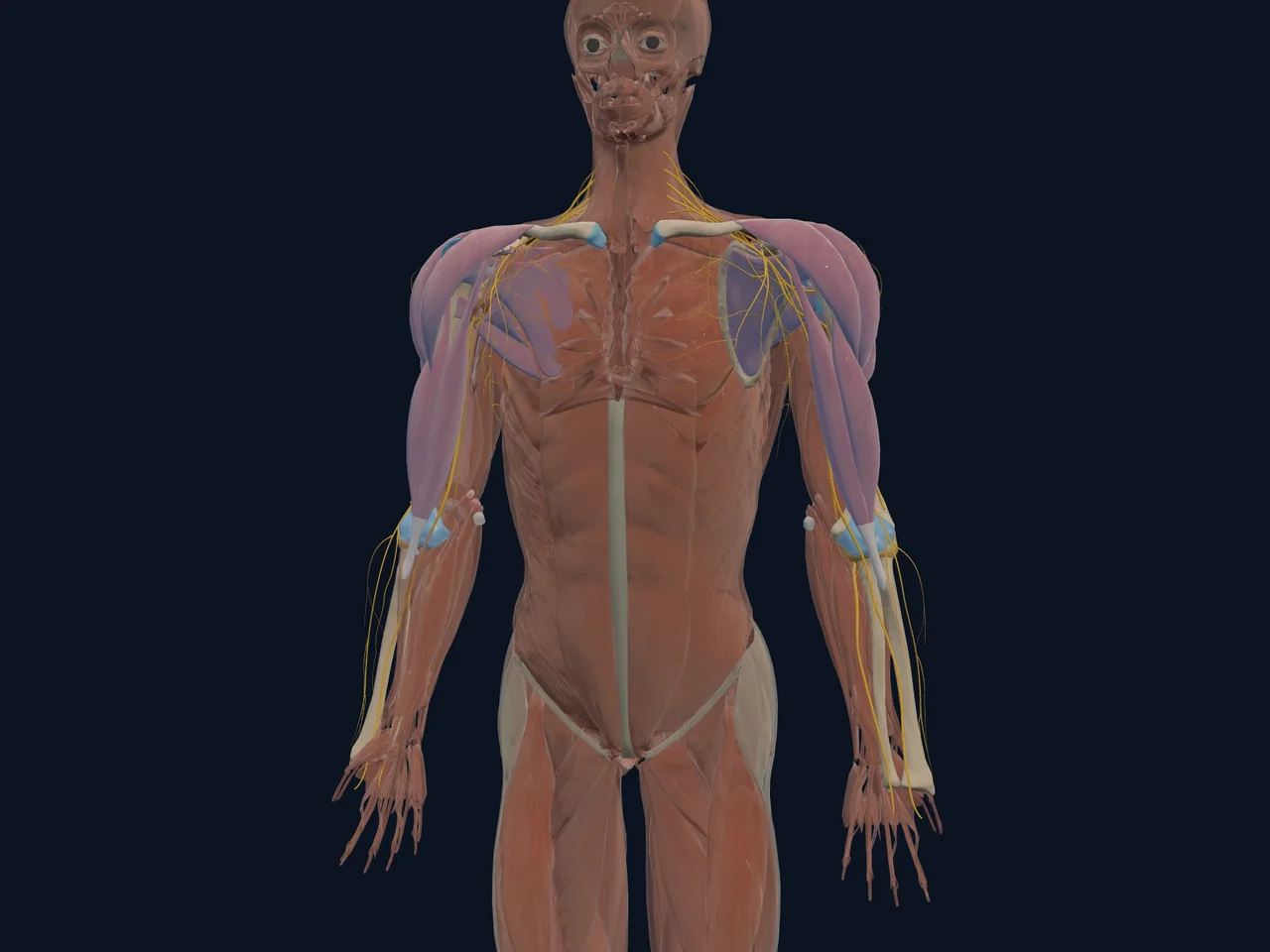
Overview
The brachial plexus is the major network of nerves that runs from your neck through your shoulder and into your arm, carrying every signal that lets you move and feel your entire arm and hand. Think of it as a bundle of wires leaving a central hub (your spinal cord), splitting, merging, and re-splitting several times before forming the individual nerves that reach your shoulder, arm, and hand. Because it passes directly through the shoulder region, it's closely connected to shoulder anatomy — and it's vulnerable to injury during major shoulder trauma.
Location
- Formed by the ventral rami (front branches) of spinal nerves C5 through T1, emerging from the lower neck
- Passes between the anterior and middle scalene muscles in the neck, then travels beneath the collarbone
- Continues into the axilla (armpit region), where its main branches form and head down into the arm
- Passes very close to the shoulder joint itself as several of its branches (including the suprascapular and axillary nerves) split off to serve shoulder-specific structures
The brachial plexus is often taught in five stages, sometimes remembered with the mnemonic "Rob Taylor Drinks Cold Beer": Roots (spinal nerves C5–T1), Trunks (upper, middle, lower), Divisions (anterior and posterior, for each trunk), Cords (lateral, posterior, and medial), and Branches (the individual named nerves, like the axillary and suprascapular nerves) (Kenhub: Brachial plexus).
Function
- Carries all motor (movement) signals from the spinal cord to the muscles of the shoulder, arm, forearm, and hand
- Carries all sensory signals (touch, pain, temperature, position sense) from the shoulder, arm, forearm, and hand back to the spinal cord and brain
- Gives rise to the specific nerves that control shoulder function directly, including the suprascapular nerve (supraspinatus and infraspinatus), axillary nerve (deltoid and teres minor), and the subscapular nerves (subscapularis)
Structures It Connects To
- Cervical spine — the brachial plexus originates from spinal nerve roots exiting between the neck vertebrae
- Suprascapular nerve — one of its earliest branches, splitting off from the upper trunk to supply two rotator cuff muscles
- Axillary nerve — a terminal branch of the posterior cord, supplying the deltoid and teres minor
- Musculocutaneous, radial, median, and ulnar nerves — the other major terminal branches, continuing down into the arm and hand
- Subclavian and axillary arteries — travel closely alongside the brachial plexus through the neck and armpit region
Movements It Assists
The brachial plexus itself doesn't directly cause movement — it's the communication pathway that allows the brain to control movement throughout the whole arm. Through its shoulder-specific branches, it enables:
- Shoulder abduction and external rotation (via the suprascapular nerve, supplying the supraspinatus and infraspinatus)
- Shoulder abduction and further external rotation (via the axillary nerve, supplying the deltoid and teres minor)
- Shoulder internal rotation (via the subscapular nerves, supplying the subscapularis)
- All movement and sensation further down the arm, forearm, and hand, via its other terminal branches
Common Injuries
- Brachial plexus injury — can range from a mild, temporary "stinger" (common in contact sports) to a severe traction injury where nerve roots are stretched or torn, often from a forceful pull between the head and shoulder
- Erb's palsy — a specific pattern of brachial plexus injury (usually affecting the upper roots, C5–C6) that can occur during difficult childbirth or high-force trauma, commonly affecting the suprascapular, musculocutaneous, and axillary nerves (Kenhub: Brachial plexus injury)
- Can occur alongside severe shoulder dislocation, since the nerve network passes so close to the joint
Pain Referral Patterns
- Brachial plexus injuries can cause pain, numbness, or weakness anywhere from the shoulder down to the hand, depending on which part of the network is affected
- A "stinger" or "burner" injury (common in contact sports) typically causes a brief, sharp, electric-shock-like sensation running down the arm
- More severe injuries can cause widespread weakness or numbness throughout the whole arm, which is considered a more serious presentation requiring prompt medical evaluation
Clinical Relevance
Because the brachial plexus gives rise to nearly every nerve controlling the shoulder and arm, clinicians use a careful, systematic exam — testing strength and sensation in specific patterns — to figure out exactly which part of the plexus (or which individual downstream nerve) might be affected after an injury (Cleveland Clinic: Brachial Plexus). This matters because a problem higher up in the plexus (closer to the neck) tends to be more serious and slower to recover from than a problem in one of the smaller, more distal branches.
Interesting Facts
- The brachial plexus is one of the most structurally complex nerve networks in the human body, with multiple stages of splitting and merging before reaching its final branches — a stark contrast to how most nerves simply travel in a single, unbranching line.
- A "stinger" or "burner," common in contact sports like football and rugby, is technically a mild, temporary brachial plexus injury, even though it's rarely described using that medical term by athletes or coaches.
- Despite carrying signals for the entire arm, the brachial plexus originates from just five spinal nerve levels (C5 to T1) — a small starting point for such an enormous area of control.
Related Anatomy
- Suprascapular nerve — one of the brachial plexus's earliest shoulder-specific branches
- Axillary nerve — a terminal branch of the brachial plexus supplying the deltoid and teres minor
- Glenohumeral joint — the brachial plexus and its branches pass close to this joint
- Clavicle — the brachial plexus passes directly beneath this bone
Related Injuries
References
- Cleveland Clinic. "Brachial Plexus." https://my.clevelandclinic.org/health/body/24350-brachial-plexus
- Kenhub. "Brachial plexus: Anatomy, branches and mnemonics." https://www.kenhub.com/en/library/anatomy/brachial-plexus
- Kenhub. "Brachial plexus injury: Clinical case, anatomy, symptoms." https://www.kenhub.com/en/library/anatomy/upper-and-lower-brachial-plexus-injury
- Physiopedia. "Brachial Plexus." https://www.physio-pedia.com/Brachial_Plexus
- StatPearls (NCBI Bookshelf). "Anatomy, Shoulder and Upper Limb, Axillary Nerve." https://www.ncbi.nlm.nih.gov/books/NBK493212/