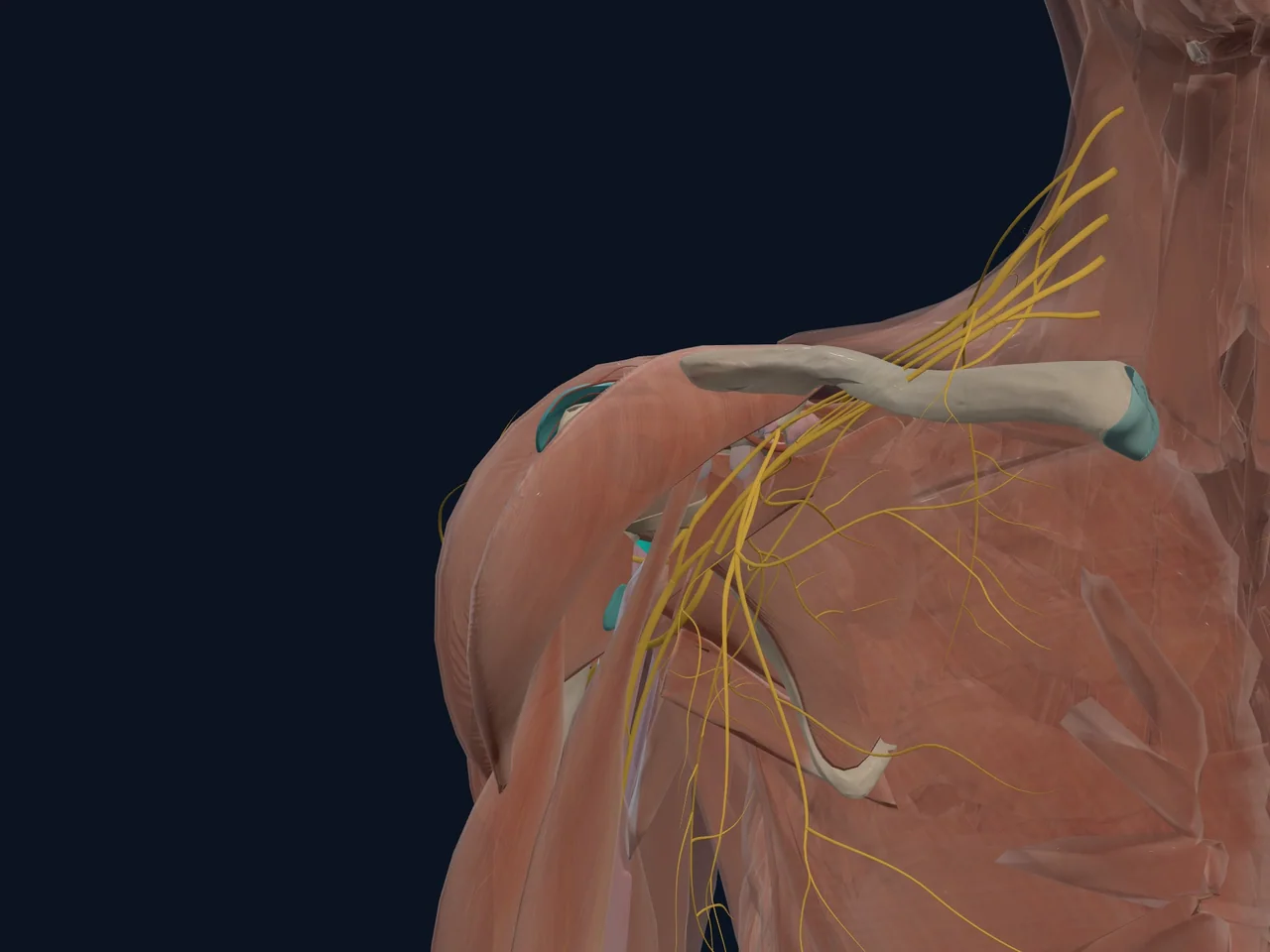
Overview
The glenohumeral joint (shoulder socket joint) is the main ball-and-socket joint of your shoulder — where the rounded top of your upper arm bone meets the shallow socket on your shoulder blade. It's the most mobile joint in the entire body, letting you reach overhead, behind your back, and across your body. That huge range of motion comes at a cost: the socket is so shallow that the joint depends heavily on surrounding muscles, ligaments, and cartilage for stability, which is why it's also one of the more commonly injured joints.
Location
- Located where the rounded head of the humerus (upper arm bone) meets the glenoid — the shallow, cup-like socket on the outer corner of the scapula (shoulder blade)
- Sits just below the acromion and in front of the muscles of the shoulder blade
- Enclosed within a loose joint capsule that allows for a very large range of motion
The glenoid socket is often compared to a golf tee, and the humeral head to a golf ball — the "ball" is much bigger than the shallow "tee" it sits on (Kenhub: Glenohumeral joint).
Function
- Allows the arm to move in almost every direction: forward, backward, out to the side, and in rotation
- Provides the foundation for all overhead, throwing, pushing, and pulling movements
- Works together with the shoulder blade's own motion (scapulohumeral rhythm) to maximize total reach
- Relies on a combination of the labrum (a ring of cartilage that deepens the socket slightly), the joint capsule, ligaments, and the rotator cuff muscles for stability, since the bones alone provide very little
Structures It Connects To
- Humerus (upper arm bone) — forms the "ball" of the joint
- Scapula (shoulder blade) — forms the "socket" (glenoid) of the joint
- Glenoid labrum — a ring of soft cartilage around the socket's rim that deepens it slightly and provides an attachment point for ligaments
- Joint capsule — a sleeve of connective tissue surrounding the whole joint
- Glenohumeral ligaments — bands of tissue that thicken parts of the capsule and resist excess movement
- Rotator cuff muscles (supraspinatus, infraspinatus, teres minor, subscapularis) — wrap around the joint and provide dynamic stability
- Long head of biceps brachii — its tendon passes through the joint capsule and attaches inside the socket rim
This joint is really a team effort between bone, cartilage, ligament, and muscle — no single structure keeps it stable on its own.
Movements It Assists
- Flexion (raising the arm forward)
- Extension (moving the arm backward)
- Abduction (raising the arm out to the side)
- Adduction (bringing the arm back down toward the body)
- Internal and external rotation
- Circumduction (a full circular sweep of the arm)
Common Injuries
- Shoulder dislocation — the humeral head slips partly or fully out of the socket, most often forward
- Labral tear (SLAP lesion) — a tear in the cartilage ring around the socket
- Rotator cuff tear — affects the muscles that stabilize this joint
- Adhesive capsulitis (frozen shoulder) — the joint capsule thickens and tightens, severely limiting motion
- Shoulder osteoarthritis — wear-and-tear changes to the joint surfaces
- Shoulder impingement syndrome — often involves structures crowding the space just above this joint
Pain Referral Patterns
- Pain is usually felt deep in the shoulder, often described as a dull ache that can become sharp with certain movements
- Instability or dislocation causes pain that spreads through the whole shoulder and sometimes down the upper arm
- Frozen shoulder pain often starts as a dull, deep ache and gradually adds significant stiffness
- Pain from this joint can occasionally radiate down toward the elbow, though it rarely travels past it
Clinical Relevance
Because the glenohumeral joint sacrifices bony stability for mobility, clinicians pay close attention to the "dynamic stabilizers" — the rotator cuff muscles and the muscles controlling the shoulder blade — when assessing shoulder pain or instability (Physiopedia: Glenohumeral Joint). Many rehabilitation programs for this joint focus on strengthening these supporting muscles rather than the joint itself, since strong, well-coordinated muscles are what actually keep the joint centered during movement.
Interesting Facts
- The glenohumeral joint has the greatest range of motion of any joint in the human body — it can move through roughly 180 degrees in multiple directions.
- Only about a quarter to a third of the humeral head's surface touches the glenoid socket at any given moment, which is a big part of why this joint is more prone to dislocation than most other joints.
- The joint capsule is so loose and roomy that, if it were removed and laid flat, it would be far larger than the bones it surrounds — this slack is exactly what gives the shoulder its exceptional flexibility (Physiopedia: Glenohumeral Joint).
Related Anatomy
- Scapula — forms the socket half of this joint
- Proximal humerus — forms the ball half of this joint
- Shoulder ligaments — reinforce the joint capsule
- Rotator cuff overview — the muscles providing dynamic stability
- Subacromial bursa — sits just above this joint, cushioning the rotator cuff tendons
- Axillary nerve — runs close to the joint capsule and can be affected during dislocation
- Scapulothoracic joint — works together with the glenohumeral joint to create full overhead shoulder motion
- Sternoclavicular joint — the other end of the collarbone, part of the same kinetic chain
- Brachial plexus (shoulder overview) — the nerve network that can be stretched or injured during a glenohumeral dislocation
Related Injuries
- Shoulder dislocation
- Labral tear (SLAP lesion)
- Adhesive capsulitis (frozen shoulder)
- Shoulder osteoarthritis
- Rotator cuff tear
References
- StatPearls (NCBI Bookshelf). "Anatomy, Shoulder and Upper Limb, Glenohumeral Joint." https://www.ncbi.nlm.nih.gov/books/NBK537018/
- Physiopedia. "Glenohumeral Joint." https://www.physio-pedia.com/Glenohumeral_Joint
- Kenhub. "Glenohumeral (shoulder) joint." https://www.kenhub.com/en/library/anatomy/glenohumeral-joint
- OrthoInfo (AAOS). "Shoulder Anatomy." https://orthoinfo.aaos.org/en/diseases--conditions/shoulder-anatomy/
- PMC. "Anatomy and Biomechanics of the Shoulder." https://pmc.ncbi.nlm.nih.gov/articles/PMC5039561/