Overview
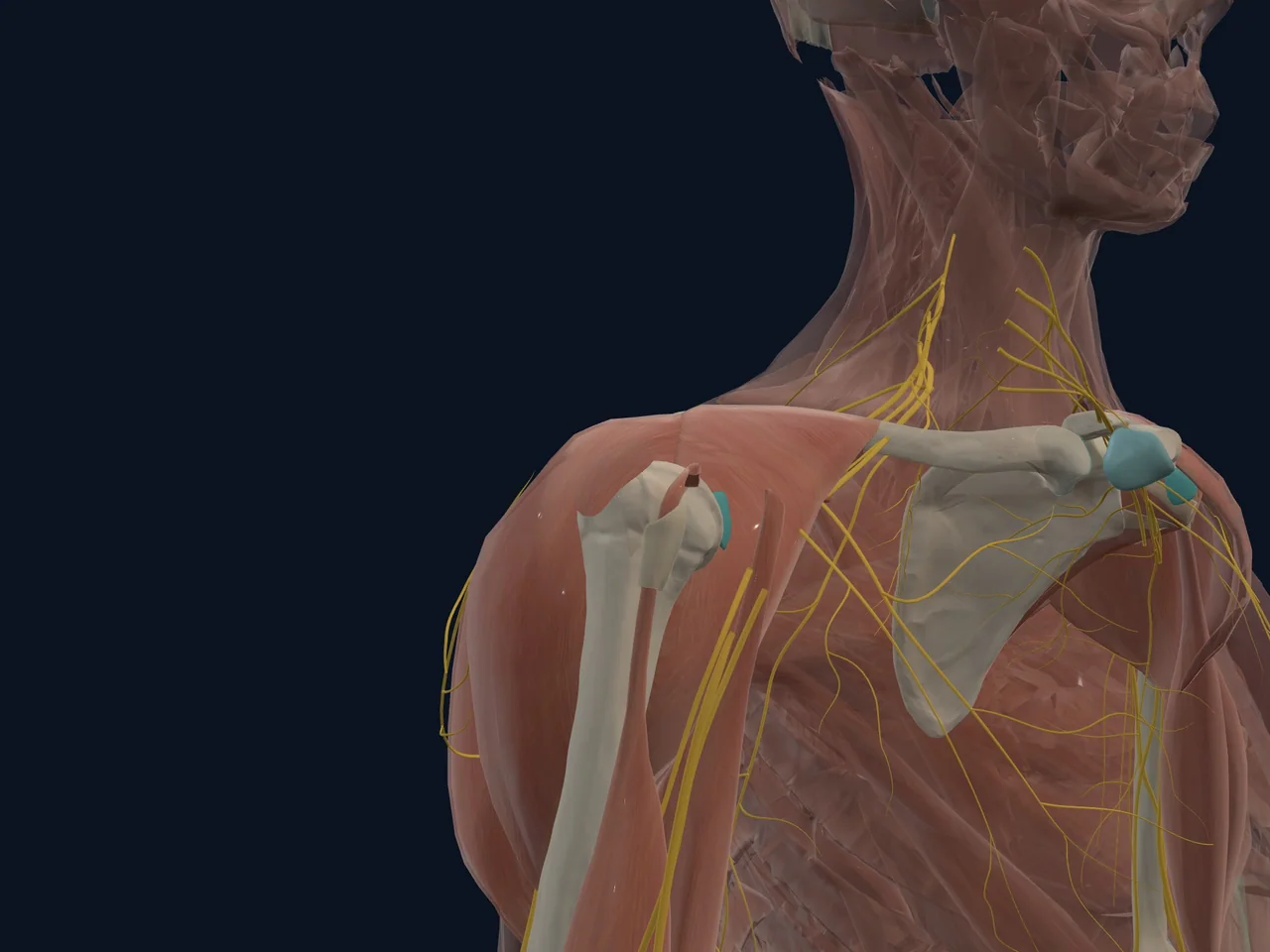
The subacromial bursa is a small, flattened, fluid-filled sac tucked between your rotator cuff tendons and the bony roof of your shoulder. Think of it as a slippery cushion or a tiny water balloon that lets two surfaces glide smoothly over each other without rubbing and wearing each other down. It's one of the most common sources of shoulder pain because it sits in a genuinely tight space that gets compressed every time you raise your arm.
Location
- Sits directly above the supraspinatus tendon (part of the rotator cuff) and directly below the acromion (the bony roof of the shoulder) and the deltoid muscle
- Occupies the "subacromial space," a narrow gap between the top of the humeral head and the underside of the acromion
- Extends slightly beyond the edge of the acromion in some people, sometimes called the subdeltoid extension
Function
- Reduces friction between the rotator cuff tendons and the overlying bone and deltoid muscle as the arm moves
- Allows smooth, pain-free gliding of the supraspinatus tendon during shoulder movement, especially overhead reaching
- Cushions and protects the rotator cuff tendons from the mechanical stress of being repeatedly compressed in a tight space
Structures It Connects To
- Supraspinatus tendon — sits directly beneath the bursa
- Acromion — sits directly above the bursa
- Deltoid muscle — overlies the bursa from above
- Coracoacromial ligament — forms part of the "roof" above the bursa and the rotator cuff
The subacromial bursa isn't attached to bone or muscle in the way a tendon or ligament is — it's simply a slippery sac that sits between structures, allowing them to move independently of one another.
Movements It Assists
- Facilitates smooth shoulder abduction (raising the arm out to the side) and flexion (raising the arm forward)
- Reduces friction during any movement where the rotator cuff tendons glide beneath the acromion
- Supports repetitive overhead movement, such as throwing, swimming, or reaching into overhead cabinets
Common Injuries
- Subacromial bursitis — inflammation and swelling of the bursa, often caused by repetitive overhead activity, direct trauma, or irritation from a nearby rotator cuff problem
- Shoulder impingement syndrome — the bursa can become compressed and irritated along with the rotator cuff tendons in this tight space
- Often occurs alongside rotator cuff tendinitis or rotator cuff tear, since all three structures share the same tight anatomical space
Pain Referral Patterns
- Pain is usually felt at the top or outer side of the shoulder, sometimes spreading a short way down the upper arm
- Overhead reaching and lifting the arm out to the side commonly worsen the pain
- Night pain, especially lying on the affected shoulder, is a common and classic complaint
- Because the bursa sits so close to the rotator cuff, bursitis pain often closely mimics rotator cuff tendinitis pain, and the two frequently occur together
Clinical Relevance
The subacromial bursa is one of the most frequently injected structures in the shoulder during corticosteroid injections, since reducing inflammation here can meaningfully ease pain associated with impingement-type symptoms (PubMed: Subacromial bursitis — corticosteroid injection RCT). Because bursitis and rotator cuff tendon irritation so often overlap and cause similar symptoms, clinicians typically rely on imaging (ultrasound or MRI) alongside a physical exam to figure out how much each structure is contributing to a person's pain.
Interesting Facts
- The subacromial bursa is the largest bursa in the human body.
- Bursae exist throughout the body wherever tendons or muscles need to glide over bone — the shoulder alone has several, but the subacromial bursa is by far the most clinically significant one in this region.
- Bursal inflammation can sometimes occur even without a true rotator cuff tear, which is an important distinction, since bursitis alone often responds very well to conservative treatment like rest, activity modification, and physiotherapy.
Related Anatomy
- Supraspinatus — the rotator cuff tendon sitting directly beneath this bursa
- Deltoid — overlies the bursa from above
- Rotator cuff overview — the bursa cushions these tendons as a group
- Acromioclavicular joint — located nearby, just above the subacromial space
Related Injuries
References
- Cleveland Clinic. "Bursa." https://my.clevelandclinic.org/health/body/21786-bursa
- Physiopedia. "Subacromial Bursa." https://www.physio-pedia.com/Subacromial_Bursa
- PubMed. "Comparison of corticosteroid injection, physiotherapy and combined treatment for patients with chronic subacromial bursitis — RCT." https://pubmed.ncbi.nlm.nih.gov/37021475/
- Open Access Journal of Sports Medicine. "Optimal management of shoulder impingement syndrome." https://pmc.ncbi.nlm.nih.gov/articles/PMC3945046/