Overview
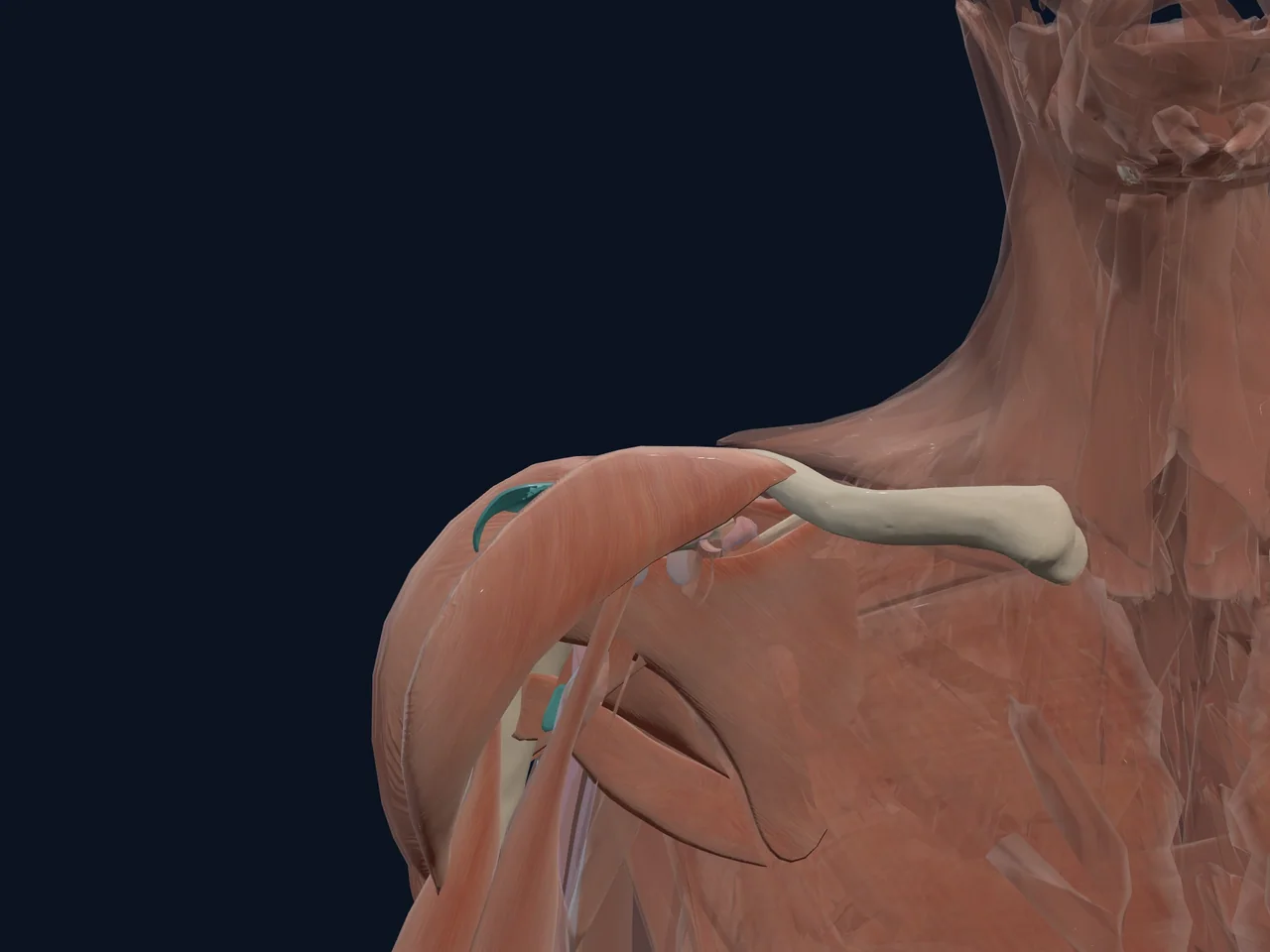
Your acromioclavicular joint (AC joint) is the small joint on top of your shoulder where the outer end of your collarbone meets the tip of your shoulder blade. You can feel it as a small bump or notch if you trace your finger along the top of your collarbone toward your shoulder. It's a small joint with a big job: it lets your shoulder blade rotate and tilt as you raise your arm, and it's a very common site of injury, especially after falls or direct hits to the shoulder.
Location
- Sits at the very top of the shoulder, at the outer end of the clavicle (collarbone)
- Formed where the clavicle meets the acromion, the bony tip of the scapula (shoulder blade)
- Located just above and in front of the glenohumeral (shoulder socket) joint, though it's a completely separate joint
The AC joint is a small, flat joint with a thin disc of cartilage between the bone ends, and it's supported by several ligaments both directly across the joint and running down toward the coracoid process of the shoulder blade (StatPearls: Acromioclavicular Joint).
Function
- Allows the shoulder blade to rotate and tilt as the arm moves overhead
- Provides a small amount of gliding motion between the collarbone and shoulder blade
- Transmits force from the arm and shoulder blade to the collarbone during pushing or weight-bearing movements
- Helps fine-tune the position of the shoulder blade during complex arm movements like throwing
Structures It Connects To
- Clavicle (collarbone) — the outer end forms one side of the joint
- Acromion — the tip of the scapula (shoulder blade), forms the other side of the joint
- Acromioclavicular ligaments — directly stabilize the joint (anterior, posterior, superior, and inferior parts)
- Coracoclavicular ligaments (conoid and trapezoid) — run from the coracoid process of the shoulder blade up to the underside of the collarbone, providing extra vertical stability
- Deltoid and trapezius muscles — attach nearby and cross over the joint
Even though the AC joint itself is small, it's braced by a network of ligaments that do most of the work of keeping the collarbone and shoulder blade properly aligned.
Movements It Assists
- Upward rotation of the shoulder blade during overhead reaching
- Shoulder blade tilting and internal/external rotation as the arm moves
- Fine adjustments in shoulder blade position during pushing, lifting, and throwing
Common Injuries
- AC joint sprain/separation — the most common injury here, usually from a fall directly onto the shoulder or a blow during contact sports (AC joint injury)
- AC joint osteoarthritis — wear-and-tear changes that develop over time, sometimes after previous injury or heavy repetitive loading
- Distal clavicle osteolysis — gradual bone breakdown at the joint, often linked to repetitive heavy lifting like bench pressing
Pain Referral Patterns
- Pain is usually felt as a sharp, localized point right on top of the shoulder
- Reaching the arm across the body (like reaching for a seatbelt) often reproduces the pain sharply
- More severe injuries can cause pain and visible swelling or a bump right at the joint
- Pain from this joint rarely spreads far — it tends to stay fairly localized compared to deeper shoulder problems
Clinical Relevance
AC joint injuries are graded on a scale (commonly Grades I through VI) based on how many ligaments are damaged and how far the collarbone has shifted out of position (StatPearls: Acromioclavicular Joint Injury). Lower grades usually heal well with rest, a sling, and physiotherapy, while higher grades — where the ligaments are completely torn — sometimes need surgical repair. Because the joint sits so close to the skin, a clinician can often diagnose a separation by look and feel alone, though X-rays confirm the grade.
Interesting Facts
- A visible "bump" or step-off deformity on top of the shoulder after a fall is a classic sign of a significant AC joint separation, caused by the collarbone shifting upward relative to the shoulder blade.
- The AC joint is one of the few joints in the body where a piece of cartilage (a disc) sits between two relatively flat bone surfaces rather than a rounded ball-and-socket design.
- AC joint injuries are especially common in cyclists and contact-sport athletes, since a fall directly onto the point of the shoulder transmits force straight into this joint.
Related Anatomy
- Clavicle — forms the inner side of this joint
- Scapula — its acromion forms the outer side of this joint
- Shoulder ligaments — includes the coracoclavicular and acromioclavicular ligaments supporting this joint
- Trapezius — crosses over this joint region and helps control the collarbone
- Deltoid — attaches near this joint on the acromion
Related Injuries
References
- StatPearls (NCBI Bookshelf). "Acromioclavicular Joint Injury." https://www.ncbi.nlm.nih.gov/books/NBK493188/
- Physiopedia. "Acromioclavicular Joint." https://www.physio-pedia.com/Acromioclavicular_Joint
- Kenhub. "Acromioclavicular joint." https://www.kenhub.com/en/library/anatomy/acromioclavicular-joint
- OrthoInfo (AAOS). "Shoulder Anatomy." https://orthoinfo.aaos.org/en/diseases--conditions/shoulder-anatomy/