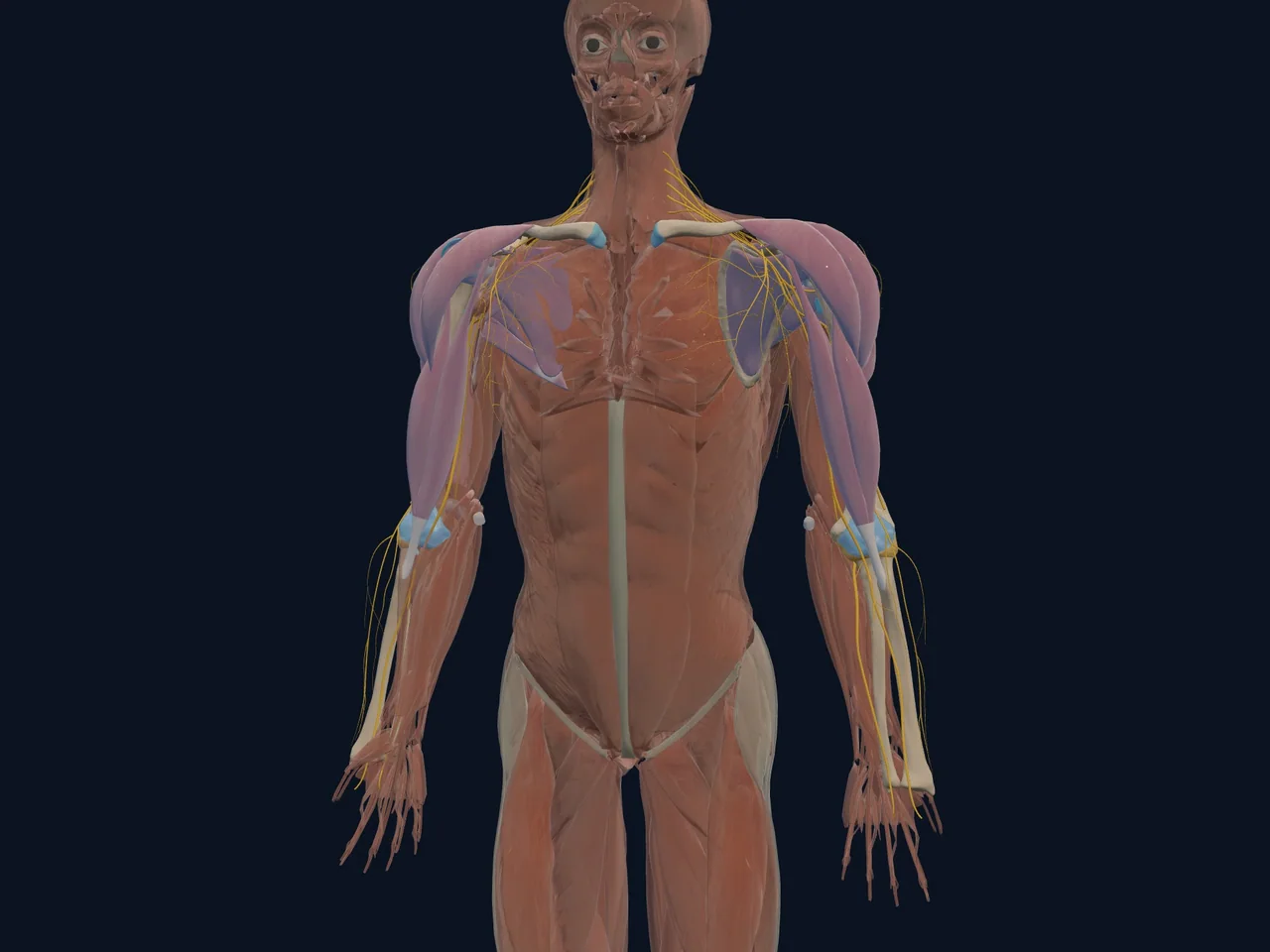
Overview
Your rotator cuff isn't a single structure — it's a team of four muscles and their tendons that wrap around your shoulder joint like a cuff on a sleeve, holding the ball of your upper arm bone snugly in its shallow socket. These four muscles work together every time you lift, reach, throw, or even just let your arm hang by your side. Because the shoulder joint's socket is so shallow, the rotator cuff does most of the heavy lifting (literally and figuratively) when it comes to keeping the joint stable, which is why rotator cuff problems are among the most common causes of shoulder pain.
Location
- Surrounds the glenohumeral (shoulder socket) joint on almost all sides — front, back, and top
- All four muscles originate on the scapula (shoulder blade) and insert onto the humerus (upper arm bone)
- Sits deep to (underneath) the larger, more superficial deltoid muscle
The four rotator cuff muscles are the supraspinatus (top), infraspinatus (back), teres minor (back, below infraspinatus), and subscapularis (front) — often remembered with the mnemonic "SITS" (Cleveland Clinic: Rotator Cuff Anatomy).
Function
- The four muscles' tendons blend together to form a continuous "cuff" of tissue around the top of the humerus, providing dynamic stability
- Each muscle also has an individual job: supraspinatus initiates arm lifting to the side, infraspinatus and teres minor rotate the arm outward, and subscapularis rotates the arm inward
- Together, they keep the humeral head centered in the shallow glenoid socket during virtually every arm movement, preventing it from sliding too far in any direction
- Provide fine motor control for precise arm positioning during activities like throwing
Structures It Connects To
- Scapula (shoulder blade) — origin point for all four muscles
- Humerus (upper arm bone) — insertion point for all four tendons, on the greater and lesser tuberosities
- Glenohumeral joint capsule — the rotator cuff tendons blend into and reinforce the joint capsule
- Subacromial bursa — sits just above the supraspinatus tendon, cushioning it against the overlying acromion and deltoid
- Suprascapular nerve — supplies the supraspinatus and infraspinatus
- Axillary nerve — supplies the teres minor
- Upper and lower subscapular nerves — supply the subscapularis
Movements It Assists
- Shoulder abduction (raising the arm out to the side) — supraspinatus initiates this movement
- External rotation of the arm — infraspinatus and teres minor
- Internal rotation of the arm — subscapularis
- Overall joint stabilization during flexion, extension, and all other shoulder movements
Common Injuries
- Rotator cuff tear — a partial or complete tear in one or more of the four tendons, most often the supraspinatus
- Rotator cuff tendinitis — irritation and inflammation of the tendons without a full tear, often from repetitive overhead use
- Shoulder impingement syndrome — the rotator cuff tendons get pinched in the tight space beneath the acromion
- Subacromial bursitis — inflammation of the bursa sitting right next to the rotator cuff tendons, often occurring alongside cuff irritation
Pain Referral Patterns
- Most rotator cuff pain is felt at the top or outer side of the shoulder, often spreading down the outer upper arm — but rarely past the elbow
- Night pain, especially when lying on the affected side, is one of the most classic and common complaints
- Pain with a specific "painful arc" — worse in the middle range of raising the arm to the side — is a hallmark pattern
- Weakness with specific movements (lifting to the side, or rotating the arm in or out) can point to which of the four muscles is most affected
Clinical Relevance
Because the four rotator cuff muscles work as an interconnected team, an injury to one often changes how the others function, sometimes leading to compensatory patterns that cause additional strain elsewhere in the shoulder (StatPearls: Rotator Cuff Syndrome). Clinicians typically test each of the four muscles individually — checking specific movements and strength — to build a clear picture of exactly which part of the cuff is affected, since treatment approaches can differ depending on which tendon and how much of it is involved.
Interesting Facts
- The word "cuff" in rotator cuff refers to how the four tendons blend together into a single, continuous sheet of tissue wrapping around the joint, much like a cuff wraps around a sleeve.
- Studies using MRI have found that rotator cuff tears are extremely common with age, even in people who have no shoulder pain at all — some research suggests over half of people over 60 have some degree of tear without ever noticing symptoms.
- Despite doing so much stabilizing work, the entire rotator cuff group weighs only a small fraction of what the much larger deltoid muscle weighs, showing how much of the joint's stability comes down to precision and coordination rather than raw muscle bulk.
Related Anatomy
- Supraspinatus — initiates arm lifting and is the most commonly injured rotator cuff muscle
- Infraspinatus — the main external rotator
- Teres minor — assists external rotation
- Subscapularis — the main internal rotator
- Glenohumeral joint — the joint the rotator cuff stabilizes
- Subacromial bursa — cushions the rotator cuff tendons
- Deltoid — works alongside the rotator cuff for arm-raising power
Related Injuries
References
- Cleveland Clinic. "What Is the Anatomy of the Rotator Cuff?" https://my.clevelandclinic.org/health/body/rotator-cuff
- StatPearls (NCBI Bookshelf). "Anatomy, Rotator Cuff." https://www.ncbi.nlm.nih.gov/books/NBK441844/
- StatPearls (NCBI Bookshelf). "Rotator Cuff Syndrome." https://www.ncbi.nlm.nih.gov/books/NBK531506/
- Physiopedia. "Rotator Cuff." https://www.physio-pedia.com/Rotator_Cuff
- Kenhub. "Rotator cuff muscles: Anatomy, functions, injury." https://www.kenhub.com/en/library/anatomy/the-rotator-cuff
- Clinical Orthopaedics and Related Research (PMC). "Surgical Anatomy of the Rotator Cuff." https://pmc.ncbi.nlm.nih.gov/articles/PMC2505212/
- OrthoInfo (AAOS). "Rotator Cuff Tears." https://orthoinfo.aaos.org/en/diseases--conditions/rotator-cuff-tears/