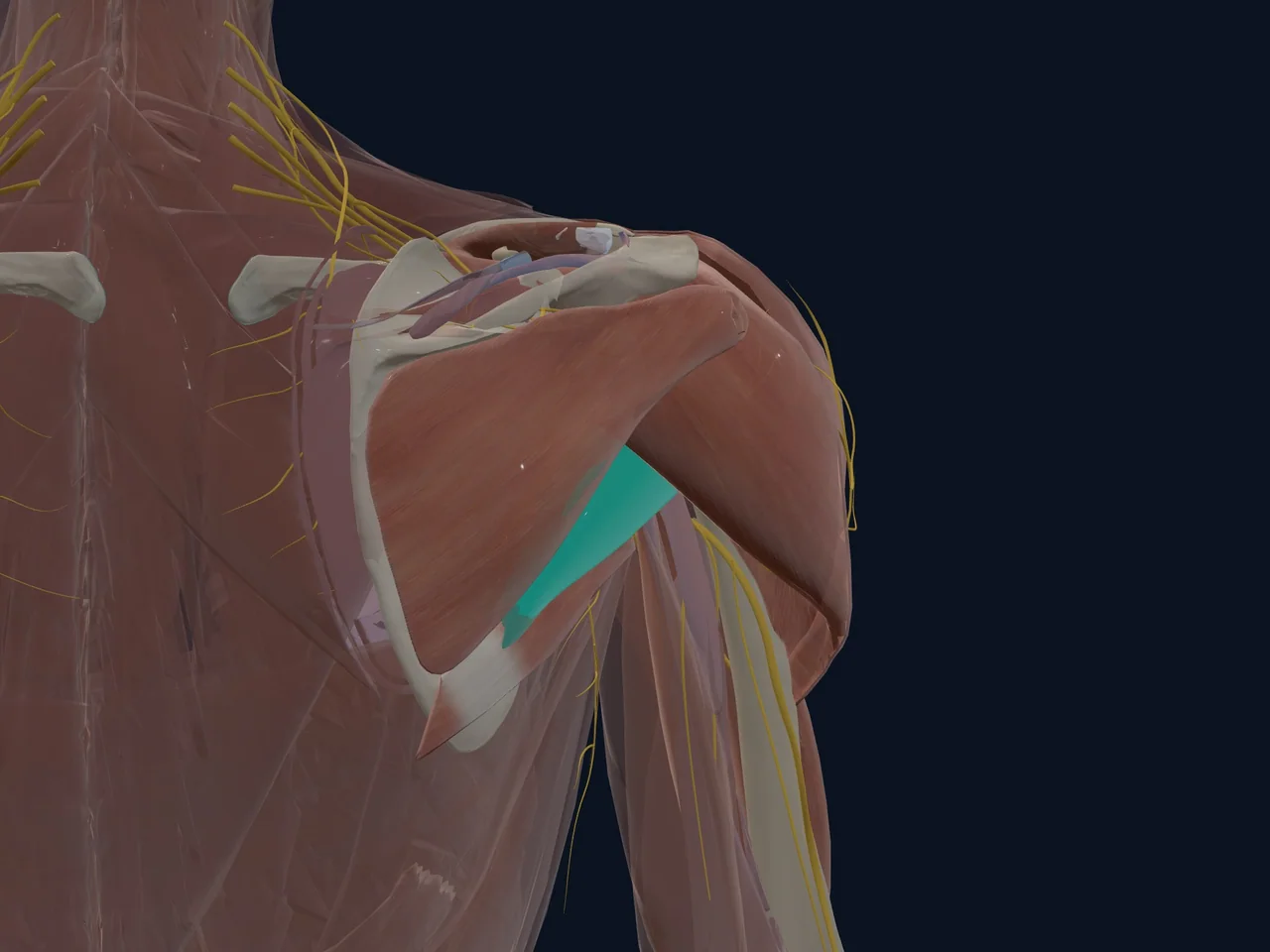
Overview
The teres minor is the smallest of the four rotator cuff muscles, tucked along the outer edge of your shoulder blade. It's often overshadowed by its larger neighbor, the infraspinatus, since the two muscles do similar jobs — both help turn your arm outward and stabilize your shoulder joint. Because it's small and works alongside a bigger muscle doing the same task, injuries specific to the teres minor alone are relatively uncommon.
Location
- Runs along the upper part of the lateral border (outer edge) of the scapula (shoulder blade)
- Sits just below the infraspinatus, and the two muscles are often difficult to tell apart during dissection or imaging
- Its tendon crosses the back of the shoulder joint before attaching to the upper arm bone
Origin, Insertion, Nerve Supply, and Action
- Origin: Upper two-thirds of the lateral (outer) border of the scapula (shoulder blade)
- Insertion: Lower part of the greater tuberosity of the humerus (upper arm bone), just below the infraspinatus attachment
- Nerve supply: Axillary nerve (spinal nerve roots C5–C6)
- Action: External rotation of the arm (turning the arm outward); assists in stabilizing the humeral head in the shoulder socket
In plain English: the teres minor is a small helper muscle that works as a team with the infraspinatus to turn your arm outward and keep your shoulder joint snug and stable, especially when your arm is out to the side or overhead (Kenhub: Shoulder muscles).
Function
- Assists external rotation of the arm at the shoulder, working alongside the infraspinatus
- Helps stabilize the back of the shoulder joint, resisting excess forward movement of the humeral head
- Contributes to fine motor control of arm position during throwing and overhead activities
Structures It Connects To
- Scapula (shoulder blade) — its origin point along the outer border
- Humerus (upper arm bone) — its insertion point on the greater tuberosity
- Infraspinatus — sits just above it, sharing a very similar function
- Axillary nerve — supplies motor signals to this muscle, running nearby through the quadrangular space
- Teres major — a separate, larger muscle running just below it with an opposite action (internal rotation)
Movements It Assists
- External rotation of the shoulder
- Shoulder joint stabilization during arm movement, particularly resisting forward sliding of the humeral head
- Fine control during throwing and overhead reaching, alongside the infraspinatus
Common Injuries
- Rotator cuff tear — the teres minor is the least commonly torn of the four rotator cuff tendons, since it's small and works closely with the larger infraspinatus
- Rotator cuff tendinitis — can involve this muscle alongside the infraspinatus in overuse injuries
- Quadrangular space syndrome — a rare condition where the nearby axillary nerve is compressed, which can indirectly affect teres minor function and cause shoulder symptoms
Pain Referral Patterns
- Pain is usually felt at the back of the shoulder, along the outer edge of the shoulder blade
- Because it works so closely with the infraspinatus, isolated teres minor pain is uncommon — symptoms usually overlap with infraspinatus-related pain patterns
- Deep aching along the back of the shoulder with overhead sports can sometimes involve this muscle
Clinical Relevance
The teres minor rarely causes problems entirely on its own, since it shares its job so closely with the infraspinatus. However, on shoulder MRI, it's an important muscle to check because unusual fatty changes limited only to the teres minor (without matching changes in the infraspinatus) can point toward a specific nerve issue involving the axillary nerve rather than a rotator cuff tendon problem (Kenhub: Axillary nerve).
Interesting Facts
- Despite being one of the "big four" rotator cuff muscles, the teres minor is supplied by the axillary nerve — not the suprascapular nerve that supplies the other three, making it the odd one out in terms of nerve supply.
- Its name comes from Latin: "teres" means rounded or cylindrical, describing the muscle's shape, and "minor" simply distinguishes it from the separate, larger teres major muscle nearby.
- Because it's so thin and closely bundled with the infraspinatus, some anatomy textbooks note it can be hard to separate the two muscles cleanly during dissection.
Related Anatomy
- Rotator cuff overview — the group of four muscles the teres minor belongs to
- Infraspinatus — sits just above and shares a very similar function
- Axillary nerve — supplies motor signals to this muscle
- Scapula — the bone the teres minor originates from
- Glenohumeral joint — stabilized in part by this muscle
Related Injuries
References
- Kenhub. "Shoulder muscles: Anatomy and functions." https://www.kenhub.com/en/library/anatomy/shoulder-muscles
- Kenhub. "Axillary nerve: Anatomy, course, function." https://www.kenhub.com/en/library/anatomy/axillary-nerve
- Cleveland Clinic. "What Is the Anatomy of the Rotator Cuff?" https://my.clevelandclinic.org/health/body/rotator-cuff
- Physiopedia. "Rotator Cuff." https://www.physio-pedia.com/Rotator_Cuff