Overview
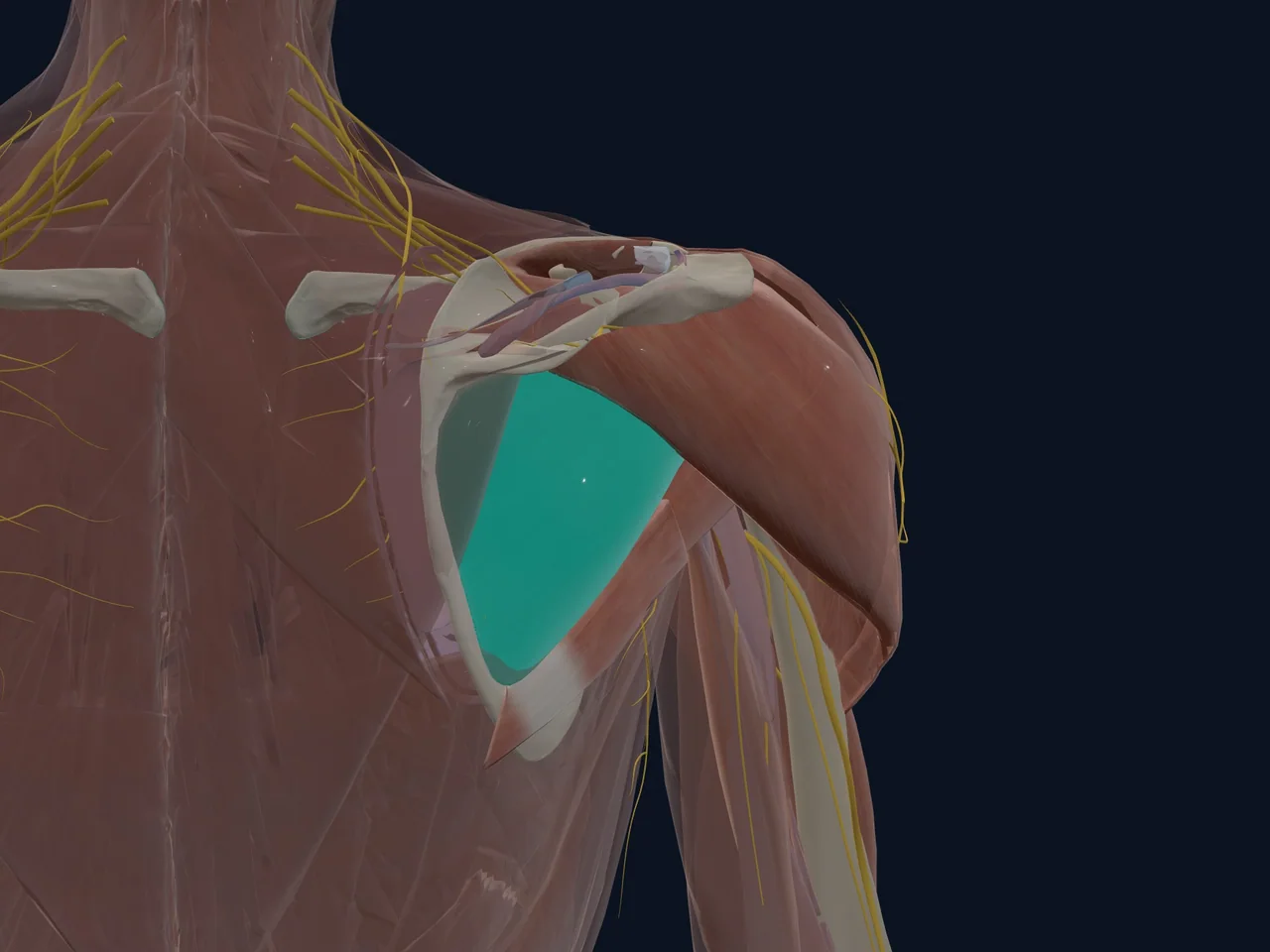
The infraspinatus is one of the four rotator cuff muscles, and it's the main muscle responsible for turning your arm outward — the motion you'd use to open a door or throw a frisbee backhand. It also plays a big role in keeping the ball of your shoulder joint centered in its socket, especially during throwing motions. Overhead athletes and throwers rely heavily on this muscle, which is why it's frequently involved in shoulder overuse injuries in these groups.
Location
- Fills the infraspinous fossa, the larger hollow on the back of the shoulder blade, below the scapular spine
- Its tendon travels across the back of the shoulder joint before attaching to the upper arm bone
- Lies beneath the trapezius and deltoid muscles, so it isn't directly visible or easily felt through the skin
Origin, Insertion, Nerve Supply, and Action
- Origin: Infraspinous fossa of the scapula (shoulder blade)
- Insertion: Greater tuberosity of the humerus (upper arm bone), just below the supraspinatus attachment
- Nerve supply: Suprascapular nerve (spinal nerve roots C5–C6)
- Action: External rotation of the arm (turning the arm outward); helps stabilize the humeral head in the shoulder socket, especially during the "cocking" phase of throwing
In plain English: the infraspinatus is your main "outward turning" muscle for the shoulder. Every time you rotate your arm outward — like winding up to throw a ball — this muscle is doing most of the work, while also helping keep the joint stable under that load (StatPearls: Scapulohumeral Rhythm).
Function
- Externally rotates the arm at the shoulder
- Stabilizes the back of the shoulder joint, resisting the humeral head sliding too far forward during throwing and overhead motions
- Works with the other rotator cuff muscles to keep the joint centered through its full range of motion
Structures It Connects To
- Scapula (shoulder blade) — its origin point
- Humerus (upper arm bone) — its insertion point on the greater tuberosity
- Supraspinatus — sits just above it and shares a nerve supply
- Teres minor — sits just below it and works together on external rotation
- Suprascapular nerve — supplies motor signals to this muscle
Movements It Assists
- External rotation of the shoulder
- Fine control of arm position during throwing, swimming, and overhead reaching
- Joint stabilization during nearly all arm movements, particularly resisting forward sliding of the humeral head
Common Injuries
- Rotator cuff tear — the infraspinatus is the second most commonly torn rotator cuff tendon after the supraspinatus
- Rotator cuff tendinitis — often develops from repetitive throwing or overhead motions
- Suprascapular nerve compression (at the spinoglenoid notch) can selectively weaken this muscle without affecting the supraspinatus, sometimes seen in volleyball players (PMC: Suprascapular Nerve Pathology)
- Shoulder impingement syndrome — can involve this tendon alongside the supraspinatus
Pain Referral Patterns
- Pain is often felt at the back of the shoulder, sometimes spreading toward the shoulder blade or outer upper arm
- Weakness or pain with resisted outward arm rotation is a classic sign of infraspinatus involvement
- Throwing athletes often notice pain during the "cocking" or "follow-through" phases of a throw
- Deep, aching pain around the shoulder blade with overhead sports is a common presentation
Clinical Relevance
Because the infraspinatus is the primary external rotator, clinicians commonly test its strength by asking a patient to rotate their arm outward against resistance with the elbow tucked at the side. Weakness in this specific movement, especially without pain, can point toward a nerve issue (like suprascapular nerve compression) rather than a purely muscular or tendon problem (PMC: Suprascapular Nerve Pathology). This distinction matters because nerve-related weakness is managed differently than a tendon tear.
Interesting Facts
- The infraspinatus is the largest of the four rotator cuff muscles by surface area, even though the supraspinatus tends to get more attention because it's more commonly injured.
- In elite throwing athletes, this muscle is often noticeably larger on the throwing-arm side, a visible adaptation to repetitive use.
- Isolated infraspinatus weakness with no supraspinatus involvement is a recognized clinical clue for nerve compression specifically at the spinoglenoid notch, a narrow passage further along the suprascapular nerve's path.
Related Anatomy
- Rotator cuff overview — the group of four muscles the infraspinatus belongs to
- Supraspinatus — sits just above and shares a nerve supply
- Teres minor — sits just below and shares a similar rotation function
- Scapula — the bone the infraspinatus originates from
- Suprascapular nerve — supplies motor signals to this muscle
Related Injuries
References
- StatPearls (Point of Care). "Anatomy, Shoulder and Upper Limb, Scapulohumeral Rhythm." https://www.statpearls.com/point-of-care/32424
- PMC (The Open Orthopaedics Journal). "Suprascapular Nerve Pathology: A Review of the Literature." https://pmc.ncbi.nlm.nih.gov/articles/PMC5366386/
- Cleveland Clinic. "What Is the Anatomy of the Rotator Cuff?" https://my.clevelandclinic.org/health/body/rotator-cuff
- Kenhub. "Shoulder muscles: Anatomy and functions." https://www.kenhub.com/en/library/anatomy/shoulder-muscles