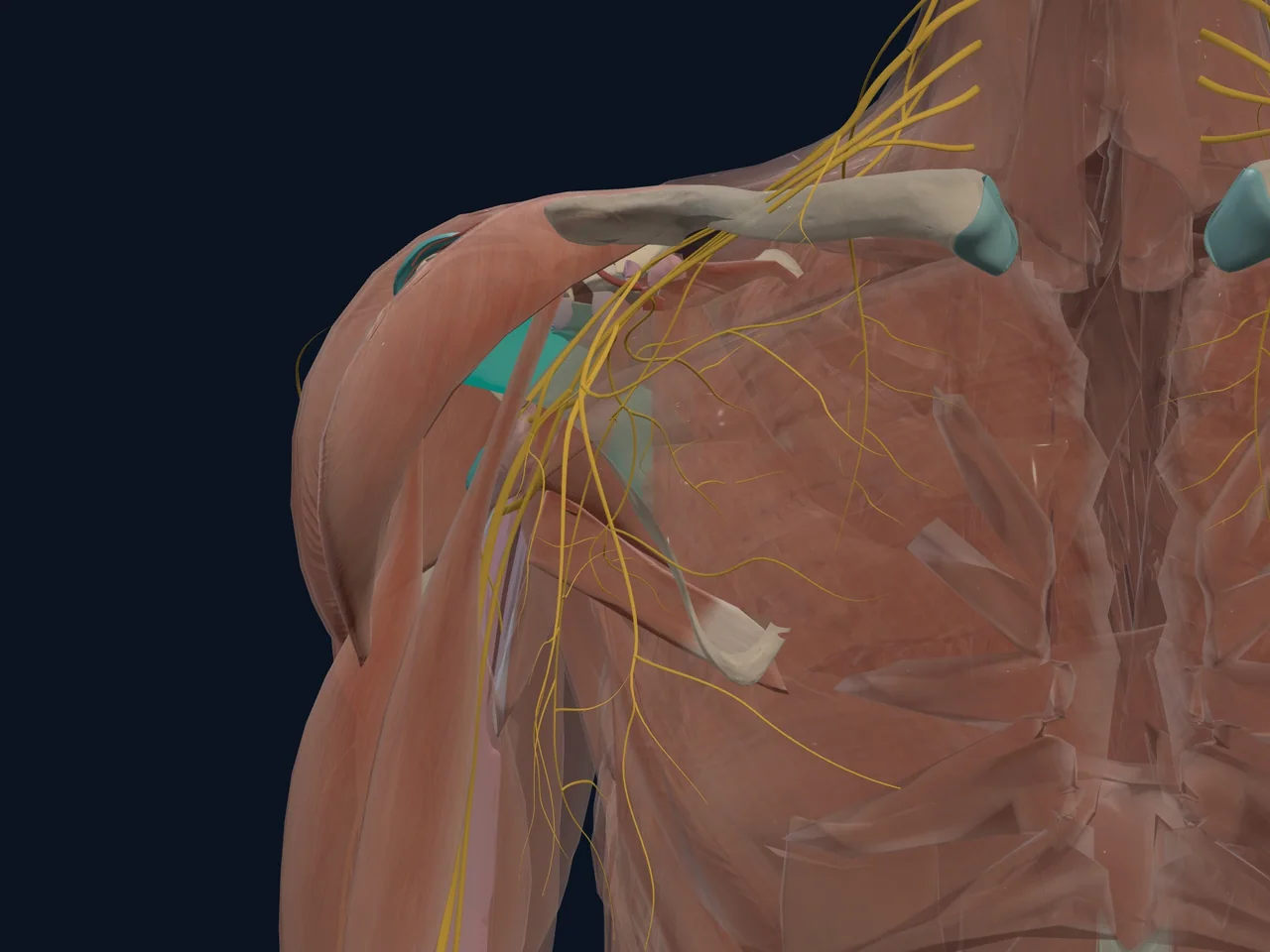
Overview
The subscapularis is the largest and strongest of the four rotator cuff muscles, and it's the only one that sits on the front of the shoulder blade rather than the back. Its main job is turning your arm inward — the motion you'd use to tuck a shirt into the back of your pants — and it plays a key role in keeping the front of your shoulder joint stable. Because it's tucked deep between the shoulder blade and the ribcage, it's harder to test and assess than the other rotator cuff muscles.
Location
- Fills the subscapular fossa, the large concave surface on the front (deep) side of the scapula (shoulder blade), facing the ribcage
- Forms part of the scapulothoracic joint's gliding surface, sitting between the shoulder blade and ribcage
- Its tendon wraps around the front of the shoulder joint before attaching to the upper arm bone
Origin, Insertion, Nerve Supply, and Action
- Origin: Subscapular fossa (the front surface of the scapula, facing the ribcage)
- Insertion: Lesser tuberosity of the humerus (upper arm bone)
- Nerve supply: Upper and lower subscapular nerves (spinal nerve roots C5–C6, branching from the posterior cord of the brachial plexus)
- Action: Internal rotation of the arm (turning the arm inward); helps stabilize the front of the shoulder joint, resisting the humeral head sliding too far forward
In plain English: the subscapularis is your main "inward turning" muscle for the shoulder, and it also acts like a front-line guard for your shoulder joint, helping stop the ball of your upper arm bone from slipping forward out of its socket (StatPearls: Axilla).
Function
- Internally rotates the arm at the shoulder
- Stabilizes the front of the shoulder joint, especially important in resisting anterior (forward) shoulder dislocation
- Contributes to overall rotator cuff strength and joint centering during all arm movements
Structures It Connects To
- Scapula (shoulder blade) — its origin point on the front surface
- Humerus (upper arm bone) — its insertion point on the lesser tuberosity
- Ribcage — the subscapularis forms part of the muscle cushion of the scapulothoracic joint
- Upper and lower subscapular nerves — supply motor signals to this muscle
- Biceps brachii tendon (long head) — runs nearby, just next to the subscapularis's insertion area
Movements It Assists
- Internal rotation of the shoulder
- Stabilization of the front of the glenohumeral (shoulder socket) joint
- Assisting arm adduction (bringing the arm back toward the body) alongside other muscles
Common Injuries
- Rotator cuff tear — subscapularis tears are less common than supraspinatus tears but are often missed on initial exam because the muscle is harder to test directly
- Shoulder dislocation — the subscapularis can be strained or torn during a forceful dislocation, since it's a key front-of-joint stabilizer
- Rotator cuff tendinitis — can affect this tendon, though less frequently than the supraspinatus
Pain Referral Patterns
- Pain is often felt at the front of the shoulder, sometimes deep in the armpit region
- Reaching behind the back (like reaching for a back pocket) commonly reproduces pain if this muscle or tendon is affected
- Because it's tucked against the ribcage, subscapularis pain can be harder to pinpoint than pain from the other rotator cuff muscles
Clinical Relevance
The subscapularis is the least commonly injured rotator cuff muscle in terms of tears, but when it is torn, it's frequently missed on a standard physical exam because it's harder to isolate and test than the supraspinatus or infraspinatus (StatPearls: Axilla). Clinicians often use specific tests, like the "lift-off test" or "belly press test," which ask a patient to push their hand away from their lower back or belly, to isolate and check subscapularis strength.
Interesting Facts
- The subscapularis is the largest of the four rotator cuff muscles by bulk, even though it gets far less attention than the supraspinatus in everyday conversations about shoulder injuries.
- It's the only rotator cuff muscle that sits on the front surface of the shoulder blade rather than the back — all three of the others are on the back (posterior) side.
- Because it has its own two-part nerve supply (upper and lower subscapular nerves), it's somewhat more resistant to complete nerve-related weakness than muscles that rely on a single nerve pathway.
Related Anatomy
- Rotator cuff overview — the group of four muscles the subscapularis belongs to
- Scapula — the bone the subscapularis originates from
- Scapulothoracic joint — the subscapularis forms part of this gliding surface
- Biceps brachii (long head) — its tendon runs near the subscapularis insertion
- Glenohumeral joint — stabilized at the front by this muscle
Related Injuries
References
- StatPearls (NCBI Bookshelf). "Anatomy, Shoulder and Upper Limb, Axilla." https://www.ncbi.nlm.nih.gov/books/NBK547723/
- Cleveland Clinic. "What Is the Anatomy of the Rotator Cuff?" https://my.clevelandclinic.org/health/body/rotator-cuff
- Kenhub. "Shoulder muscles: Anatomy and functions." https://www.kenhub.com/en/library/anatomy/shoulder-muscles
- Physiopedia. "Rotator Cuff." https://www.physio-pedia.com/Rotator_Cuff