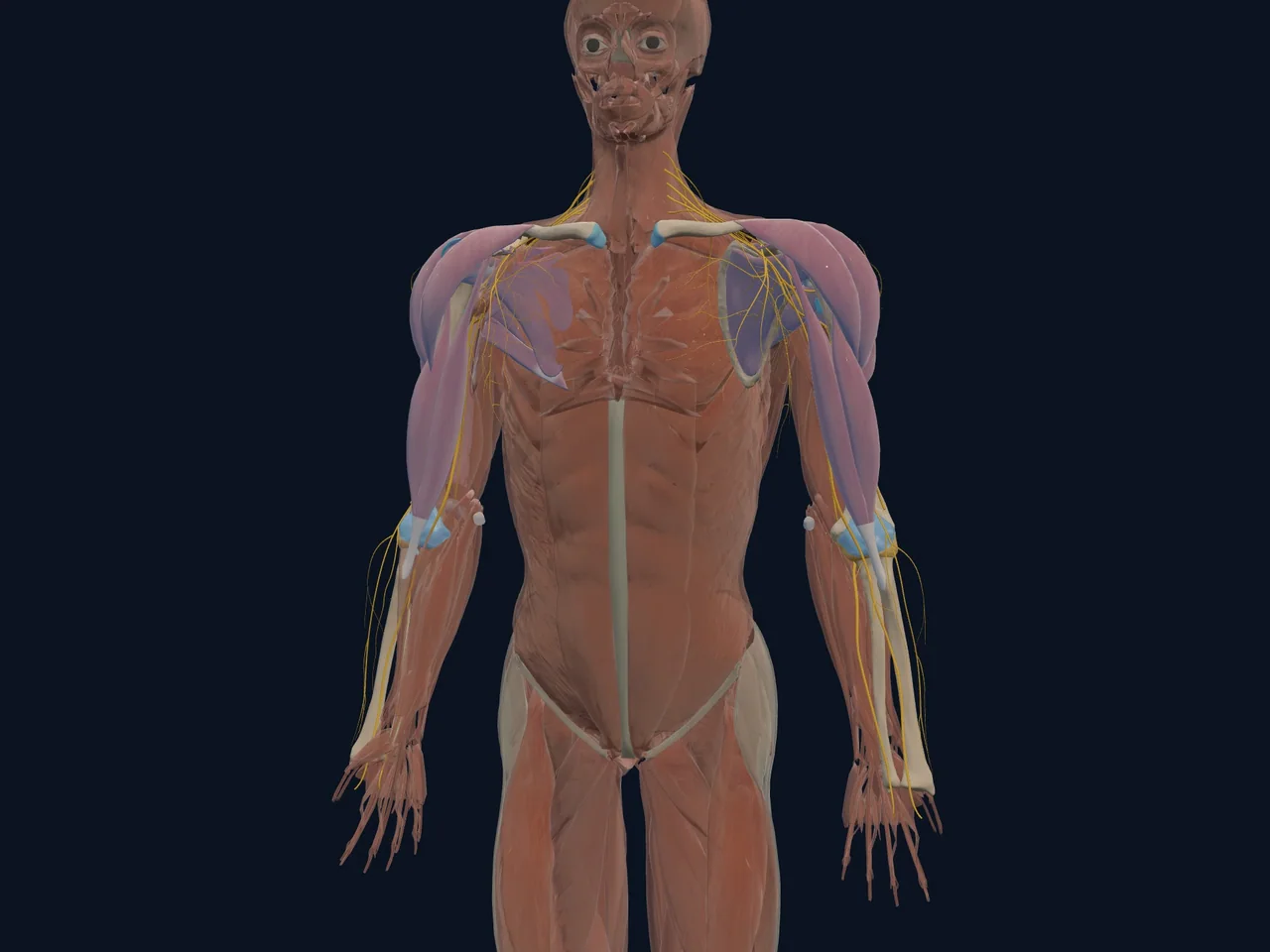
Overview
The scapulothoracic joint is the gliding connection between your scapula (shoulder blade) and the back of your ribcage. Unlike most joints in the body, it isn't held together by bone-to-bone contact or ligaments — instead, your shoulder blade glides over a cushion of muscle on your ribcage, held in place entirely by the muscles around it. This unique setup is a major reason your shoulder can move as freely as it does.
Location
- Located on the back (posterior) of the upper ribcage, where the front (deep) surface of the shoulder blade meets the ribcage
- Separated by two layers of muscle: the subscapularis (on the shoulder blade side) and the serratus anterior (on the ribcage side), which glide against each other
- Positioned beneath the trapezius and other superficial back muscles
Because there's no direct bone-on-bone contact or joint capsule here, some anatomists describe this as a "functional joint" rather than a true anatomical joint — but it behaves like one, and problems with its motion have real effects on the whole shoulder.
Function
- Allows the shoulder blade to glide, tilt, and rotate smoothly across the back of the ribcage
- Works together with the glenohumeral (shoulder socket) joint to add extra range of motion to arm movements — a coordinated pattern called scapulohumeral rhythm
- Helps position the shoulder socket optimally throughout the arm's full range of motion, which keeps the rotator cuff working efficiently
- Distributes load away from the glenohumeral joint alone during heavy lifting or overhead work
Structures It Connects To
- Scapula (shoulder blade) — the moving structure
- Ribcage — the surface the shoulder blade glides over
- Subscapularis muscle — lines the deep (front) surface of the shoulder blade
- Serratus anterior muscle — lines the ribcage side of this gliding interface
- Trapezius, rhomboids, levator scapulae — control shoulder blade positioning from the outside
This joint depends entirely on coordinated muscle activity rather than ligaments, which is unusual compared to almost every other joint in the body.
Movements It Assists
- Upward and downward rotation of the shoulder blade during arm raising and lowering
- Shoulder blade protraction (moving forward around the ribcage, as in a punching motion) and retraction (pulling shoulder blades together)
- Shoulder blade elevation and depression (shrugging up and pulling down)
- Shoulder blade tilting, which helps clear space for the rotator cuff tendons during overhead reaching
Common Injuries
This joint doesn't sustain the kinds of direct injuries that true joints do (like sprains or dislocations), but its function is commonly disrupted by:
- Scapular dyskinesis — abnormal or uncoordinated shoulder blade movement, often linked to muscle weakness or poor movement habits
- Snapping scapula syndrome — a grinding, popping, or snapping sensation as the shoulder blade moves over the ribcage
- Contributing factor in shoulder impingement syndrome, since poor shoulder blade control changes the space available for the rotator cuff tendons
- Contributing factor in rotator cuff tendinitis and rotator cuff tear, when abnormal scapular motion overloads the rotator cuff
Pain Referral Patterns
- Often felt as a dull ache or tightness between the shoulder blades or across the upper back
- Can contribute to pain felt at the front or side of the shoulder if poor shoulder blade control leads to impingement-type symptoms
- Frequently associated with a burning or fatigued feeling along the top of the shoulder blade after long periods of desk work or overhead activity
Clinical Relevance
Clinicians assess scapulothoracic movement by watching how the shoulder blade moves as a patient raises their arm, looking for asymmetry, winging, or jerky motion (scapular dyskinesis). This assessment matters because problems here can either cause or worsen other shoulder conditions — poor shoulder blade control changes how much room the rotator cuff tendons have to move, which can contribute to impingement-type pain (Physiopedia: Scapula). Rehabilitation for many shoulder conditions specifically strengthens the muscles that control this joint, particularly the serratus anterior and lower trapezius.
Interesting Facts
- The scapulothoracic joint is one of the few "joints" in the human body with no direct bone-to-bone contact, no joint capsule, and no ligaments connecting the two sides — it's purely a muscle-cushioned gliding interface.
- Roughly two-thirds of total arm-raising motion comes from the glenohumeral joint and about one-third comes from scapulothoracic motion, though this ratio varies through the range of movement.
- Because this "joint" is entirely muscle-controlled, its function can often be retrained and improved significantly through targeted exercise, unlike joints limited by fixed bony or ligament structure.
Related Anatomy
- Scapula — the moving bone in this joint
- Trapezius — a key muscle controlling shoulder blade motion here
- Glenohumeral joint — works in coordination with this joint during arm movement
- Rotator cuff overview — function depends on proper scapulothoracic motion
Related Injuries
References
- StatPearls (Point of Care). "Anatomy, Shoulder and Upper Limb, Scapulohumeral Rhythm." https://www.statpearls.com/point-of-care/32424
- Physiopedia. "Scapula." https://www.physio-pedia.com/Scapula
- Kenhub. "Arm and shoulder anatomy: Bones, muscles and nerves." https://www.kenhub.com/en/library/anatomy/arm-and-shoulder-anatomy