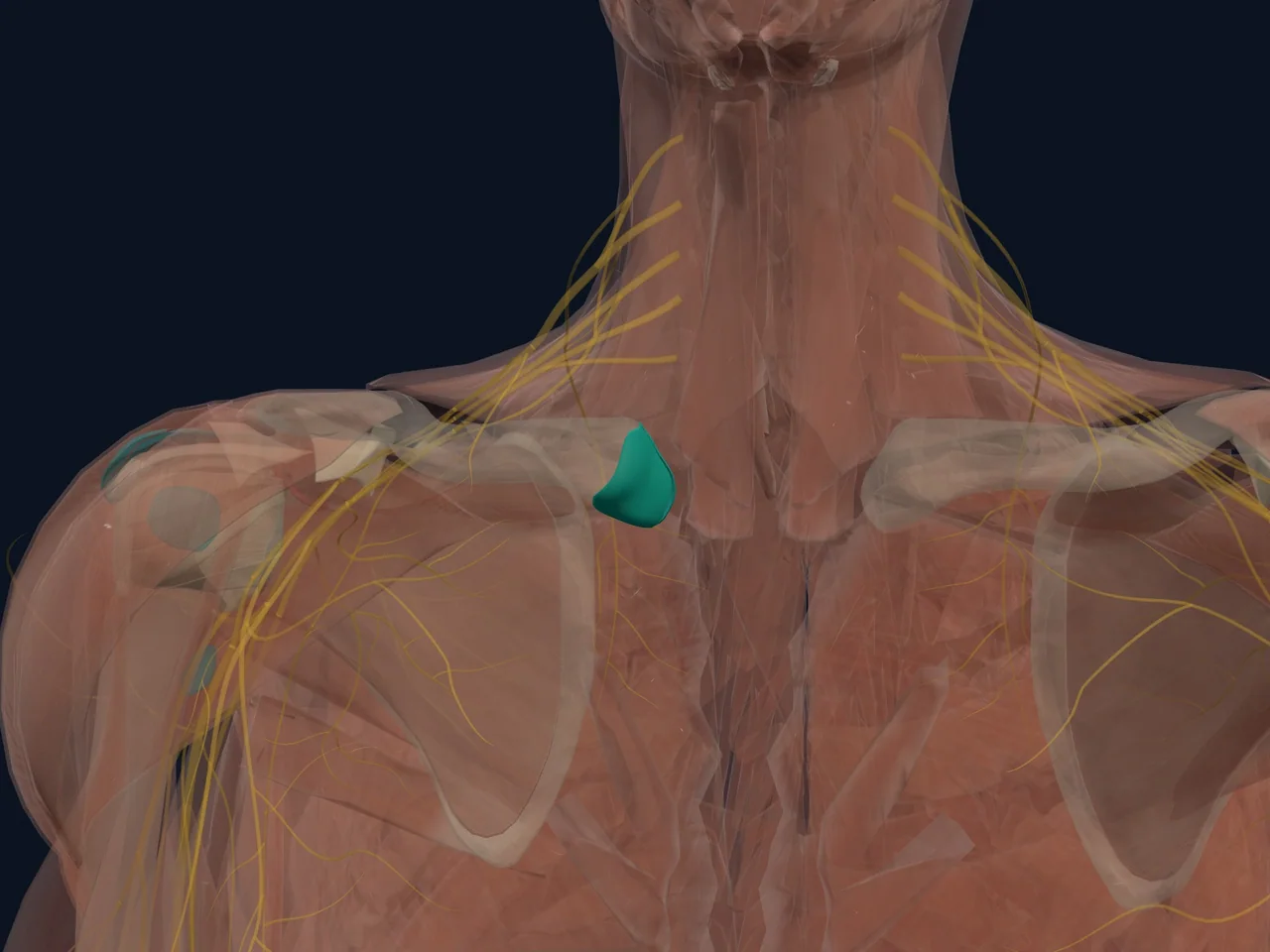
Overview
Your sternoclavicular joint (SC joint) is where the inner end of your collarbone meets your breastbone, right at the base of your neck. It's the only joint that actually connects your entire arm and shoulder to the rest of your skeleton — everything else in the shoulder floats on muscle or connects indirectly. Despite doing so much work, it's a small, sturdy joint that's rarely injured compared to other shoulder structures.
Location
- Sits at the base of the neck, where the inner (medial) end of the clavicle (collarbone) meets the top of the sternum (breastbone)
- Positioned just above the first rib, roughly in the midline of the upper chest
- Easy to feel as a small, bony prominence on either side of the top of the breastbone
The joint surfaces themselves are relatively small and don't fit together perfectly, so a disc of cartilage sits between the bones to improve the fit and cushion movement (StatPearls: Sternoclavicular Joint).
Function
- Serves as the sole bony connection between the arm/shoulder complex and the central skeleton (the ribcage and spine)
- Allows the collarbone to rotate, elevate, and move forward and backward, which lets the shoulder blade and arm move through a large range of motion
- Absorbs and transmits forces from the arm back through to the chest and spine
- Provides stability at the base of the shoulder girdle during heavy lifting or impact
Structures It Connects To
- Clavicle (collarbone) — the outer partner in the joint
- Sternum (breastbone) — specifically the manubrium, the upper part of the breastbone
- First rib cartilage — sits just below and helps form part of the joint socket
- Sternoclavicular ligaments (anterior and posterior) — reinforce the front and back of the joint
- Costoclavicular ligament — anchors the collarbone down to the first rib
- Interclavicular ligament — connects the two collarbones across the top of the breastbone
Even though it's small, the SC joint is heavily reinforced by ligaments precisely because it's the anchor point for the entire shoulder and arm.
Movements It Assists
- Collarbone elevation and depression (as in shrugging the shoulders)
- Collarbone protraction and retraction (moving the shoulder forward and backward)
- Collarbone rotation, which happens automatically as the arm is raised overhead
- Overall shoulder girdle stability during lifting and weight-bearing through the arms
Common Injuries
- SC joint sprain — uncommon, usually from a fall or a direct blow, and typically less severe than AC joint injuries
- SC joint dislocation — rare but serious, especially if the collarbone shifts backward (posteriorly) toward the airway and major blood vessels, which is considered a medical emergency
- SC joint osteoarthritis — wear-and-tear changes that can develop with age or after previous injury
Pain Referral Patterns
- Pain is usually felt right at the base of the neck, near the top of the breastbone
- Pain can worsen with shoulder shrugging or reaching the arm across the body
- Severe injuries (dislocation) can cause pain that spreads toward the neck and may come with difficulty breathing or swallowing if there's pressure on nearby structures — this needs urgent medical attention
Clinical Relevance
The SC joint is rarely dislocated because it's so well protected by strong ligaments, but when it does happen — especially a posterior (backward) dislocation — it's treated as a medical emergency, since the collarbone can press on the windpipe, esophagus, or major blood vessels just behind the joint (StatPearls: Sternoclavicular Joint). Most day-to-day SC joint discomfort, by contrast, is mild and related to overuse or minor sprains, and it responds well to rest and physiotherapy.
Interesting Facts
- The SC joint is the only true joint connecting the arm and shoulder complex to the main skeleton — everything else in the shoulder attaches indirectly through muscle or the collarbone itself.
- Despite carrying so much load, SC joint dislocations are rare because of how strong its surrounding ligaments are relative to its size.
- The joint contains its own small disc of cartilage, similar in concept to the disc in your jaw joint, which helps the mismatched bone surfaces move smoothly together.
Related Anatomy
- Clavicle — forms the outer side of this joint
- Shoulder ligaments — includes ligaments that reinforce this joint
- Scapulothoracic joint — works together with the SC joint to allow full shoulder blade motion
- Trapezius — helps control collarbone and shoulder blade position near this joint
Related Injuries
- Shoulder osteoarthritis
- Acromioclavicular joint injury — a related but distinct joint injury pattern at the other end of the collarbone
References
- StatPearls (NCBI Bookshelf). "Anatomy, Thorax, Sternoclavicular Joint." https://www.ncbi.nlm.nih.gov/books/NBK534843/
- Physiopedia. "Sternoclavicular Joint." https://www.physio-pedia.com/Sternoclavicular_Joint
- Kenhub. "Sternoclavicular joint." https://www.kenhub.com/en/library/anatomy/sternoclavicular-joint