Overview
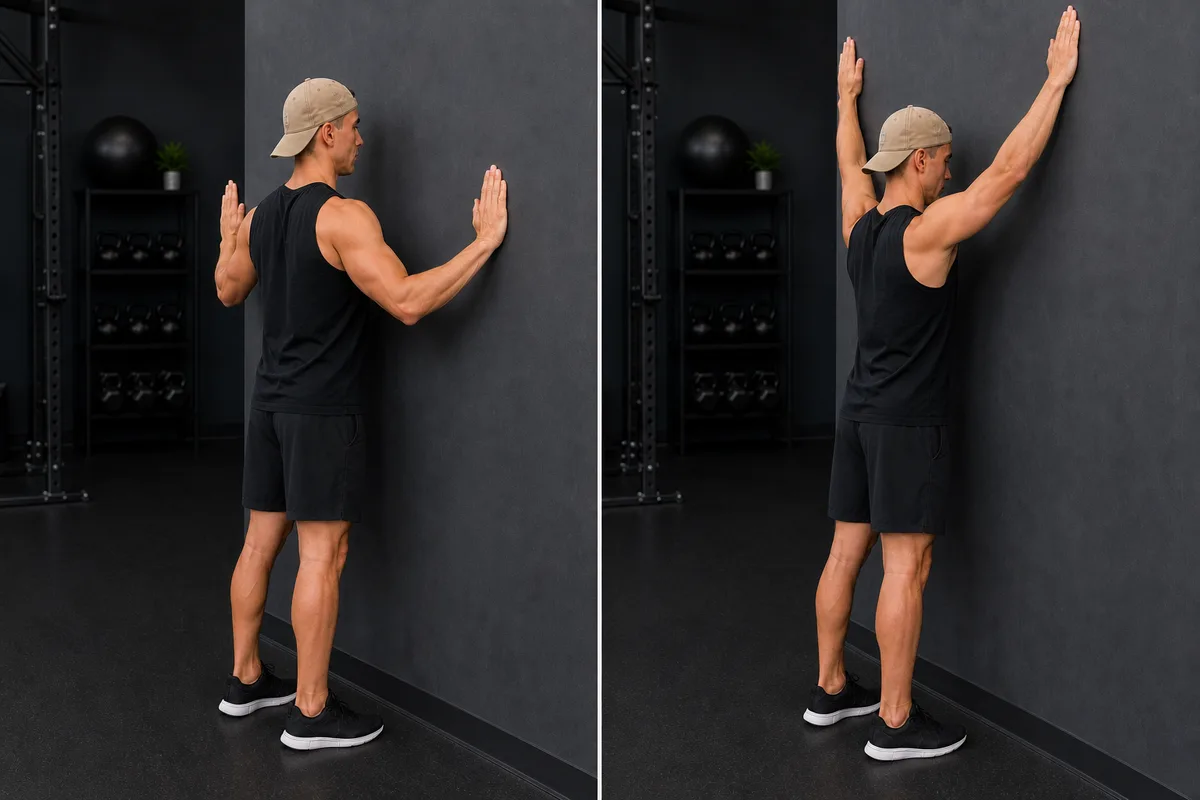
Wall slides train your shoulder blade to rotate and glide the way it should when you raise your arm overhead. Standing with your back and arms against a wall, you slide your arms up and down while keeping contact with the wall the whole time. It's a simple drill with a big payoff for anyone who struggles to raise their arm smoothly overhead.
Exercise Name
Wall Slides
Primary Purpose
- Improve scapular upward rotation — the smooth tilting and rotating motion your shoulder blade makes as you raise your arm
- Build coordination between your shoulder blade muscles and your rotator cuff during overhead movement
- Reduce compensations like shrugging or arching your lower back when reaching overhead
For every 2 degrees your arm moves overhead, your shoulder blade rotates about 1 degree to help make room for the motion. If that shoulder blade rotation is sluggish or poorly controlled, the space under the bony roof of your shoulder (where the rotator cuff tendons pass) can get crowded, which contributes to pinching and pain.
Target Muscles
- Trapezius — especially the lower and middle fibers, which help rotate and stabilize the shoulder blade
- Rotator Cuff Overview — works to keep the upper arm bone centred as the arm rises
- Deltoid — assists in lifting the arm during the sliding motion
Wall slides are less about building big strength and more about retraining a movement pattern — teaching your shoulder blade and rotator cuff to work together smoothly instead of your neck and upper trapezius doing all the work.
Difficulty Level
Beginner
Equipment Required
- A clear wall
- Optional: a thin towel or foam roller under your forearms if your skin sticks to the wall
Who Should Perform This
- People with shoulder impingement syndrome who have pain or crowding when reaching overhead
- Anyone recovering from adhesive capsulitis (frozen shoulder) working on regaining overhead motion
- Overhead athletes wanting better shoulder blade control for throwing, swimming, or lifting
- Desk workers with stiff, poorly moving shoulder blades from long periods of sitting
Who Should Avoid This
- Anyone with an unhealed fracture around the shoulder or collarbone
- People in the very early, acute stage after a shoulder dislocation, before clearance for active shoulder motion
- Anyone whose pain increases sharply or significantly with overhead reaching — reduce the range or pause and check with a health professional
- People immediately post-surgery who have not yet been cleared for active range-of-motion work
Step-by-Step Instructions
- Stand with your back, head, and hips against a wall, feet a small step forward for comfort.
- Place your forearms and the backs of your hands against the wall, elbows bent to about 90 degrees at shoulder height.
- Flatten your lower back gently against the wall by drawing your belly button in slightly.
- Slowly slide your arms up the wall, keeping your forearms and hands in contact with it the entire time.
- Go only as high as you can while keeping contact with the wall and without shrugging your shoulders up to your ears.
- Pause briefly at the top, then slowly slide your arms back down to the starting position with control.
- Repeat for 8–12 repetitions, 2–3 sets, most days of the week.
Common Mistakes
- Shrugging the shoulders up toward the ears — this means the upper trapezius and neck muscles are taking over instead of the shoulder blade rotating properly. Keep the shoulders sliding down and away from the ears.
- Arching the lower back away from the wall — this is a common compensation to fake extra range of motion. Keep the low back gently flattened throughout.
- Losing contact between the forearms and the wall — if your arms lift off the wall, you're forcing more range than your shoulder blade can currently control. Reduce how high you go.
- Moving too fast — quick, jerky movement skips the coordination benefit. Slow and controlled is more effective.
Progressions
- Increase how high you slide your arms as control improves, working toward full overhead contact with the wall
- Add light resistance with a thin resistance band looped around your wrists
- Try the exercise standing away from the wall, or in a half-kneeling position, once wall-supported control is solid
- Progress to more dynamic overhead exercises like prone Y-T raises once wall slides feel easy
Easier Alternatives
- Reduce how high you slide your arms — even a small range done well is valuable
- Perform the exercise seated with your back against a chair with a solid backrest for extra support
- Practice just the "shoulders down and back" starting position first, without sliding, to build body awareness
Related Injuries
- Shoulder Impingement Syndrome — better shoulder blade rotation reduces crowding under the shoulder's bony roof
- Adhesive Capsulitis (Frozen Shoulder) — supports regaining smooth, coordinated overhead motion
- Rotator Cuff Tendinitis — improved mechanics reduce ongoing tendon irritation during overhead movement
Related Anatomy
- Trapezius — key muscle controlling shoulder blade rotation
- Scapula (Shoulder Blade) — the bone being retrained to rotate smoothly
- Rotator Cuff Overview — supports joint centring during the motion
- Deltoid — assists with lifting the arm
References
- Physiopedia. "Rotator Cuff Strengthening Exercises." https://www.physio-pedia.com/Rotator_Cuff_Strengthening_Exercises
- Journal of Orthopaedic & Sports Physical Therapy (JOSPT). "An Update of Systematic Reviews Examining the Effectiveness of Conservative Physical Therapy Interventions for Subacromial Shoulder Pain." https://www.jospt.org/doi/10.2519/jospt.2020.8498
- StatPearls (NCBI Bookshelf). "Shoulder Impingement Syndrome." https://www.ncbi.nlm.nih.gov/books/NBK554518/
- Cleveland Clinic. "Shoulder Impingement Syndrome." https://my.clevelandclinic.org/health/diseases/23782-shoulder-impingement-syndrome
This information is for education only and is not a medical diagnosis. InjuryAtlas does not replace an assessment by a qualified health professional. If you have severe pain, visible deformity, numbness, loss of function, or symptoms that are getting worse, seek medical care promptly.