Overview
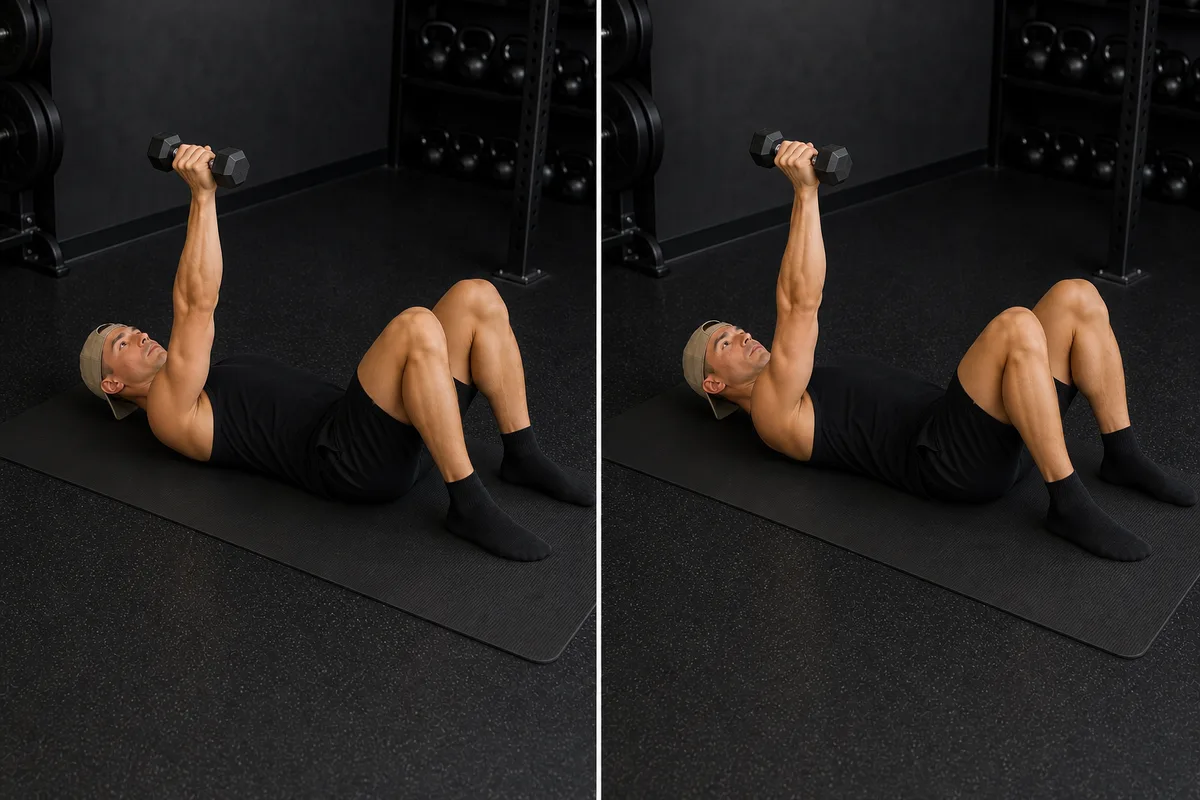
The serratus anterior punch trains a muscle that wraps around your rib cage and anchors the inside edge of your shoulder blade. Lying on your back, you punch a light weight straight up toward the ceiling, focusing on pushing your shoulder blade forward at the very top. It's a simple move that builds an often-overlooked piece of shoulder stability.
Exercise Name
Serratus Anterior Punch
Primary Purpose
- Strengthen the serratus anterior, a muscle that holds your shoulder blade flat against your rib cage and helps rotate it during overhead reaching
- Prevent or correct scapular winging, where the inner edge of the shoulder blade sticks out rather than lying flat
- Improve the coordination between your shoulder blade and your arm during pushing and overhead movements
The serratus anterior is sometimes called the "boxer's muscle" because of the punching motion used to train it. It works closely with your trapezius to rotate your shoulder blade properly as you reach overhead — when it's weak, your shoulder often loses smooth control during pushing or lifting.
Target Muscles
- Serratus anterior (the primary muscle trained, anchoring the shoulder blade to the rib cage)
- Deltoid — assists with the pushing motion of the arm
- Rotator Cuff Overview — helps stabilize the shoulder joint as the arm punches upward
While the serratus anterior doesn't yet have its own dedicated anatomy page in this library, it's a key player in shoulder blade movement, working alongside your trapezius to control the scapula (shoulder blade).
Difficulty Level
Beginner
Equipment Required
- A light dumbbell (1–3 kg / 2–6 lb) or no weight at all when starting out
- A mat or comfortable flat surface to lie on
Who Should Perform This
- People with shoulder impingement syndrome who need better shoulder blade control during overhead motion
- Anyone with visible shoulder blade winging or a shoulder blade that seems to "stick out"
- Overhead athletes and swimmers working on push-off and overhead mechanics
- Desk workers with rounded shoulders and weak shoulder blade stabilizers
Who Should Avoid This
- Anyone with an unhealed fracture around the shoulder blade, collarbone, or ribs
- People with a recent shoulder dislocation who haven't yet been cleared for active pushing movements
- Anyone with sharp pain in the front of the shoulder or ribs during the motion — check with a health professional before continuing
- People less than a few weeks post-shoulder surgery without their surgeon's clearance for resisted pushing
Step-by-Step Instructions
- Lie on your back with your knees bent and feet flat on the floor.
- Hold a light dumbbell (or start with no weight) in one hand, arm extended straight up toward the ceiling above your shoulder.
- Keep your elbow straight throughout the movement.
- Punch your fist straight up toward the ceiling, lifting your shoulder blade off the mat slightly at the very top of the movement — this is the "protraction" part of the exercise.
- Pause briefly at the top, feeling the area under your armpit and along your ribs engage.
- Slowly lower back down with control until your shoulder blade rests on the mat again.
- Repeat for 10–15 repetitions, 2–3 sets, per side, 3–4 times per week.
Common Mistakes
- Bending the elbow during the punch — this shifts effort to the triceps and upper arm instead of the shoulder blade muscles. Keep the elbow straight throughout.
- Using too much weight — this often leads to shrugging or arching the lower back instead of a clean, controlled shoulder blade movement.
- Rushing the top of the movement — the "punch" at the top, where you push your shoulder blade forward, is the whole point of the exercise. Pause and feel it rather than rushing through.
- Arching the lower back off the mat — keep your core gently engaged so the movement stays isolated to the shoulder blade and arm.
Progressions
- Increase the weight gradually as the movement becomes easy
- Perform the exercise in a standing position against a wall, pushing your hands into the wall and protracting your shoulder blades (a "wall push-up plus")
- Progress to a full push-up with a "plus" at the top, where you push your shoulder blades apart at the top of the push-up
- Combine with wall slides for a fuller shoulder blade control routine
Easier Alternatives
- Perform the exercise with no weight at all, focusing purely on the shoulder blade movement
- Reduce the range of motion, focusing on small, controlled protraction at the top rather than a large punching motion
- Try the movement seated with your back supported if lying down is uncomfortable
Related Injuries
- Shoulder Impingement Syndrome — better shoulder blade control reduces crowding during overhead motion
- Rotator Cuff Tendinitis — improved scapular mechanics reduce ongoing strain on rotator cuff tendons
Related Anatomy
- Scapula (Shoulder Blade) — the bone being stabilized and moved by this exercise
- Trapezius — works alongside the serratus anterior to control the shoulder blade
- Deltoid — assists with the punching motion
- Rotator Cuff Overview — supports joint stability during the punch
References
- Kenhub. "Serratus anterior muscle." https://www.kenhub.com/en/library/anatomy/serratus-anterior-muscle
- Physiopedia. "Rotator Cuff Strengthening Exercises." https://www.physio-pedia.com/Rotator_Cuff_Strengthening_Exercises
- Journal of Orthopaedic & Sports Physical Therapy (JOSPT). "An Update of Systematic Reviews Examining the Effectiveness of Conservative Physical Therapy Interventions for Subacromial Shoulder Pain." https://www.jospt.org/doi/10.2519/jospt.2020.8498
This information is for education only and is not a medical diagnosis. InjuryAtlas does not replace an assessment by a qualified health professional. If you have severe pain, visible deformity, numbness, loss of function, or symptoms that are getting worse, seek medical care promptly.