Exercises · IA-BAC-EXE-001

Bird Dog

Learn how to do the bird dog exercise for trunk control and back conditioning, including form cues, easier versions and progressions.

Browse Lower Back
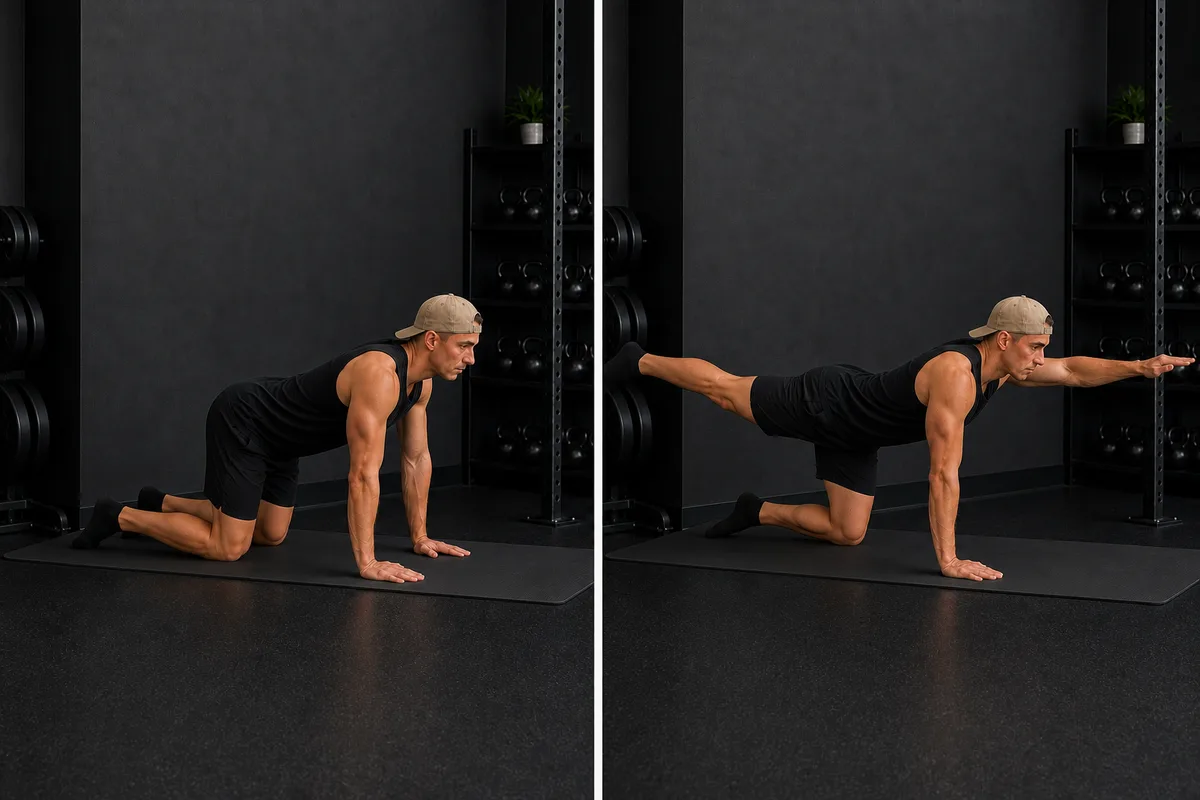
Start and finish demonstration of Bird Dog
Start and finishUse the written steps below for the full technique and safety guidance.

At a glance

Exercise profile

Target muscles
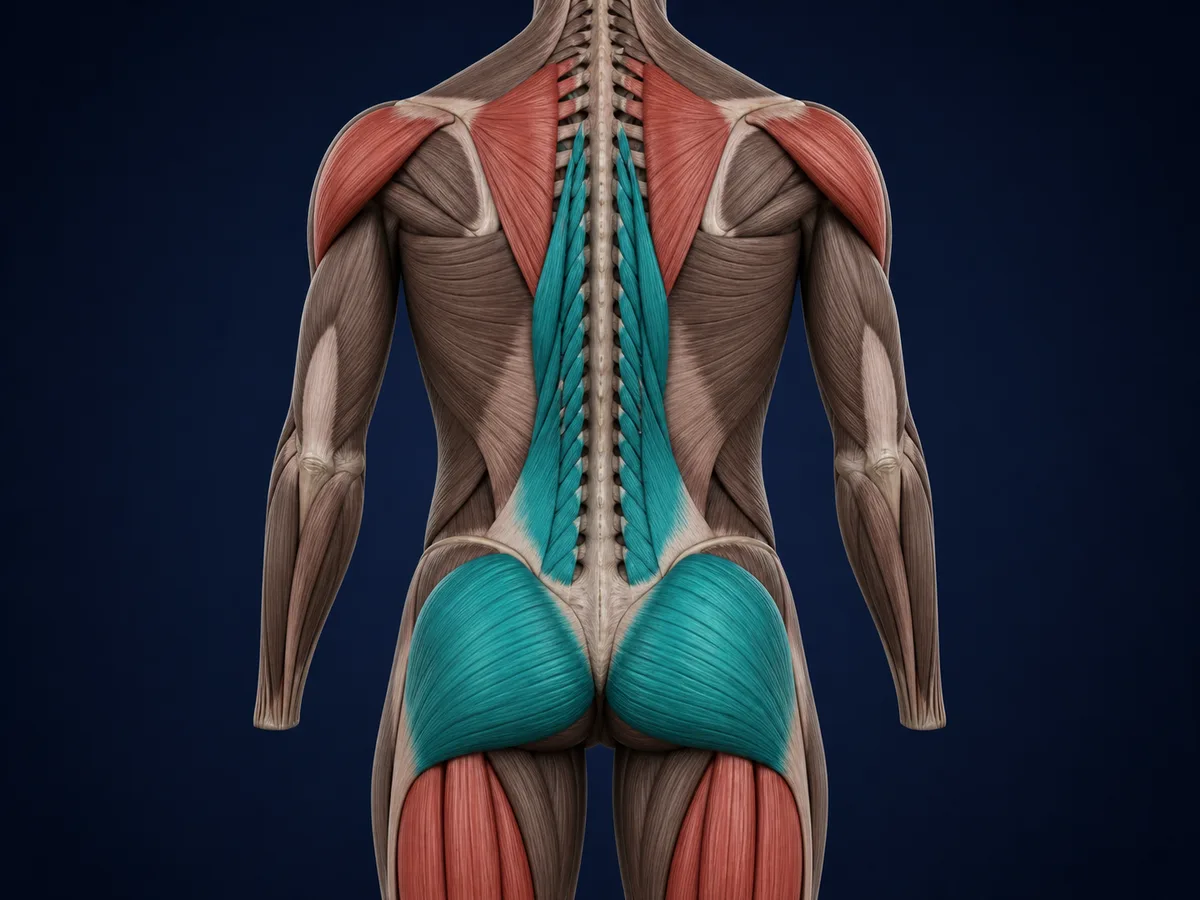
Lumbar multifidus, Erector spinae, Gluteus maximus
Exercise type
Stability and strength
Equipment
Exercise mat
Mechanics
Compound
Movement pattern
Contralateral reach
Experience level
beginner
Secondary muscles
Posterior deltoid, Middle and lower trapezius, Hamstrings

Cross-body trunk control

What this exercise works

The spinal extensors and gluteals hold the trunk and pelvis steady while the opposite arm and leg reach away from the body.

Anatomy highlighting the structures involved in Bird Dog
Teal — primary muscles doing most of the workRed — secondary muscles assistingGrey — stabilizers and surrounding anatomy

Primary emphasis

  • Lumbar multifidus
  • Erector spinae
  • Gluteus maximus

Secondary muscles

  • Posterior deltoid
  • Middle and lower trapezius
  • Hamstrings

Stabilizers

  • Abdominal wall
  • Obliques
  • Gluteus medius
  • Serratus anterior

Movement and joint actions

  • Hip extension
  • Shoulder flexion
  • Anti-rotation trunk control

Muscle contribution changes with position, range, resistance and individual technique.

Why it can help

Potential benefits and carryover

Benefits depend on technique, dosage, consistency and whether the exercise suits the person. Sport carryover means supporting the physical demands of the activity—not guaranteeing performance or preventing injury.

Everyday benefits

  • Builds trunk endurance while the limbs move
  • Trains cross-body coordination used during walking and running
  • Improves control against unwanted spinal rotation
  • Strengthens the glutes with relatively low external load
  • Develops shoulder-blade and weight-bearing arm stability
  • Provides a scalable foundation for lifting and athletic progressions

Training carryover

  • Supports trunk control during squats, hinges and loaded carries
  • Builds a base for planks, crawling and contralateral lifting drills
  • Develops shoulder stability for later weight-bearing upper-body exercises

Sport carryover

  • Supports cross-body coordination used in running and field sports
  • Develops anti-rotation control relevant to throwing and racquet sports
  • Builds trunk endurance for cycling, paddling and prolonged athletic positions

Technique

Bird Dog tips

Use these cues to keep the movement controlled and focused on its intended purpose.

  1. Start with the hands under the shoulders and knees under the hips.
  2. Reach long rather than lifting the arm and leg as high as possible.
  3. Keep the belt line level and resist rotating toward the supporting side.
  4. Shorten the reach or move one limb at a time if the back starts arching.

Overview

The bird dog trains trunk control and hip strength from a stable four-point position. It asks the back to stay steady while one arm and the opposite leg extend — a useful foundation for everyday bending, lifting and walking.

It is a beginner-friendly exercise that can be adapted to almost any level of back sensitivity.

How to Do It

  1. Start on hands and knees with your hands under your shoulders and knees under your hips.
  2. Keep your back in a comfortable, neutral position — not sagging or arched.
  3. Slowly extend one arm forward and the opposite leg back, keeping the hips level.
  4. Pause briefly, then return to the starting position.
  5. Repeat on the other side.

Aim for short, controlled holds rather than big movements. The goal is control, not how high you can reach.

What You Should Feel

  • Effort in the trunk, back and glutes
  • A steady, stable back throughout the movement
  • No sharp pain in the back or down the leg

Make It Easier

  • Keep the foot on the floor and lift only the arm
  • Lift only the leg, keeping both hands down
  • Reduce the reach and pause sooner
  • Do the exercise with the chest supported on a table or bench

Progression

  • Hold the extended position longer
  • Add slow, controlled movement speed
  • Progress to plank variations when the back tolerates it

References

  1. NICE. "Low back pain and sciatica in over 16s: assessment and management." NG59. 2016 (updated 2020). https://www.nice.org.uk/guidance/ng59

This information is for education only and is not a medical diagnosis. InjuryAtlas does not replace an assessment by a qualified health professional. If you have severe pain, visible deformity, numbness, loss of function, or symptoms that are getting worse, seek medical care promptly.
Educational information only

This information does not diagnose an injury or replace care from a qualified healthcare professional.