Anatomy at a Glance
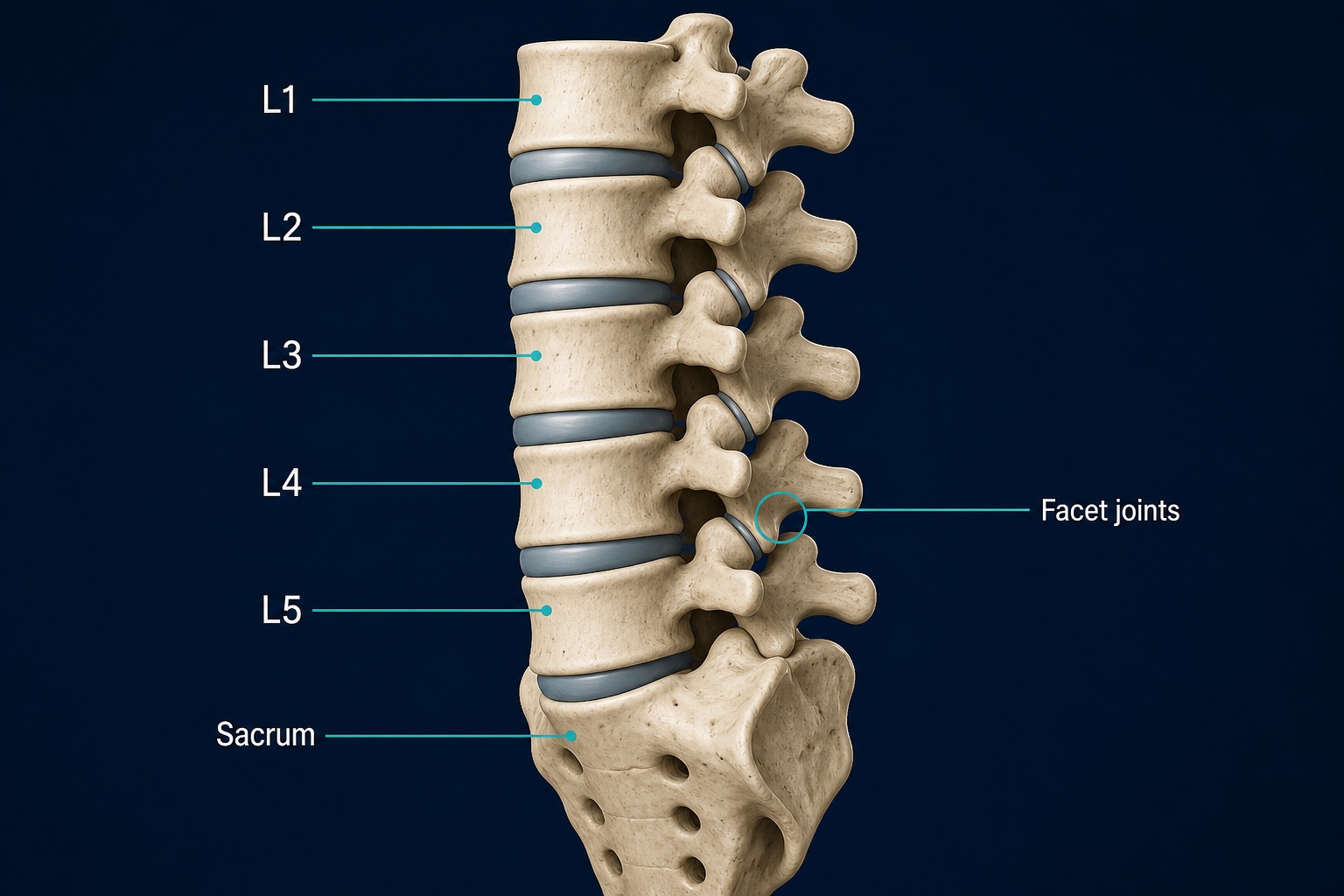
The five lumbar vertebrae increase in size toward the pelvis. Discs sit between the vertebral bodies, while paired facet joints guide movement at the back.
Overview
The lumbar spine is the lower part of the backbone — usually five strong vertebrae (L1 to L5) that carry the weight of the upper body and allow bending, lifting and twisting.
Between the vertebrae sit the intervertebral discs, which cushion and spread load. At the back, small facet joints guide movement, and the spinal canal protects the nerve roots that travel down into the legs. Muscles and ligaments wrap around all of it and do most of the work of stabilizing the spine during daily activity.
Location and Connections
- Sits between the ribcage (T12) and the sacrum (S1)
- Usually five lumbar vertebrae, labelled L1 to L5
- Each motion segment has a disc, two facet joints, ligaments and muscles
- Nerve roots exit at each level and form the nerves of the legs, including the sciatic nerve
What It Does
The lumbar spine transmits load from the upper body to the pelvis, allows controlled bending and rotation, and protects the spinal cord and nerve roots. Its design favours stability over extreme flexibility — which is why stiffening up after injury is common, and why movement is usually part of recovery.
Common Problems
- Non-specific lower back pain, often from muscles, ligaments and joints
- Disc-related irritation or herniation, sometimes with leg pain
- Facet joint irritation
- Spinal stenosis, more common with age
- Muscle strain after lifting or awkward movement
Most lower back pain involves the soft tissues and joints rather than dangerous structural damage. Pain location alone does not identify the exact source.
Clinical Relevance
Assessment matters when pain is severe, follows major trauma, comes with leg numbness or weakness, or includes changes in bladder or bowel function. Sudden saddle numbness, difficulty urinating or weakness in both legs needs urgent care.
Related Anatomy
Related Injuries
- Lumbar disc herniation and sciatica
- Lumbar facet joint pain
- Spondylolysis and spondylolisthesis
- Vertebral compression fracture
References
- StatPearls. "Anatomy, Back, Lumbar Spine." https://www.ncbi.nlm.nih.gov/sites/books/NBK557616/
- StatPearls. "Anatomy, Back, Lumbar Vertebrae." https://www.ncbi.nlm.nih.gov/sites/books/NBK459278/