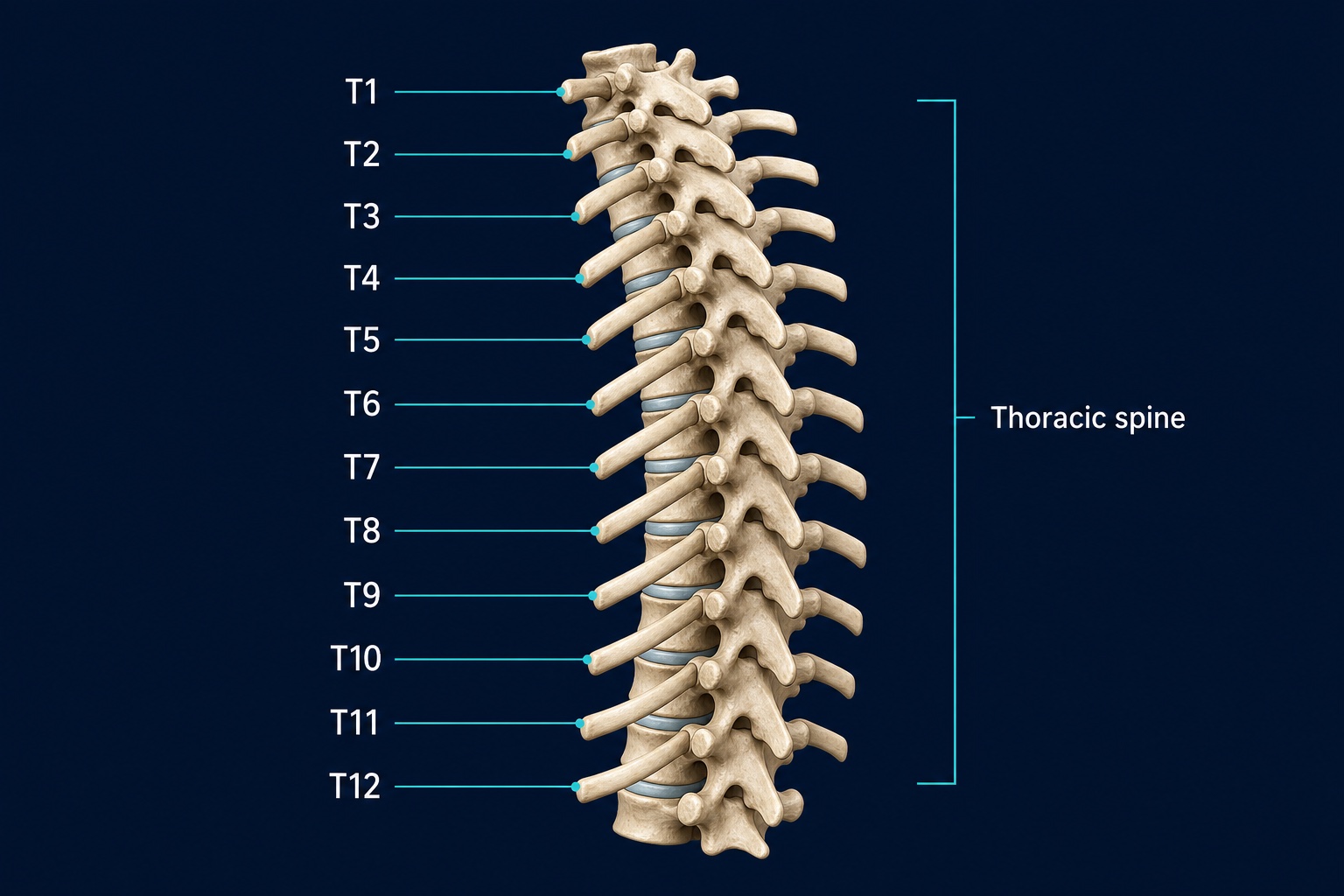
Anatomy at a Glance
The thoracic spine contains 12 vertebrae. Each level connects with ribs, making this region more stable and less mobile than the neck or lower back.
Overview
The thoracic spine is the mid-back portion of the vertebral column. Its 12 vertebrae are labelled T1 to T12, beginning below the neck and ending where the lumbar spine starts.
Each thoracic vertebra connects with ribs. These joints and the surrounding rib cage protect the heart and lungs, support breathing mechanics and limit excessive spinal motion.
Location and Connections
- T1 sits below the seventh cervical vertebra at the base of the neck
- T12 meets L1 at the thoracolumbar junction
- Intervertebral discs sit between adjacent vertebral bodies
- Facet joints guide motion at the back of each segment
- Ribs attach to the vertebral bodies and transverse processes
The lower thoracic levels—especially T11 and T12—have shorter, floating ribs and transition toward the more mobile lumbar spine.
What It Does
The thoracic spine supports the chest, protects the spinal cord and provides controlled rotation, bending and extension. Its normal outward curve is called thoracic kyphosis. A kyphotic curve is normal; it becomes clinically relevant when it is excessive, painful, progressive or associated with fracture.
Common Problems
- Muscle and joint-related mid-back pain
- Vertebral compression fractures, especially with osteoporosis or significant trauma
- Postural stiffness and reduced thoracic mobility
- Less commonly, thoracic disc herniation or nerve/spinal-cord compression
Age-related disc and joint changes are common and do not automatically explain pain. Symptoms, examination findings and functional changes matter more than an imaging phrase alone.
When It Matters Clinically
Prompt assessment is appropriate after substantial trauma, with severe unrelenting pain, or when pain comes with weakness, numbness, difficulty walking, fever, unexplained weight loss or bladder/bowel changes.
Related Reading
References
- StatPearls. "Anatomy, Back, Thoracic Vertebrae." https://www.ncbi.nlm.nih.gov/books/NBK459153/
- American College of Radiology. "Management of Vertebral Compression Fractures." https://acsearch.acr.org/docs/70545/Narrative/