Anatomy at a Glance
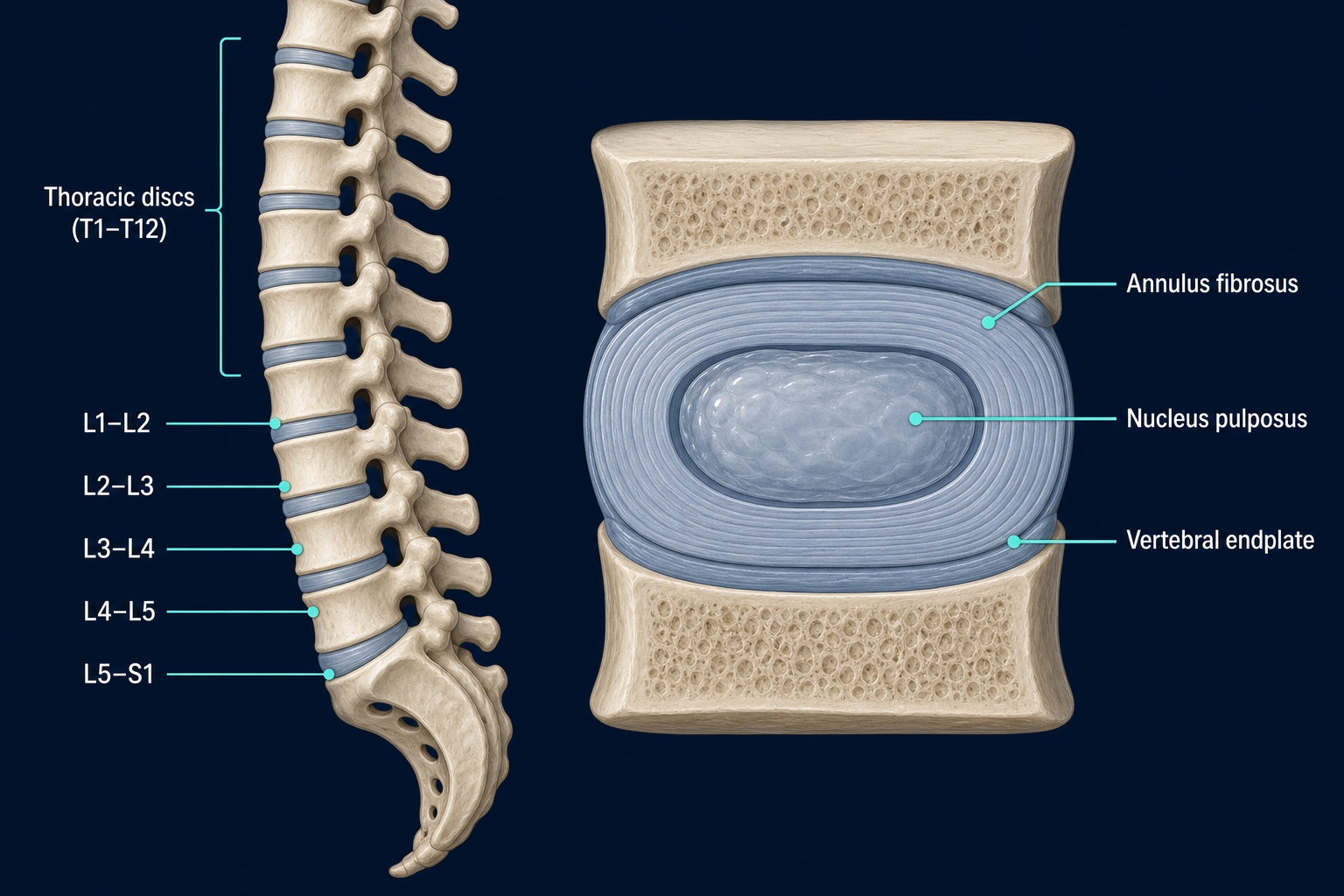
Discs sit between adjacent vertebral bodies. Their layered annulus surrounds the softer nucleus, while vertebral endplates connect each disc to the bone above and below.
Overview
The intervertebral discs are the soft cushions between the vertebrae. Each disc has a firm outer ring (annulus fibrosus) and a gel-like centre (nucleus pulposus), which together absorb load and allow the spine to move.
Thoracic discs sit between the mid-back vertebrae and are stabilized by the rib cage. Lumbar discs sit between the larger lower-back vertebrae and carry a substantial share of the body's load. Discs change naturally with age, and those changes are common on scans even in people without pain.
Location and Attachments
- One disc between most pairs of vertebrae, from the neck to the sacrum
- Twelve thoracic disc levels from T1–T2 through T12–L1
- Five lumbar disc levels from L1–L2 through L5–S1
- Attached above and below to the vertebral endplates
What It Does
Discs spread and absorb compressive load, keep the vertebrae separated, and allow controlled bending and rotation. Because they sit between the bones, they are load-bearing structures — which is why repeated heavy lifting and prolonged postures matter more than "wear and tear" alone.
Common Problems
- Disc bulges and herniations, sometimes pressing on a nerve root and causing leg pain
- Age-related disc changes that are often painless
- Disc-related pain that settles with time and movement for most people
- Age-related disc degeneration that may be present with or without symptoms
Scan changes do not equal pain: many people with disc bulges or herniations on imaging have no symptoms at all. A scan finding alone does not identify the cause of back or leg pain.
Clinical Relevance
Leg pain that follows a nerve pattern (sciatica), weakness or numbness deserves assessment. Sudden bladder or bowel changes, saddle numbness or weakness in both legs needs urgent care.
Related Anatomy
Related Injuries
References
- StatPearls. "Anatomy, Back, Intervertebral Discs." https://pubmed.ncbi.nlm.nih.gov/29262063/
- NICE. "Low back pain and sciatica in over 16s: assessment and management." NG59. 2016 (updated 2020). https://www.nice.org.uk/guidance/ng59