Exercises · IA-CHE-EXE-006

Resistance-Band Chest Press

Learn the resistance-band chest press for scalable chest, shoulder and triceps strengthening.

Browse Chest & Pecs
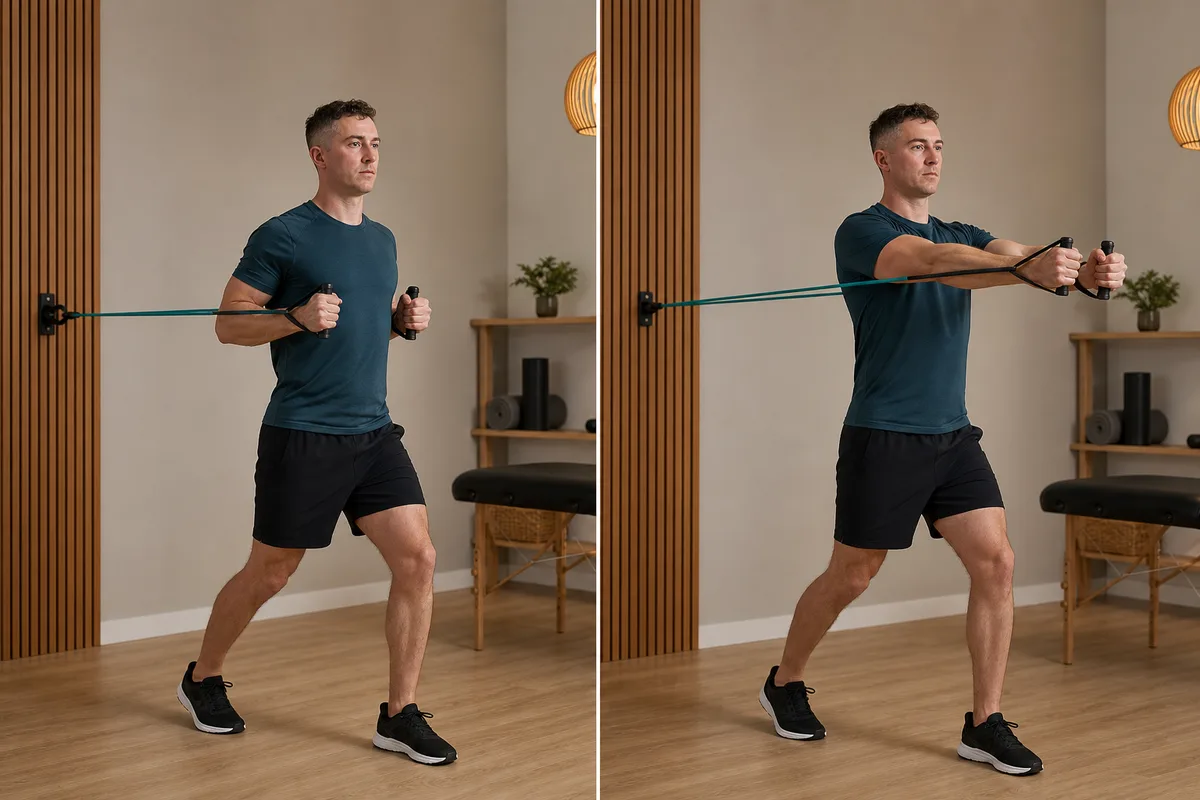
Start and finish demonstration of Resistance-Band Chest Press
Start and finishUse the written steps below for the full technique and safety guidance.

At a glance

Exercise profile

Target muscles
Pectoralis major
Exercise type
Strength
Equipment
Resistance band, Stable anchor
Mechanics
Compound
Movement pattern
Push (bilateral)
Experience level
beginner
Secondary muscles
Anterior deltoid, Triceps brachii

Upper-body pushing strength

What this exercise works

The chest creates the main forward press while the triceps straighten the elbows and the shoulder muscles guide the arm.

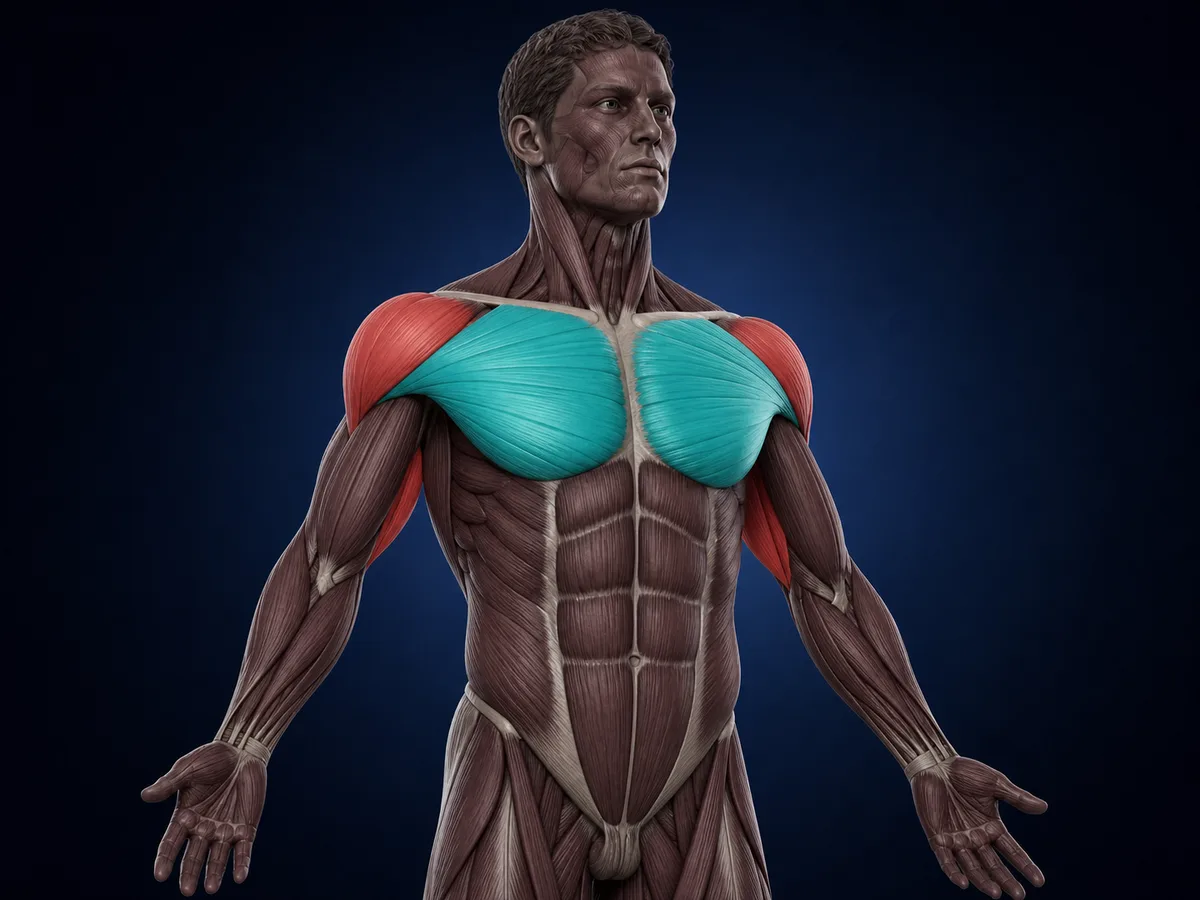
Anatomy highlighting the structures involved in Resistance-Band Chest Press
Teal — primary muscles doing most of the workRed — secondary muscles assistingGrey — stabilizers and surrounding anatomy

Primary emphasis

  • Pectoralis major

Secondary muscles

  • Anterior deltoid
  • Triceps brachii

Stabilizers

  • Serratus anterior
  • Rotator cuff
  • Abdominal wall

Movement and joint actions

  • Shoulder horizontal adduction
  • Elbow extension
  • Scapular protraction

Muscle contribution changes with position, range, resistance and individual technique.

Why it can help

Potential benefits and carryover

Benefits depend on technique, dosage, consistency and whether the exercise suits the person. Sport carryover means supporting the physical demands of the activity—not guaranteeing performance or preventing injury.

Everyday benefits

  • Builds scalable chest and pushing strength
  • Trains the chest, shoulders and triceps together
  • Allows resistance to be adjusted without changing body position
  • Can bridge the gap between isometric pressing and push-up variations

Training carryover

  • Supports progression toward dumbbell and barbell pressing
  • Builds capacity for push-ups and incline push-ups
  • Trains standing trunk control during an upper-body press

Sport carryover

  • Supports pushing demands in football, wrestling and contact sports
  • Develops pressing strength relevant to racquet and throwing-sport conditioning

Technique

Resistance-Band Chest Press tips

Use these cues to keep the movement controlled and focused on its intended purpose.

  1. Anchor the band securely at chest height before beginning.
  2. Keep the ribs stacked over the pelvis instead of leaning or arching backward.
  3. Press smoothly without letting the shoulders shrug toward the ears.
  4. Return slowly until the elbows reach a comfortable position beside the body.

Overview

The resistance-band chest press provides a scalable pushing exercise without requiring the body-weight demand of a push-up.

How to Do It

  1. Secure a resistance band behind you at mid-chest height and check the anchor.
  2. Stand in a staggered stance with one handle in each hand and elbows softly bent.
  3. Brace the trunk and press both hands forward until the arms are almost straight.
  4. Pause, then return slowly without letting the band snap back.
  5. Begin with 2 sets of 8–12 controlled repetitions.

What You Should Feel

Expect effort through the chest, front shoulders and triceps. Stop for sharp chest pain, sudden weakness or increasing shoulder pain.

Common Mistakes

  • Using an insecure anchor or damaged band
  • Flaring the elbows straight sideways
  • Arching the lower back
  • Letting the band pull the arms back quickly

Progression

Add controlled repetitions before increasing band tension. A split stance or single-arm version can add stability demand later.

References

  • Frimley Health NHS Foundation Trust. "Starting to Exercise After a Cancer Diagnosis." Chest press. https://www.fhft.nhs.uk/patients-and-visitors/patient-information-library/starting-exercise-after-cancer-diagnosis
  • Royal Berkshire NHS Foundation Trust. "Strength and Conditioning Exercise Class." Resistance-band chest press. https://www.royalberkshire.nhs.uk/media/jrncq23/strength-and-conditioning-exercise-class_jul25.pdf
This is general education. Inspect resistance bands before use and follow clinician restrictions after chest or shoulder surgery.
Educational information only

This information does not diagnose an injury or replace care from a qualified healthcare professional.