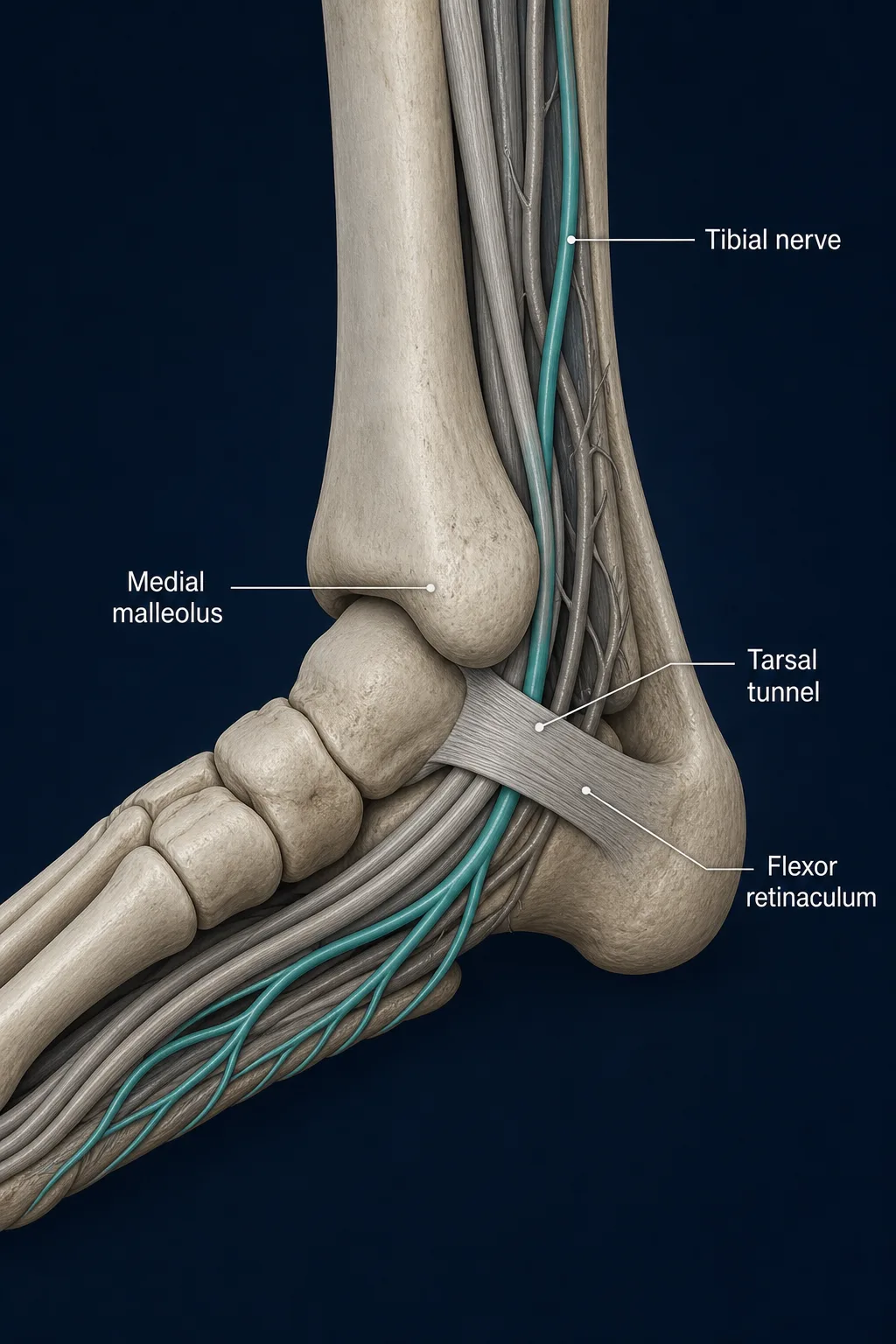
The tibial nerve is the larger branch of the sciatic nerve below the knee. It runs down the back of the calf, passes behind the inner ankle bone through a narrow passage called the tarsal tunnel, then fans out into the sole of the foot.
Location
- Continues from the sciatic nerve at the back of the knee, running deep within the calf alongside the posterior tibial artery
- Passes behind the medial malleolus (inner ankle bone) inside the tarsal tunnel, alongside the flexor tendons of the toes
- The tarsal tunnel's roof is the flexor retinaculum, a fibrous band that keeps its contents in place but can also compress the nerve
- Divides into the medial and lateral plantar nerves as it enters the sole of the foot
Function
- Carries sensation from the sole of the foot and heel
- Supplies the small muscles in the sole of the foot that help control toe movement and the foot's arch
- Contributes motor input to the calf muscles higher up its course
Common Problems
- Tarsal tunnel syndrome — compression of the nerve as it passes behind the inner ankle, causing burning, tingling or numbness in the sole of the foot
- Direct trauma or swelling around the ankle narrowing the tunnel
- A space-occupying lesion (cyst, varicosity) within the tunnel in less common cases
Symptoms That May Need Assessment
- Burning, tingling or numbness in the sole of the foot, especially with standing or walking
- Symptoms that worsen through the day or with prolonged weight-bearing
- Weakness of the small foot muscles or a change in foot shape over time
- Symptoms following an ankle fracture, sprain or other trauma near the inner ankle
Sudden, severe or progressive symptoms — or any foot that becomes cold, pale or profoundly numb — warrant prompt assessment.
Related Anatomy
- Ankle joint overview — the joint the tibial nerve passes behind
- Tarsal tunnel syndrome — the main condition affecting this nerve
References
- StatPearls. "Anatomy, Bony Pelvis and Lower Limb, Tibial Nerve." https://www.ncbi.nlm.nih.gov/books/NBK532906/
- StatPearls. "Tarsal Tunnel Syndrome." https://www.ncbi.nlm.nih.gov/books/NBK513274/