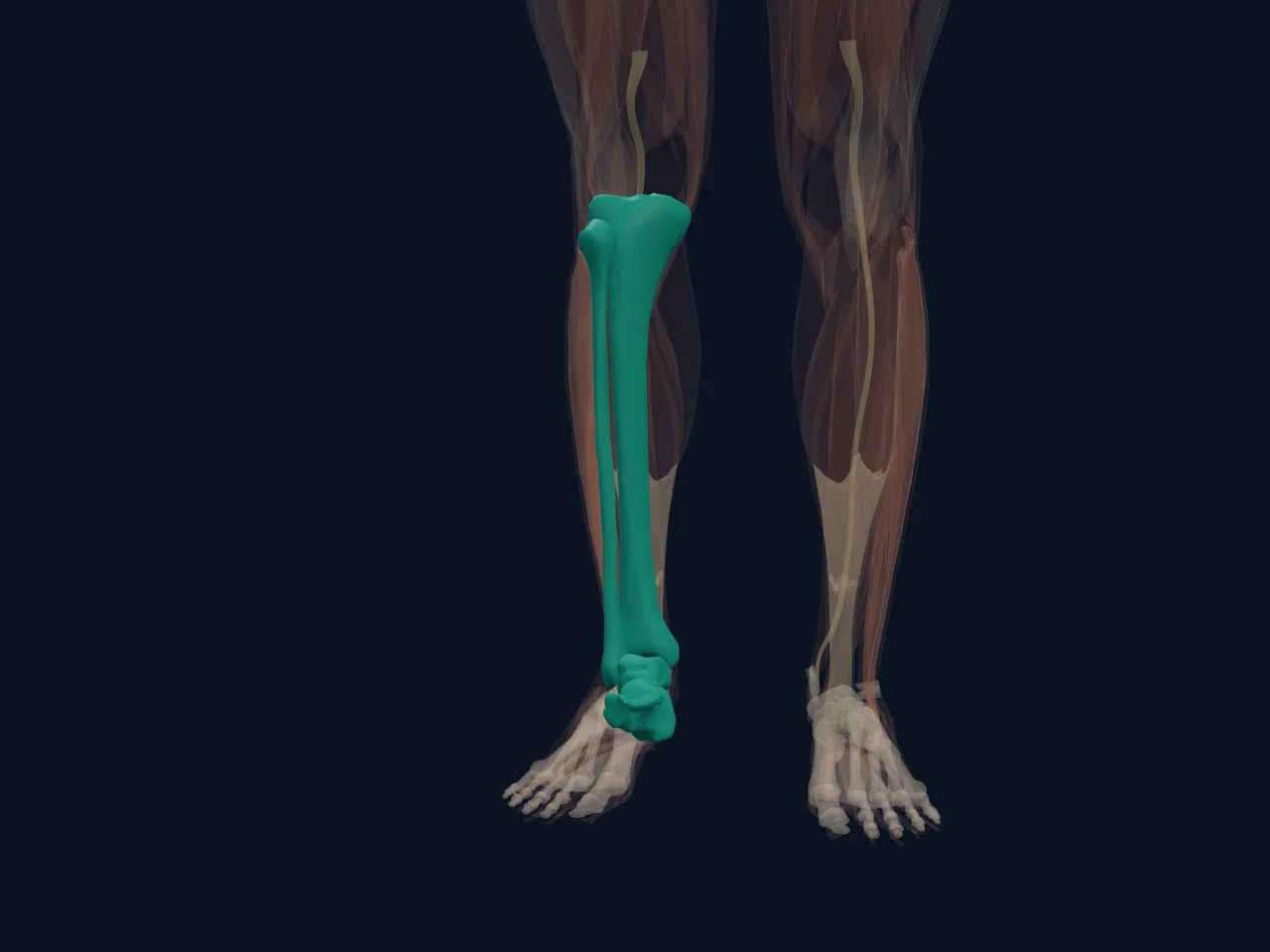
Overview
The ankle joint is the hinge between the shin and foot. The lower end of the tibia forms the inside and roof, the fibula forms the outside, and the talus sits between them. Together the tibia and fibula create a snug socket called the ankle mortise.
This joint mainly moves the foot up (dorsiflexion) and down (plantarflexion). Side-to-side motion mostly comes from the joints below it, but the ankle ligaments and surrounding muscles control that movement.
Main Parts
- Tibia: the larger shin bone; its inner ankle bump is the medial malleolus.
- Fibula: the slimmer outside shin bone; its lower end is the lateral malleolus.
- Talus: the bone between them that transfers body weight into the foot.
- Cartilage: smooth lining over the joint surfaces that allows low-friction motion.
- Syndesmosis: the strong connection between tibia and fibula just above the joint.
Why It Matters
The ankle has to be stable enough for landing, yet mobile enough for walking, squatting and running. A limited ability to bring the knee forward over the foot can change how the knee, hip and foot share load. A rolled ankle commonly stresses the ligaments on the outside; a twist with pain higher above the joint can involve the syndesmosis instead.
What Can Feel Similar?
Pain around the ankle is not automatically a sprain. Tendons, bone, cartilage, the Achilles and the joints beneath the ankle can all produce similar symptoms. Marked bony tenderness, inability to take four steps, obvious deformity, a cold or numb foot, or worsening swelling after trauma needs prompt assessment.
Related Anatomy
References
- American College of Radiology. ACR Appropriateness Criteria: Acute Trauma to the Ankle. https://acsearch.acr.org/docs/69436/Narrative/
This information is for education only and is not a medical diagnosis.