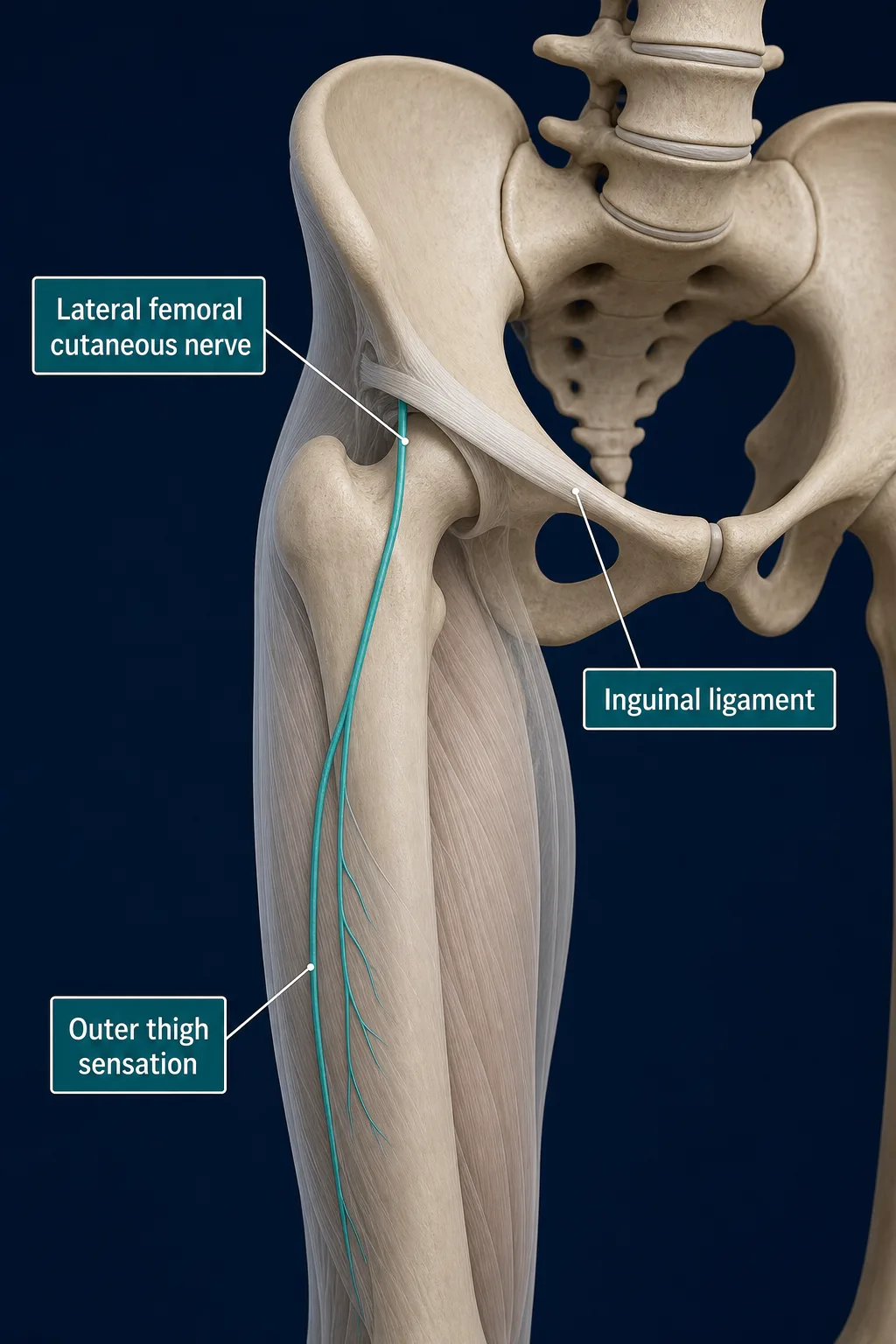
The lateral femoral cutaneous nerve is a purely sensory nerve that supplies skin on the outer thigh. It has no motor role, so irritation here changes sensation only — it never causes leg weakness.
Location
- Branches directly from the lumbar plexus (mainly the L2 and L3 nerve roots), well above the hip
- Crosses the inside of the pelvis and passes near the front of the hip bone, close to the anterior superior iliac spine (the bony point at the front of the pelvis)
- Passes under or through the inguinal ligament, the band running from that bony point toward the groin — the tightest and most common spot for compression
- Fans out into the skin over the outer and front-outer thigh
Function
- Carries sensation from the skin of the outer thigh, down to around the knee
- Has no motor fibers — it does not control any muscle
Common Problems
- Meralgia paresthetica — compression of the nerve as it passes under the inguinal ligament, causing burning, tingling or numbness over the outer thigh
- Tight belts, waistbands, seatbelts or duty belts compressing the area
- Pregnancy, weight gain or obesity increasing pressure near the inguinal ligament
- Prolonged standing or hip extension stretching the nerve against the ligament
Symptoms That May Need Assessment
- Burning, tingling or numbness limited to the outer thigh
- Symptoms that build with standing or walking and ease when sitting
- No associated leg weakness (since the nerve is sensory only) — new weakness suggests a different cause and deserves assessment
- Symptoms following pelvic or hip surgery, or during pregnancy
Related Anatomy
- Hip joint overview — the joint this nerve runs near but does not supply
- Meralgia paresthetica — the main condition affecting this nerve
References
- StatPearls. "Anatomy, Abdomen and Pelvis, Lateral Femoral Cutaneous Nerve." https://www.ncbi.nlm.nih.gov/books/NBK535409/
- StatPearls. "Meralgia Paresthetica." https://www.ncbi.nlm.nih.gov/books/NBK448157/
This information is for education only and is not a medical diagnosis.