Overview
A proximal hamstring avulsion occurs when one or more hamstring tendons partially or completely pull away from the sitting bone. It is more serious than the common muscle-belly strain and can be missed when the initial injury is labelled simply as a “pulled hamstring.”
Where the Injury Happens
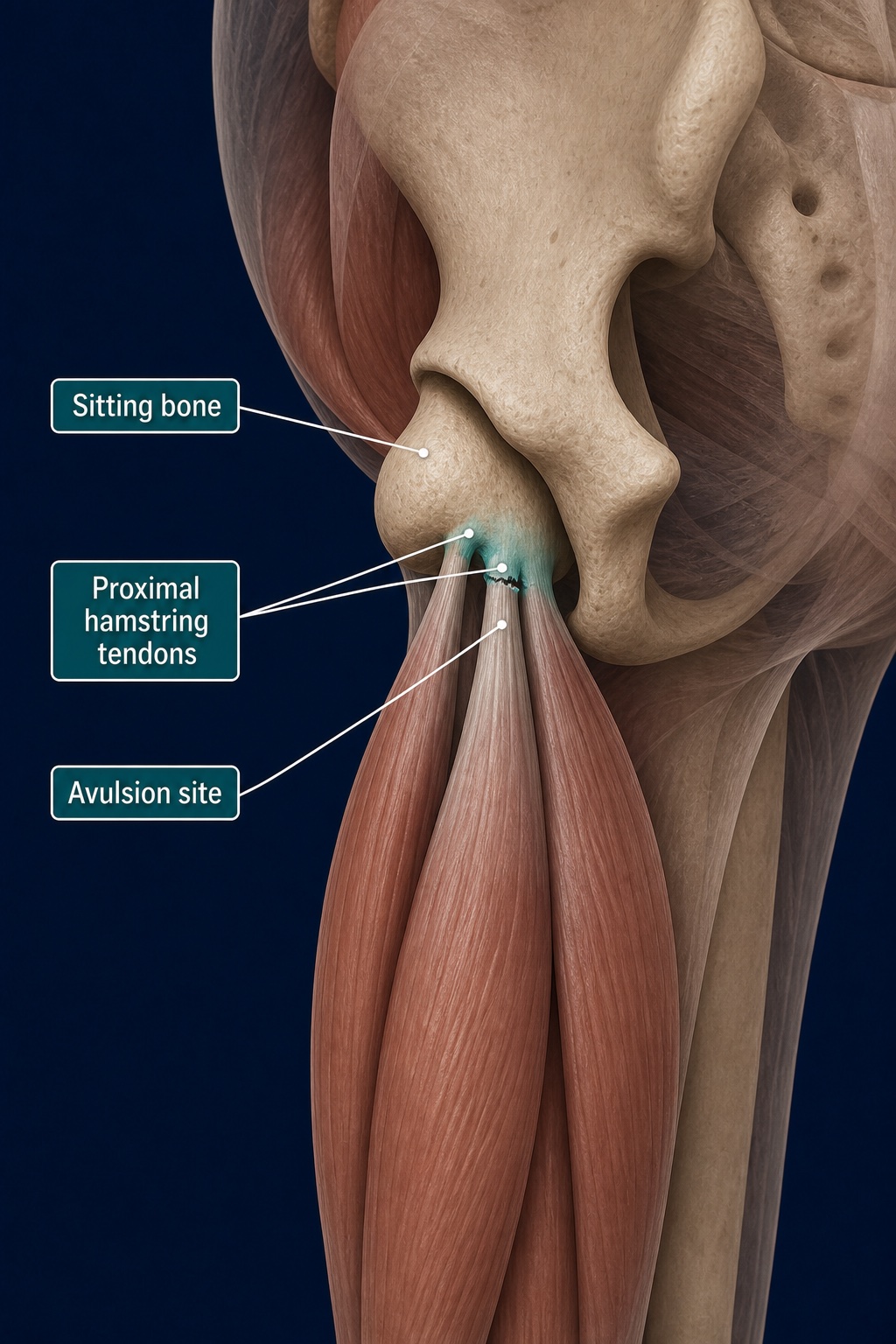
The tear occurs at the top of the hamstrings where the tendons attach to the ischial tuberosity—the “sitting bone” beneath the buttock.
Typical Injury Pattern
- A sudden forced bend at the hip while the knee is straight, such as a slip
- A pop or tearing sensation beneath the buttock
- Rapid bruising down the back of the thigh
- Weakness when bending the knee or extending the hip
- Pain sitting directly on the injured side
Why Early Assessment Matters
The number of tendons involved, how far they have retracted, functional loss and the person's goals all affect treatment. MRI is commonly used when a significant avulsion is suspected. Complete multi-tendon injuries may need an early surgical opinion; smaller partial injuries can often begin with structured non-operative rehabilitation.
Recovery Approach
Early management protects the healing tissue and restores comfortable walking. Loading then progresses from controlled isometrics to hip-extension and knee-flexion strength before faster running and long-length hamstring work return. Aggressive stretching in the early stage can place unnecessary tension on the injured origin.
Seek Prompt Assessment
- A pop followed by extensive bruising
- A visible change in the back of the thigh
- Marked weakness or difficulty walking
- Numbness, burning or electric symptoms down the leg
- Severe pain directly at the sitting bone after trauma
Connected Guides
References
- Degen RM. "Proximal Hamstring Injuries: Management of Tendinopathy and Avulsion Injuries." Current Reviews in Musculoskeletal Medicine. 2019. https://pubmed.ncbi.nlm.nih.gov/30806898/
- Hillier-Smith R, Paton B. "Outcomes following surgical management of proximal hamstring tendon avulsions: a systematic review and meta-analysis." Bone & Joint Open. 2022. https://pubmed.ncbi.nlm.nih.gov/35549447/
This information is for education only and is not a medical diagnosis. A suspected complete avulsion needs timely assessment.