Overview
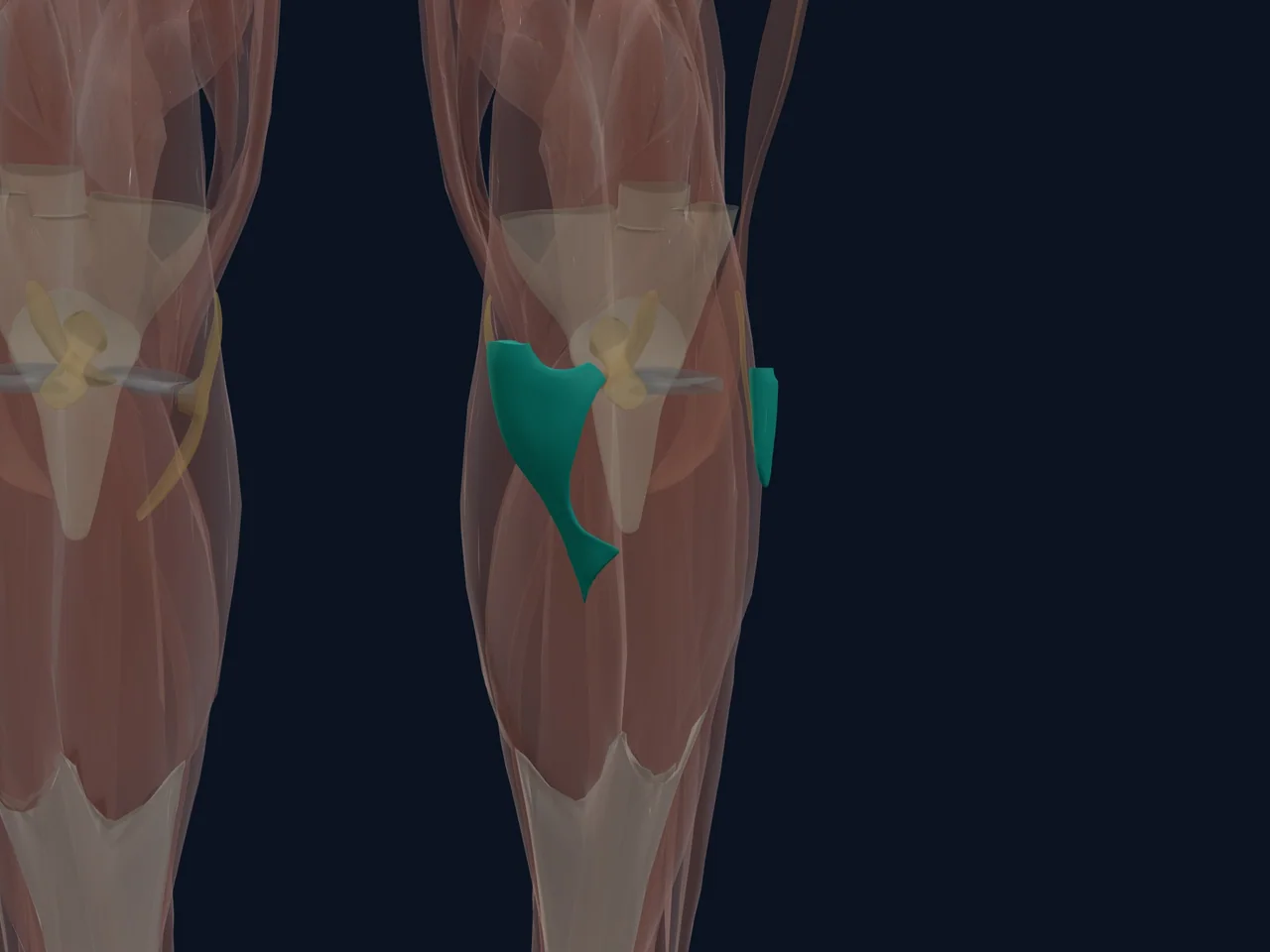
The hamstring tendons at the knee are not one single tendon. Three hamstring muscles cross the joint and attach on different sides of the lower leg: semitendinosus and semimembranosus medially, and biceps femoris laterally.
Together they bend the knee, help extend the hip and contribute to rotational and dynamic knee stability.
Location and Attachments
- Semitendinosus: joins the pes anserinus on the upper inner tibia
- Semimembranosus: has a broad attachment at the back of the medial tibia with expansions into nearby capsule
- Biceps femoris: attaches mainly to the fibular head on the outside of the knee
The gracilis and sartorius also join semitendinosus at the pes anserinus, so pain there is not automatically a hamstring injury.
What They Do
- Flex the knee
- Help control tibial rotation
- Support the knee during running, landing and direction changes
- Assist the cruciate ligaments by dynamically controlling tibial motion
Common Problems
- Distal hamstring strain
- Semimembranosus or biceps femoris tendinopathy
- Pes anserine irritation on the inner upper tibia
- Avulsion or tearing after high force
- Referred pain from the hip, back or nerve tissue
The exact pain location and the movement that provokes symptoms help distinguish these structures from the menisci, collateral ligaments and calf muscles.
Clinical Relevance
Sudden bruising, a palpable gap, marked weakness or inability to bear weight after a forceful injury warrants assessment. More gradual pain is usually evaluated through load history, resisted testing, flexibility, strength and nearby joint function.
Related Anatomy
References
- StatPearls. "Anatomy, Bony Pelvis and Lower Limb, Hamstring Muscle." https://www.ncbi.nlm.nih.gov/books/NBK546688/
- StatPearls. "Pes Anserine Bursitis." https://www.ncbi.nlm.nih.gov/books/NBK532941/