Overview
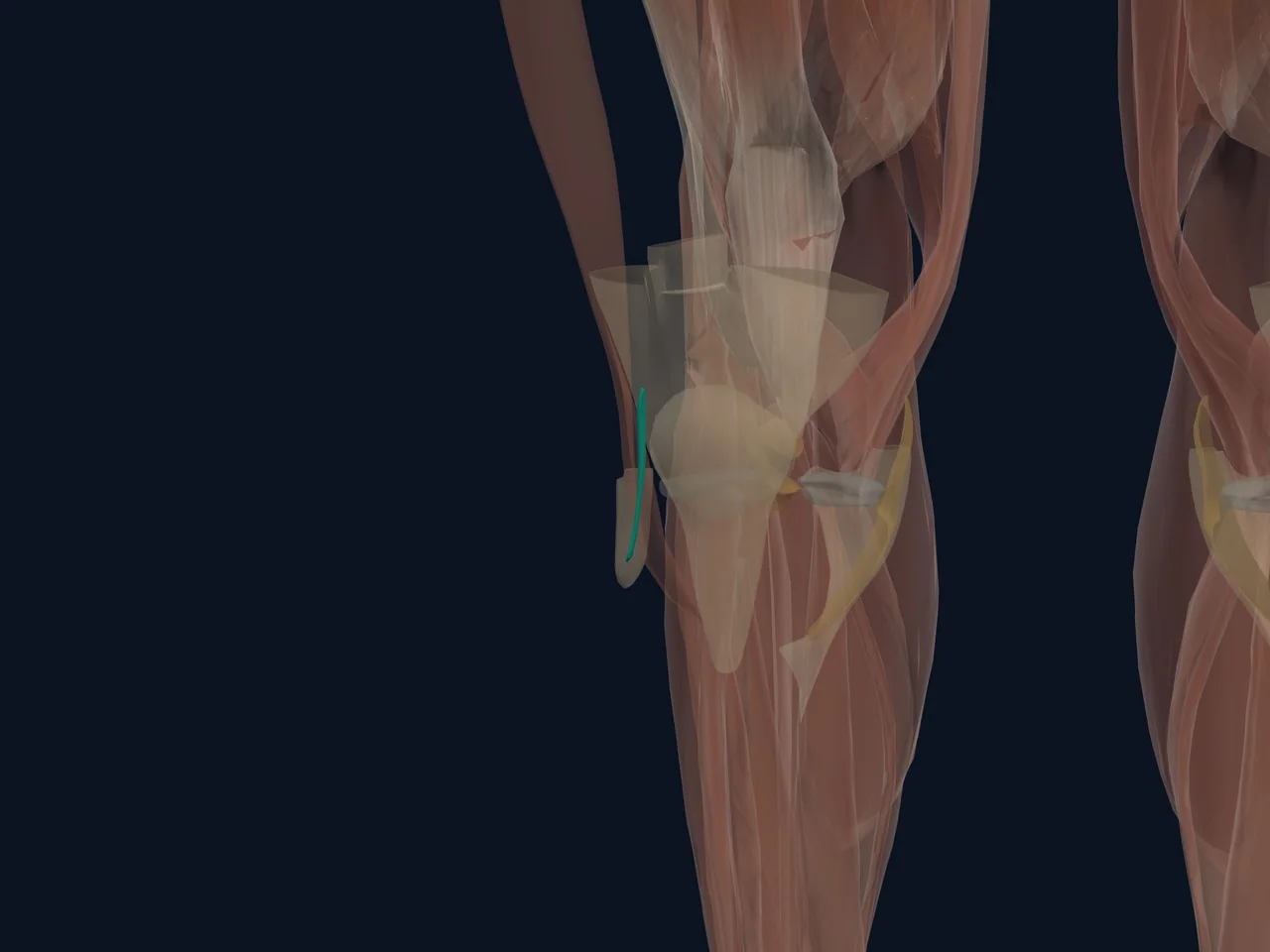
The lateral collateral ligament (LCL) is the cord-like ligament on the outside of the knee. It connects the femur to the fibula and resists varus force—the lower leg angling inward relative to the thigh so the outer knee opens.
Location and Attachments
- Begins at the lateral femoral epicondyle
- Runs downward to the head of the fibula
- Sits outside the joint capsule
- Does not attach directly to the lateral meniscus
- Works as part of the broader posterolateral corner
What It Does
The LCL supports side-to-side and rotational stability. It works with nearby tendons, capsule and posterolateral structures, so a significant outer-knee injury may involve more than the LCL alone.
Common Injury Pattern
LCL injury can follow a force to the inside of the knee, a twisting injury or knee hyperextension. Isolated injury is less common than combined posterolateral injury. Pain over the outer knee can also come from the iliotibial band, lateral meniscus, proximal tibiofibular joint or nearby tendons.
Clinical Relevance
Assessment includes the mechanism, exact tenderness, swelling, stability and nerve function. Numbness or weakness in the lower leg or foot after an outer-knee injury needs prompt evaluation because the common fibular nerve passes nearby.
Related Anatomy
References
- StatPearls. "Lateral Collateral Ligament Knee Injury." https://www.ncbi.nlm.nih.gov/books/NBK560847/
- AAOS OrthoInfo. "Collateral Ligament Injuries." https://orthoinfo.aaos.org/en/diseases--conditions/collateral-ligament-injuries/