If your knee hurts when you squat, it does not automatically mean the exercise is damaging your joint, or that you need to stop squatting forever.
A squat asks the knee to bend while the quadriceps, patellar tendon and joint absorb load. If one of those tissues is already sensitive, the movement may expose the problem. The squat may aggravate it without being the original cause.
Where you feel the pain matters. So do the way it started, the presence of swelling or locking, and how your knee feels later that day and the next morning.
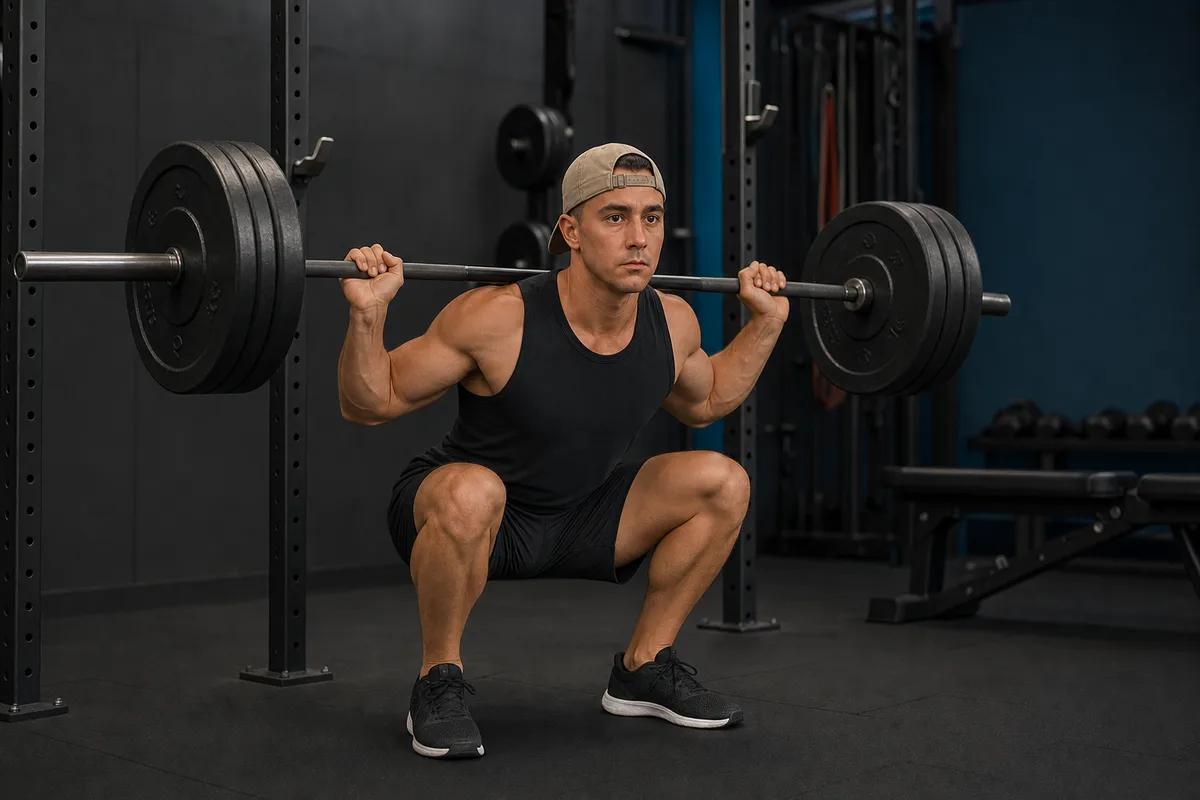
The squat is useful information, but it is not a diagnosis by itself.
Start With Where It Hurts
Pain location cannot confirm an injury, but it can help narrow the conversation.
| Where you feel it | Common possibilities |
|---|---|
| Around or behind the kneecap | Patellofemoral pain or irritation of the joint behind the kneecap |
| Just below the kneecap | Patellar tendon irritation, especially with jumping or heavy knee-dominant training |
| Just above the kneecap | Quadriceps tendon irritation |
| Along the inner or outer joint line | Meniscus irritation, collateral-ligament injury or another joint-line structure |
| Deep inside the knee | Joint irritation, meniscus symptoms or arthritis, depending on age and history |
| At the back of the knee | Hamstring or other posterior tissue irritation; occasionally swelling from within the joint |
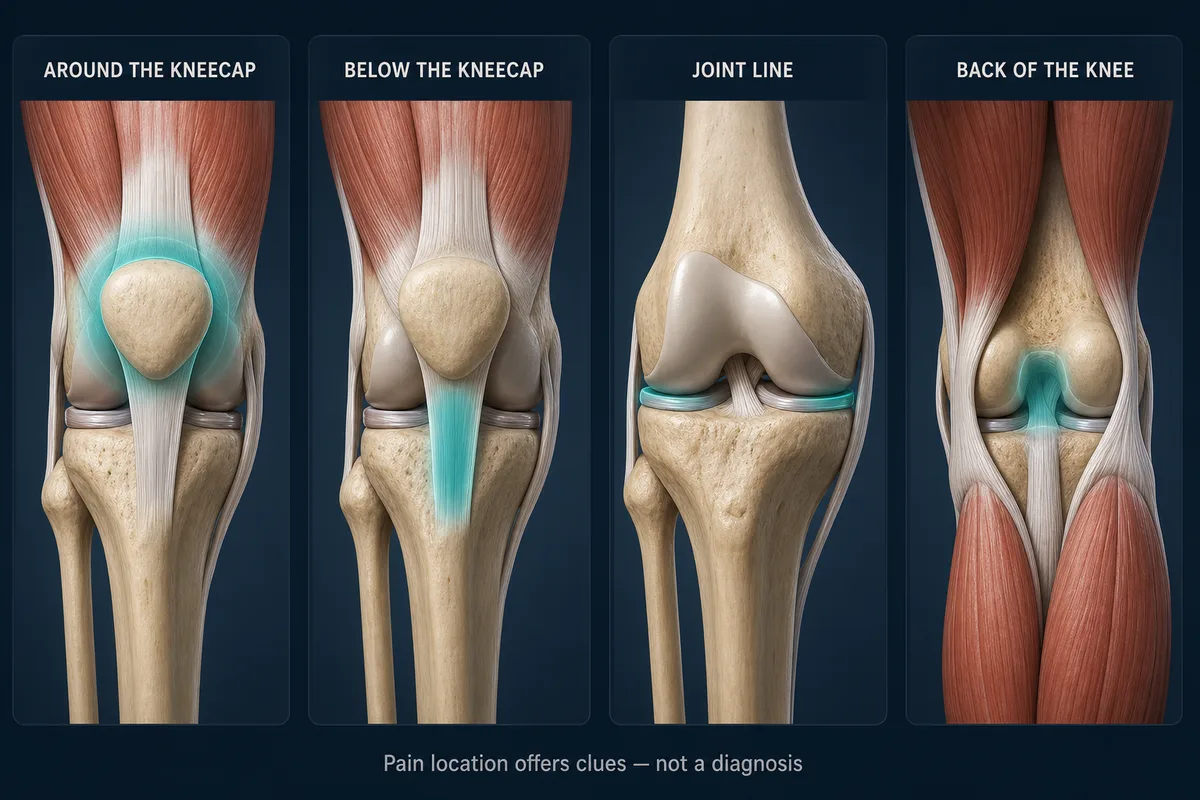
Pain location provides a clue, not a final answer. Several knee problems can overlap.
Why Squatting Can Bring Out Knee Pain
As you squat lower, your knee bends farther and the demand on the muscles and tissues around it changes. Adding weight, repetitions, speed or training frequency increases that demand again.
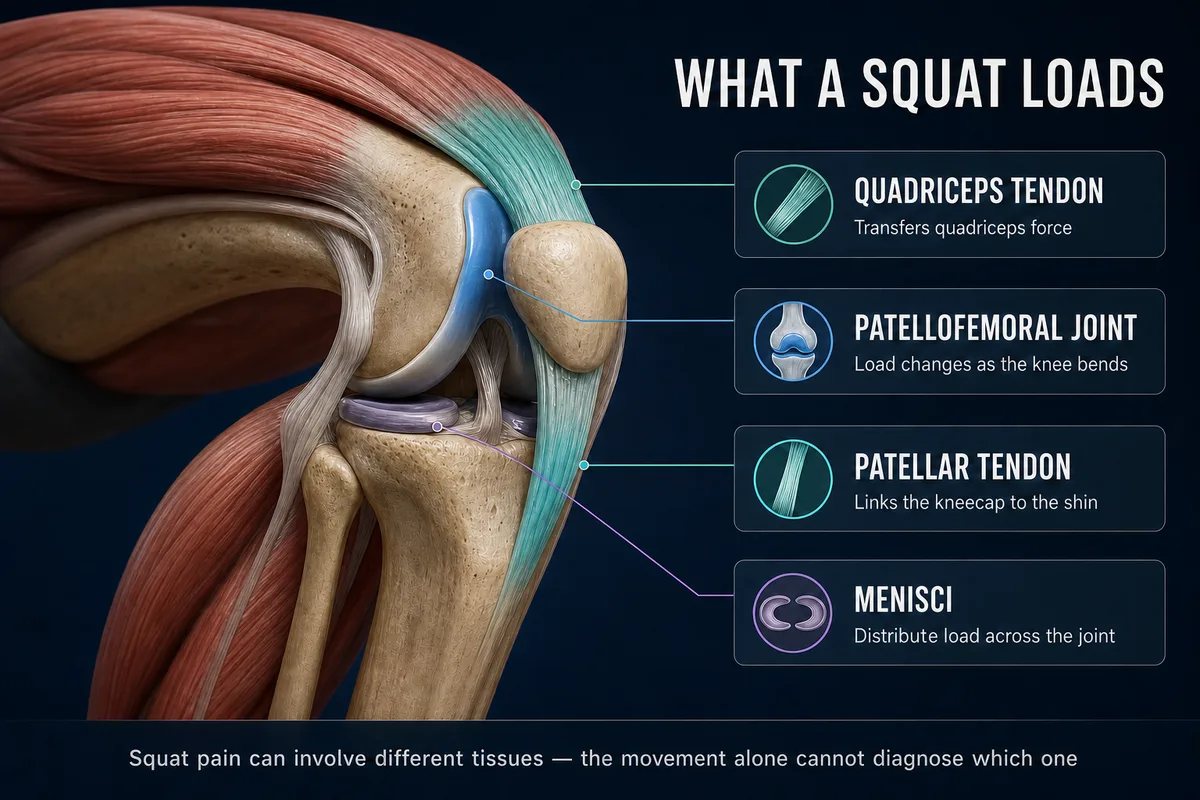
A squat loads several connected tissues. The movement alone cannot tell you which one is producing pain.
Pain often appears after something in the overall workload changes:
- You added weight or volume quickly.
- You returned after time away from training.
- You started running, jumping or playing a court sport as well as lifting.
- You began squatting deeper or more often.
- Your knee was already irritated by work, sport or a previous injury.
- Your recovery between sessions has not matched the amount of training.
The last workout may be the moment you notice the pain, but it is not always the whole cause.
Pain Around or Behind the Kneecap
Pain at the front of the knee is commonly associated with patellofemoral pain. It may hurt during squats, stairs, running, jumping or after sitting with the knee bent for a long time.
This does not necessarily mean the kneecap is “out of place.” The symptoms can reflect how the kneecap joint is tolerating repeated load, along with the capacity of the quadriceps, hip muscles and the rest of the leg.
The most consistently supported exercise approach combines progressive quadriceps and hip strengthening. The exact exercise matters less than choosing a version your knee can tolerate and progressing it sensibly.
Pain Below or Above the Kneecap
Pain focused just below the kneecap may involve the patellar tendon. It is more suggestive when the pain is very local and increases with jumping, sprinting, heavy squats or other activities that load the knee extensors.
Pain immediately above the kneecap may involve the quadriceps tendon.
Tendon pain is usually managed with load adjustment followed by progressive strengthening. Complete rest may settle symptoms temporarily, but it does not rebuild the tendon’s ability to handle training. On the other hand, repeatedly testing it with heavy, painful sets can keep it irritated.
Pain Along the Joint Line
Pain along the inner or outer edge of the knee can come from a meniscus, a collateral ligament or another nearby structure.
A meniscus becomes more concerning after a twist or awkward loaded movement, particularly when there is swelling, catching, locking or difficulty fully straightening the knee. Clicking alone is not proof of a tear; painless noises are common.
A knee that is physically locked or cannot fully extend after an injury should be assessed promptly.
Deep, Stiff or Achy Knee Pain
A more diffuse ache may reflect general joint irritability or osteoarthritis, particularly when stiffness, reduced motion and age-related changes are part of the picture.
Arthritis does not automatically make squatting off-limits. Exercise is a core treatment for knee osteoarthritis and can improve pain and function, although symptoms may temporarily fluctuate while someone builds tolerance.
The useful question is not simply, “Is squatting good or bad?” It is, “Which squat variation and dose can this knee handle right now?”
Is Your Squat Form the Problem?
Sometimes technique changes make a squat feel better. That does not mean there is one perfect form for every body.
Your limb lengths, ankle mobility, stance, training goal and the type of squat all affect how the movement looks. A comfortable stance may be narrow for one person and wider for another.
Are knees allowed to travel over the toes?
Yes. Forward knee travel is a normal part of many squats and everyday movements such as stairs. Restricting it shifts some demand away from the knee, but usually sends more work to the hips and trunk.
That can be a useful temporary adjustment when the knee is sensitive. It is not a universal rule that the knees must stay behind the toes.
What about the knees moving inward?
If changing the position improves comfort or control, a cue such as “keep the knee tracking with the foot” may help. But one frame of a squat cannot diagnose an injury, and small amounts of inward movement are not automatically dangerous.
What to Change the Next Time You Squat
Start with the smallest adjustment that makes the movement more comfortable:
- Reduce the load. Try body weight or a lighter weight before abandoning the movement.
- Shorten the range. Squat to a box, bench or pain-tolerable depth.
- Reduce the number of sets or repetitions. Total workload matters, not only the weight on the bar.
- Slow the movement down. A controlled tempo can make it easier to find a stable, comfortable path.
- Use support. Holding a rack, suspension strap or rail can help you practise the pattern with less demand.
- Try another variation. A sit-to-stand, goblet squat or split squat may feel different from a barbell squat.
Change one or two things at a time. If you change the depth, load, shoes, stance and frequency together, you will not know which adjustment helped.
Heel elevation can make a squat feel more accessible when ankle motion is limited, but it can also increase demand on the knee extensors. Treat it as an option to test, not an automatic fix for knee pain.
A Simple Return-to-Squat Progression
There is no single progression that fits every knee, but this is a practical framework:
- Start with a controlled sit-to-stand or supported squat.
- Increase the comfortable range of motion.
- Add an unloaded or lightly loaded squat variation.
- Build repetitions before making a large jump in weight.
- Gradually return to the depth, load and speed your activity requires.
Mild, stable discomfort that settles soon after training may be acceptable for some conditions. Sharp pain, escalating pain, new swelling, giving way or a clear worsening that lasts into the next day means the session needs to be reconsidered.
This is general education rather than a personalized rehabilitation plan. A physiotherapist or other qualified clinician can adjust the progression to your diagnosis, health and goals.
What Not to Do
- Do not repeatedly test a painful knee with a heavy set to see whether it is “still there.”
- Do not force a depth that causes sharp or escalating pain.
- Do not assume every click, crack or pop means tissue damage.
- Do not stop all leg training indefinitely without a plan to rebuild capacity.
- Do not copy another person’s stance simply because it looks correct online.
- Do not use a brace, sleeve or heel lift as a substitute for finding and managing the underlying load problem.
When Knee Pain Should Be Assessed
Arrange an assessment if:
- The pain began with a twist, fall, collision or sudden pop.
- The knee swelled rapidly after an injury.
- The knee locks or you cannot fully straighten it.
- It repeatedly gives way.
- You cannot comfortably bear weight.
- Pain or swelling is progressively worsening.
- Sensible load changes have not produced improvement.
- The symptoms are limiting work, sleep, sport or normal daily activity.
Seek urgent care for an obvious deformity, a hot and markedly swollen joint with fever, loss of circulation or sensation, or calf swelling accompanied by chest pain or shortness of breath.
Frequently Asked Questions
Should I stop squatting if my knee hurts?
Not always. Many people can keep training with a lighter load, shorter range, different variation or reduced volume. Stop and seek an assessment when the pain followed a significant injury or comes with locking, instability, rapid swelling or an inability to bear weight.
Are deep squats bad for the knees?
Deep squats create different and often greater demands than shallow squats, but that does not make them inherently harmful. Depth should match your mobility, training history, goals and current tolerance.
Why does my knee hurt on the way up?
Rising from the bottom requires the quadriceps and knee-extensor mechanism to produce force. Pain around the kneecap or patellar tendon may therefore be more noticeable during the ascent. That pattern still cannot confirm a diagnosis by itself.
Will a knee sleeve fix squat pain?
A sleeve may provide warmth, compression or confidence, and some people find it comfortable. It does not identify the cause or replace appropriate load management and strengthening.
Do I need an MRI?
Usually not as the first step for gradual, uncomplicated squat-related pain. Imaging is more likely to be considered after significant trauma, persistent locking, substantial instability, suspected serious injury or symptoms that do not improve as expected.
Key Takeaways
- Knee pain during a squat does not automatically mean you are damaging the joint.
- Pain location, onset, swelling, locking and instability are more useful than the squat alone.
- Front-of-knee pain is commonly associated with patellofemoral pain; local pain below the kneecap may involve the patellar tendon.
- Squat technique is individual, and knees travelling over the toes is not automatically harmful.
- Reduce load, depth or volume first, then rebuild gradually.
- A locked, unstable or rapidly swollen knee should be assessed promptly.
See It in 3D
Use the InjuryAtlas 3D knee explorer to view the patella, patellar tendon, menisci and major knee ligaments together. Seeing where the structures sit can make different pain locations easier to understand.
Continue Learning
- Patella anatomy
- Patellar tendon anatomy
- Quadriceps tendon anatomy
- Medial meniscus anatomy
- Lateral meniscus anatomy
- ACL anatomy
- MCL anatomy
Educational information only, not a diagnosis or a substitute for an individual assessment.
Sources: Patellofemoral Pain: Clinical Practice Guidelines (JOSPT/APTA); Management of Patellar Tendinopathy; Dutch multidisciplinary guideline on anterior knee pain; AAOS Clinical Practice Guideline: Acute Isolated Meniscal Pathology; NICE Osteoarthritis Guideline; Cochrane Review: Exercise for Knee Osteoarthritis; The Biomechanics of the Squat Exercise; Effect of Heel Elevation on Squat Mechanics.