The quickest way to understand the difference is by location:
- The ACL sits deep in the centre of the knee and helps control forward movement and rotation of the shinbone.
- The MCL runs along the inner side of the knee and resists forces that push the knee inward.
An ACL tear often follows a planted-foot pivot, awkward landing or sudden deceleration. An MCL tear more often follows a force to the outside of the knee, although twisting can injure it too.
Those patterns are useful, but they are not a home diagnosis. Both injuries can cause pain, swelling, a pop and difficulty walking, and they can occur together.

How the injury happened can provide a valuable clue, but an examination is still needed to identify the damaged structures.
ACL vs MCL at a Glance
| Feature | ACL tear | MCL tear |
|---|---|---|
| Location | Deep inside the knee | Along the inner side of the knee |
| Main role | Controls forward shin movement and rotation | Resists the knee collapsing inward |
| Common mechanism | Pivoting, cutting, awkward landing or sudden deceleration | Blow to the outside of the knee or a force that drives it inward |
| Pain pattern | May feel deep or difficult to pinpoint | Often tender directly over the inner-knee ligament |
| Swelling | Rapid, substantial swelling is more concerning | May be more localized, but swelling varies |
| Instability | Knee may feel as though it shifts or gives way, especially with turning | Inner knee may feel unstable under side-to-side stress |
| Usual treatment direction | Rehabilitation with or without reconstruction, depending on the person and injury | Most isolated injuries begin with non-surgical treatment |
Where the ACL and MCL Sit
The anterior cruciate ligament connects the femur to the tibia inside the joint. It crosses in front of the posterior cruciate ligament and contributes to stability during turning, landing and sudden changes of direction.
The medial collateral ligament is a broad ligament complex on the inside of the knee. Its superficial and deep fibres help stabilize the medial knee, and the deeper tissues connect with the joint capsule and medial meniscus.
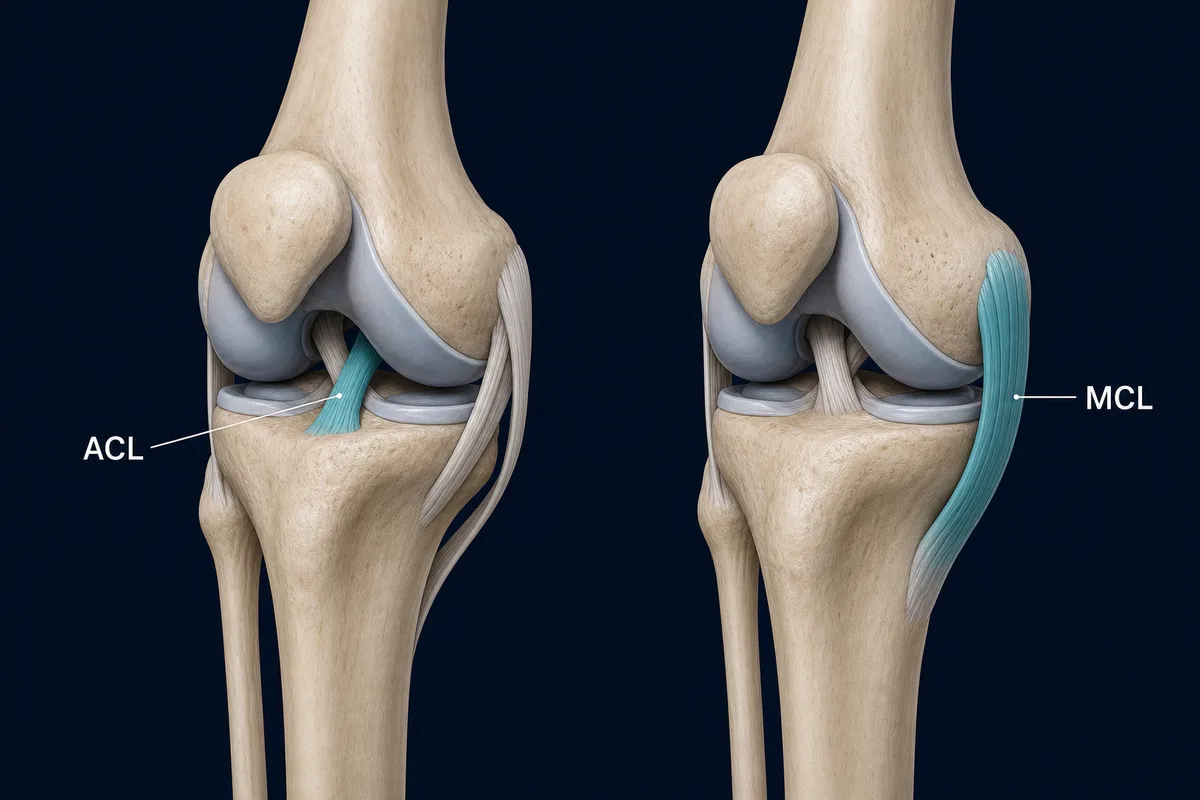
The ACL is deep within the joint. The MCL is much closer to the skin along the inner knee.
How ACL Injuries Commonly Happen
Many ACL injuries happen without another person striking the knee. Common situations include:
- Planting the foot and changing direction quickly
- Landing awkwardly from a jump
- Decelerating suddenly
- Twisting while the foot remains fixed
- Hyperextending the knee
Contact can also tear the ACL, particularly when a collision forces the knee into an awkward combination of bending, rotation and inward collapse.
People sometimes describe a pop followed by rapid swelling and difficulty continuing the activity. The knee may later feel unreliable when pivoting or changing direction.
A pop does not prove that the ACL tore. Meniscus injuries, kneecap instability and other knee injuries can also produce a pop.
How MCL Injuries Commonly Happen
The classic MCL mechanism is a force to the outside of the knee that pushes it inward. This can happen during football, hockey, soccer, skiing and other contact or cutting sports.
An MCL can also be injured without contact when the knee moves inward and rotates while the foot is planted.
Pain is often easier to locate than with an ACL injury. The inner knee may be tender when touched, and movements that place sideways stress on the knee may hurt.
What Each Injury May Feel Like
More suggestive of an ACL injury
- A non-contact pivot, landing or sudden stop
- A pop at the time of injury
- Swelling that develops quickly
- A feeling that the knee shifted or gave way
- Difficulty trusting the knee during turning or cutting
- Pain that feels deep or poorly localized
More suggestive of an MCL injury
- A blow to the outside of the knee
- Pain and tenderness along the inner knee
- Pain when the knee is pushed inward or loaded from the side
- Local swelling or bruising over the inner knee
- A feeling of looseness from side-to-side rather than during pivoting
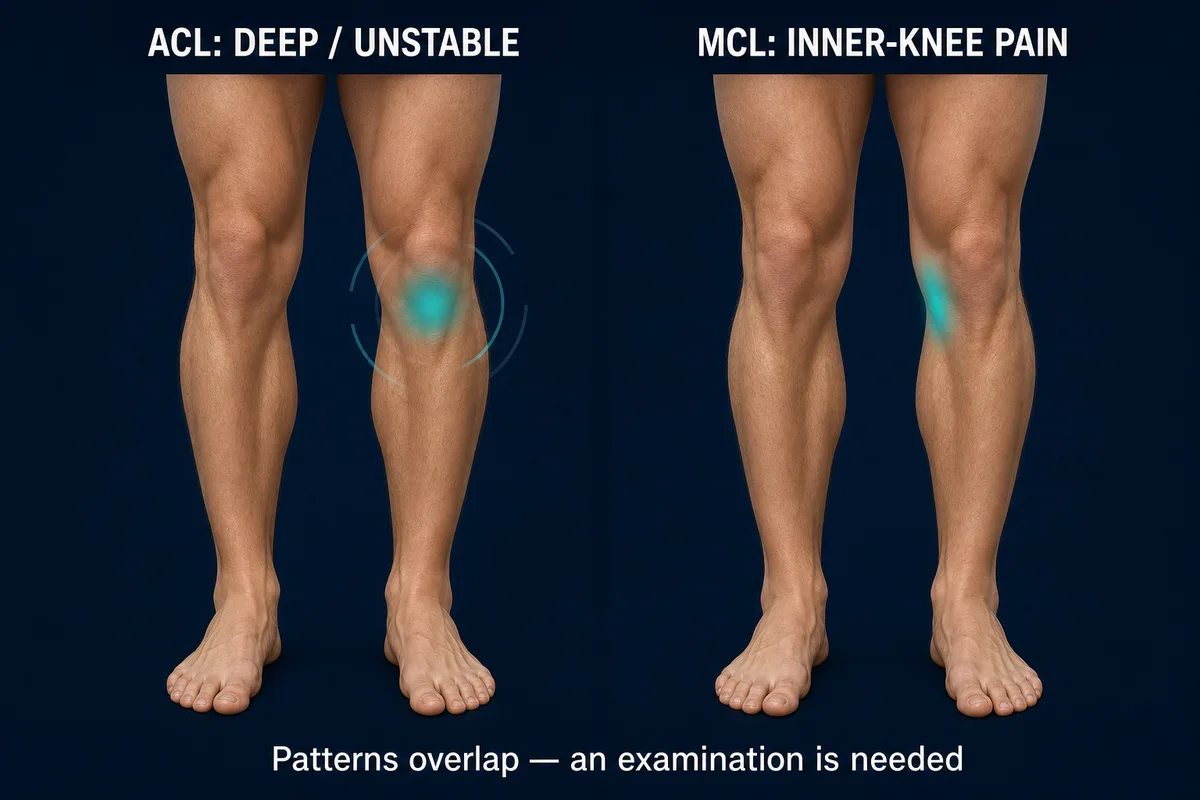
These are patterns, not diagnostic rules. Meniscus injuries, bone bruising and other ligament injuries can produce similar symptoms.
Can You Tear the ACL and MCL Together?
Yes. A force that drives the knee inward while it rotates can damage both ligaments. The meniscus, cartilage or other supporting structures may also be injured.
Combined injuries deserve a careful assessment because the treatment plan may differ from the plan for an isolated MCL sprain or isolated ACL tear. Marked instability in more than one direction is especially important to investigate.
Does Swelling Tell Them Apart?
Rapid, substantial swelling after a pivoting injury raises concern for an injury inside the joint, including an ACL tear. But swelling alone cannot identify the structure.
An isolated MCL injury may produce more localized swelling and tenderness along the inner knee. Severe MCL injuries can still create extensive swelling, and a combined injury may not follow either neat pattern.
The timing of swelling is useful information to give a clinician; it is not a self-test.
How Clinicians Tell the Difference
A clinician combines several pieces of information:
- The mechanism. Was it a pivot, landing, collision or direct blow?
- The swelling. How quickly did it appear, and where is it concentrated?
- Tenderness. Is the pain directly over the MCL or more difficult to localize?
- Stability testing. Tests such as the Lachman test assess ACL-related movement, while valgus stress testing assesses the medial knee.
- Range of motion and weight bearing. Loss of motion may reflect pain, swelling, meniscus involvement or another injury.
- Imaging when appropriate. MRI can show the ligaments and associated injuries; X-rays can check for fractures or avulsion injuries.
No single home manoeuvre can safely confirm the diagnosis. Guarding, pain and swelling can also make early testing difficult.
Do ACL and MCL Tears Need Surgery?
ACL treatment
An ACL tear does not automatically require surgery. Rehabilitation is important whether treatment is surgical or non-surgical.
Reconstruction is more likely to be discussed when the knee remains unstable, the person wants to return to pivoting sports or demanding work, or there are associated injuries that affect the plan. Age alone does not decide treatment; activity goals, instability, other damage and personal preferences all matter.
For an acute isolated ACL tear that is going to be reconstructed, current AAOS guidance favours early reconstruction because the risk of additional meniscus and cartilage injury begins to rise within three months. That recommendation applies after the decision for surgery has already been made, it does not mean every ACL tear should be operated on.
MCL treatment
Most isolated MCL injuries begin with non-surgical care. Depending on severity, that may include a hinged brace, temporary use of crutches, early protected movement and progressive strengthening.
Surgery is considered more selectively, for example, with certain complete tears, persistent instability, displaced tissue or complex injuries involving several ligaments.
The grade of an MCL injury cannot be determined from pain intensity alone.
What to Do Immediately After the Injury
If you have just injured the knee:
- Stop the activity rather than repeatedly testing whether the knee will hold.
- Protect it from another pivot or collision.
- Use crutches if you cannot walk without a marked limp.
- Elevate the leg and use a cold pack for short-term comfort if helpful.
- Arrange an assessment when there was a pop, rapid swelling, instability or difficulty bearing weight.
Avoid forcing the knee straight or repeatedly twisting it to “check” the ligament. A comfortable amount of movement is often helpful, but the right early plan depends on the severity and associated injuries.
Recovery Is Not Just a Timeline
Return to running, cutting or sport should be based on more than the number of weeks since injury.
Useful milestones can include:
- Swelling is controlled.
- Knee motion has returned.
- Walking and stairs are comfortable and controlled.
- Strength has been rebuilt on both sides.
- Hopping, landing and changing direction meet the demands of the activity.
- The knee feels stable and the person is psychologically ready to return.
An isolated low-grade MCL injury and a reconstructed ACL follow very different recovery paths. Avoid treating a generic online timeline as a clearance test.
When the Knee Should Be Assessed Promptly
Arrange prompt assessment if:
- The knee gave way during a pivot, landing or collision.
- You heard or felt a pop followed by swelling.
- The knee swelled substantially within hours.
- You cannot bear weight or walk normally.
- The knee repeatedly buckles.
- You cannot fully straighten it or it feels physically locked.
- There is marked tenderness, bruising or looseness along the inner knee.
- Symptoms are not steadily improving.
Seek urgent care for an obvious deformity, a cold or numb foot, severe pain after high-energy trauma, or a hot and markedly swollen joint accompanied by fever.
Frequently Asked Questions
Which is worse: an ACL tear or an MCL tear?
A complete ACL tear often has a greater effect on pivoting stability and may lead to a longer return-to-sport process. Many isolated MCL tears heal well without surgery. Severity, associated injuries and the person’s goals matter more than the ligament name alone.
Can I walk with a torn ACL or MCL?
Sometimes. Being able to walk does not rule out either injury. Pain, swelling and stability vary widely, and some people can walk soon after a substantial tear.
Can pain location diagnose the injury?
No. Inner-knee tenderness is more suggestive of the MCL, while ACL pain may feel deeper, but meniscus and other injuries can overlap with both patterns.
Does a loud pop mean the ACL is torn?
No. A pop raises concern when it occurs with a pivot, rapid swelling or instability, but it is not specific to the ACL.
Do I need an MRI?
Not every knee injury needs immediate MRI. A clinician may order one when the examination suggests a ligament tear, when associated meniscus or cartilage damage is suspected, or when the result would change treatment planning.
Can an MCL tear heal without surgery?
Many isolated MCL tears are treated successfully without surgery using protection, progressive movement and strengthening. Complex tears and persistent instability require individual assessment.
Key Takeaways
- The ACL sits deep inside the knee; the MCL runs along the inner side.
- ACL injuries commonly follow pivoting or awkward landing, while MCL injuries commonly follow an inward force on the knee.
- Rapid swelling and pivoting instability are more concerning for the ACL; localized inner-knee tenderness is more suggestive of the MCL.
- Symptoms cannot confirm the diagnosis, and both ligaments can tear together.
- An ACL tear does not automatically require surgery, and most isolated MCL injuries begin with non-surgical treatment.
- A pop, rapid swelling, locking, inability to bear weight or repeated giving way should be assessed.
See It in 3D
Open the InjuryAtlas 3D knee explorer to compare the ACL in the centre of the joint with the MCL along the inner knee.
Continue Learning
- ACL anatomy
- ACL rehabilitation guide
- MCL anatomy
- MCL rehabilitation guide
- PCL anatomy
- Medial meniscus anatomy
- Lateral meniscus anatomy
- Why does my knee hurt when I squat?
Educational information only, not a diagnosis or a substitute for an individual assessment.
Sources: AAOS Clinical Practice Guideline: Management of Anterior Cruciate Ligament Injuries; AAOS OrthoInfo: Collateral Ligament Injuries; Medial Collateral Ligament Injury of the Knee: Current Concepts and Management; Medial-Sided Ligamentous Injuries of the Athlete's Knee; Panther Symposium ACL Treatment Consensus.