Anatomy at a Glance
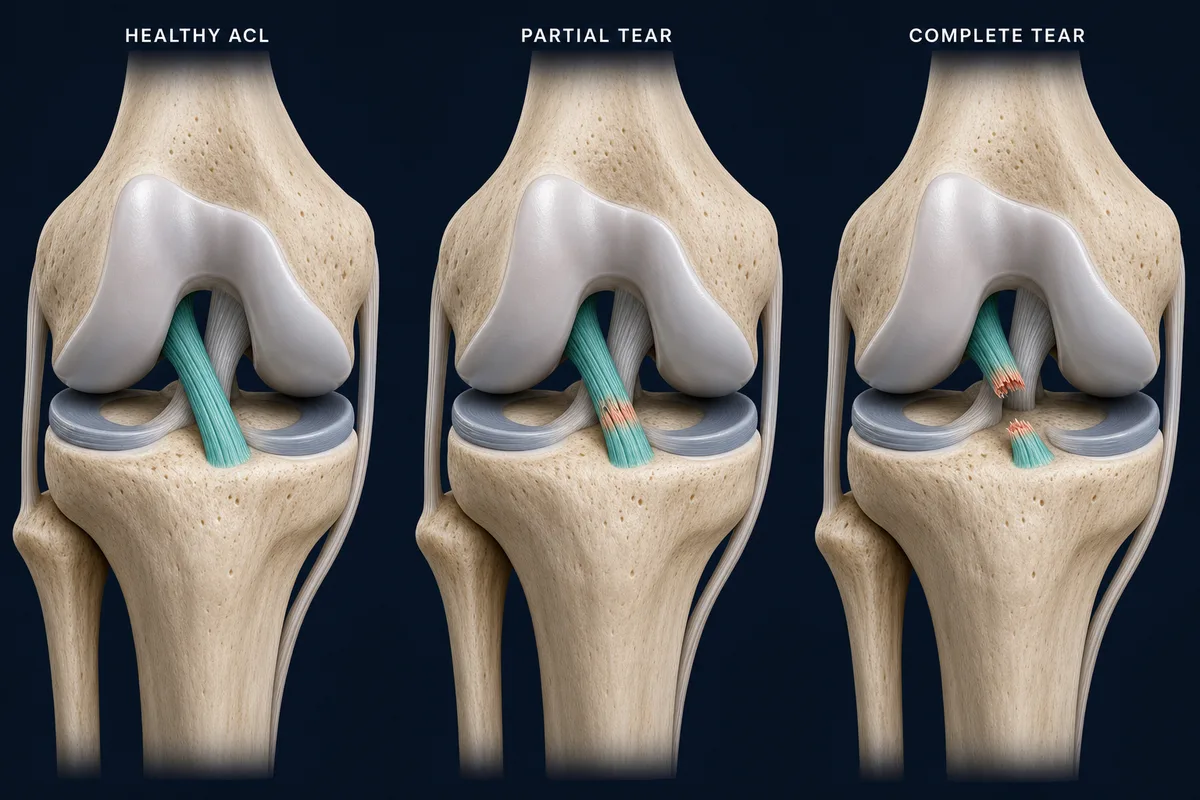
The ACL runs through the centre of the knee. A partial tear disrupts some fibres; a complete tear interrupts the ligament's continuity.
Start With the Path You Are Actually On
ACL rehabilitation is not one list of exercises performed for a certain number of weeks. The early work may look similar whether you are preparing for surgery, recovering after reconstruction or trying non-operative rehabilitation—but the precautions and final goals can be very different.
Most programs eventually need to restore five things:
- comfortable knee motion;
- control of swelling;
- quadriceps and hamstring strength;
- confidence during single-leg movement; and
- the ability to run, land, cut or work without the knee giving way.
Progress should be based on what the knee can demonstrate, not only the date on a calendar. Surgery does not replace rehabilitation, and choosing non-operative care does not mean simply waiting for the knee to feel better.
This guide is general education. After reconstruction, your surgeon's instructions take priority because graft choice, meniscus repair, cartilage procedures and other injuries can change weight-bearing, bracing and movement restrictions.
Before You Begin
An ACL injury should be assessed rather than self-diagnosed from a pop or swelling. The ACL injury guide explains the usual examination and treatment decisions.
Get prompt medical advice when:
- the knee is locked and cannot fully straighten;
- it repeatedly buckles during ordinary walking;
- swelling is large or rapidly increasing;
- you cannot bear weight after a significant injury;
- the knee or leg looks deformed;
- the foot becomes cold, pale or numb; or
- a postoperative wound becomes increasingly red, hot or draining, or you develop fever, calf swelling, chest pain or shortness of breath.
The Three ACL Rehabilitation Pathways
Non-operative rehabilitation
Some people regain enough stability for their chosen activities without reconstruction. The plan still needs progressive strength, balance, running and task-specific training. Repeated giving-way episodes matter because they can place the menisci and cartilage at risk.
Pre-operative rehabilitation
If reconstruction is planned, the time before surgery is useful. The usual goals are to settle swelling, regain full knee extension, improve bending, restore quadriceps control and walk without a marked limp. Going into surgery with a quiet, mobile knee generally gives rehabilitation a better starting point.
Rehabilitation after ACL reconstruction
After surgery, early loading and movement are commonly encouraged within the limits set by the surgical team. The graft is not ready for sport just because pain has settled. Strength, movement quality and sport-specific capacity take many months to rebuild.
Phase 1: Settle the Knee and Restore Control
Main goals: reduce swelling, regain full knee extension, steadily recover bending, activate the quadriceps and walk as normally as your restrictions allow.
Early work often includes:
- frequent, comfortable knee-straightening practice;
- heel slides for controlled bending;
- quadriceps tightening or terminal knee-extension work;
- straight-leg raises when you can keep the knee from sagging;
- calf raises and gentle hip strengthening; and
- short periods of walking with crutches or a brace when prescribed.
Knee extension deserves attention. A knee that remains slightly bent changes walking and makes it harder to recruit the quadriceps. Do not force through a mechanical block or disregard a surgeon's range restriction.
Cold packs, elevation or compression may help short-term comfort and swelling, but they do not replace movement and progressive loading.
Signs you may be ready to progress
- Swelling is small and trending down.
- The knee can straighten as well as the other side, or is steadily approaching it.
- Bending is improving without a major flare afterward.
- You can perform a straight-leg raise without the knee drooping.
- Walking is becoming more even within your permitted weight-bearing level.
Phase 2: Rebuild Everyday Strength
Main goals: recover normal walking, build quadriceps and hamstring capacity, improve single-leg control and tolerate stairs and daily activity.
Exercise selection depends on irritability and surgical restrictions. Common building blocks include:
- sit-to-stand;
- supported squats or leg press through a controlled range;
- low step-ups;
- bridges and hamstring work;
- calf raises;
- stationary cycling when bending permits; and
- balance work that progresses from two legs to one.
Both open-chain exercise, such as knee extension, and closed-chain exercise, such as squats and step-ups, can contribute to recovery. The load and range should be selected deliberately—especially after reconstruction—rather than treating one category as universally safe or dangerous.
The quadriceps often remain weak long after walking looks normal. Progressive resistance is important. Light exercise forever is not enough preparation for running, jumping or a demanding job.
Signs you may be ready to progress
- Full or nearly full knee motion.
- Little or no reactive swelling after strength sessions.
- Controlled stairs and basic single-leg tasks.
- No episodes of giving way.
- Strength is improving on objective testing, not only by feel.
Phase 3: Build Capacity for Running and Landing
Main goals: develop stronger single-leg mechanics, tolerate repeated impact and introduce running without the knee becoming swollen or painful.
This phase may include:
- heavier squats, split squats, step-ups and hinging patterns;
- progressive knee-extension and hamstring strengthening;
- single-leg squat and step-down variations;
- low-level jumping and landing drills;
- hopping progressions; and
- a walk-jog program before continuous running.
Running should not start only because a certain week has arrived. The Aspetar guideline suggests combining time since surgery with clinical and functional criteria. Useful checkpoints include full knee extension, almost full bending, no more than trace swelling, adequate quadriceps strength and the ability to tolerate repeated hopping or equivalent impact preparation without pain.
Start with short, easy running intervals on a predictable surface. Increase total running time before adding hills, speed or sharp changes of direction. If the knee swells or loses motion afterward, the current dose may be ahead of its capacity.
Phase 4: Reintroduce Speed and Direction Change
Main goals: restore deceleration, cutting, reactive movement and confidence under the demands of sport or work.
Straight-line running is not the same as being ready to pivot. Later rehabilitation may include:
- faster running and controlled sprint exposure;
- planned direction changes before reactive cutting;
- acceleration and deceleration drills;
- repeated jumping and landing in several directions;
- fatigue-resistant single-leg strength; and
- drills that resemble the actual sport, job or activity.
Movement quality matters, but it should not be judged from one perfect repetition. The knee needs to tolerate repeated work, changing speeds and decisions without swelling, hesitation or collapse in control.
Phase 5: Return to Participation, Then Performance
Returning to sport is a process, not one clearance day.
- Return to participation: modified practice or controlled work exposure.
- Return to sport: full participation, sometimes with managed minutes or workload.
- Return to performance: rebuilding the speed, confidence and consistency you had before injury.
A return-to-sport decision commonly combines:
- no meaningful pain or swelling;
- full knee motion;
- a stable clinical examination;
- quadriceps and hamstring strength testing;
- hop, jump and landing tests;
- running and change-of-direction capacity;
- the demands and risk level of the activity; and
- psychological readiness and trust in the knee.
Passing one hop test is not enough. Limb symmetry can also hide weakness if both legs have lost capacity. Test results should be interpreted alongside pre-injury goals, movement quality and training exposure.
How Long Does ACL Rehabilitation Take?
There is no single reliable finish date. Everyday function may return well before the knee is prepared for unrestricted pivoting sport.
After reconstruction, running is often introduced several months into rehabilitation and return to high-demand pivoting sport commonly takes nine months or longer. Those are broad reference points, not promises or automatic clearance dates. A meniscus repair, cartilage procedure, graft-related issue, persistent swelling, strength deficit or interruption in training can change the path.
Non-operative rehabilitation may avoid surgical healing restrictions, but it still requires time to determine whether the knee remains stable during the person's real activities.
What Should Exercise Feel Like?
Muscle effort and some temporary discomfort can be expected. The session is more likely to be appropriate when:
- technique stays controlled;
- pain remains mild rather than escalating;
- the knee does not buckle;
- swelling does not meaningfully increase; and
- motion and walking are not worse the following day.
A persistent increase in swelling is useful feedback. Reduce one variable—load, range, speed or total volume—and reassess rather than repeatedly training through the same flare.
Common ACL Rehabilitation Mistakes
Chasing flexion while ignoring extension
Bending feels like obvious progress, but restoring comfortable knee straightening is a crucial early target.
Stopping strength work once walking feels normal
Normal-looking walking does not prove that the quadriceps has recovered enough for running or sport.
Treating running as the end of rehabilitation
Running mainly tests straight-line capacity. Cutting and pivoting require later strength, braking, reactive movement and decision-making.
Using time as the only progression rule
Tissue healing matters, but the calendar cannot show whether swelling, motion, strength or confidence is ready.
Comparing every recovery with somebody else's
Graft choice, associated injuries, sport, baseline strength and individual response all affect the path.
Questions to Ask Your Clinician
- Were the meniscus, cartilage or other ligaments also injured?
- Do I have restrictions on weight-bearing, bracing or knee bending?
- Which measurements will decide when I can run?
- How will quadriceps strength be tested?
- What will my return-to-sport or return-to-work testing include?
- What should I do if swelling returns after a progression?
Related InjuryAtlas Resources
- ACL tear
- ACL anatomy
- ACL vs MCL tear
- General knee loading principles
- Medial meniscus
- Lateral meniscus
- Explore the ACL in 3D
References
- Kotsifaki R, et al. “Aspetar Clinical Practice Guideline on Rehabilitation after Anterior Cruciate Ligament Reconstruction.” British Journal of Sports Medicine. 2023. https://pmc.ncbi.nlm.nih.gov/articles/PMC11785408/
- American Academy of Orthopaedic Surgeons. “Management of Anterior Cruciate Ligament Injuries.” 2022. https://www.aaos.org/aclcpg
- American Academy of Orthopaedic Surgeons. “Return to Play to Pre-Injury Level Following Anterior Cruciate Ligament Injury: Appropriate Use Criteria.” 2024. https://www.aaos.org/aclreturntoplayauc
- Diermeier T, et al. “Treatment after anterior cruciate ligament injury: Panther Symposium ACL Treatment Consensus Group.” Orthopaedic Journal of Sports Medicine. 2020. https://pmc.ncbi.nlm.nih.gov/articles/PMC7524809/
This information is for education only and is not a medical diagnosis or personalised rehabilitation program. Follow the restrictions from your surgeon or rehabilitation professional after an operation. Seek medical care promptly for a locked knee, major trauma, repeated giving way, inability to bear weight, worsening calf swelling, chest pain, shortness of breath or signs of infection.