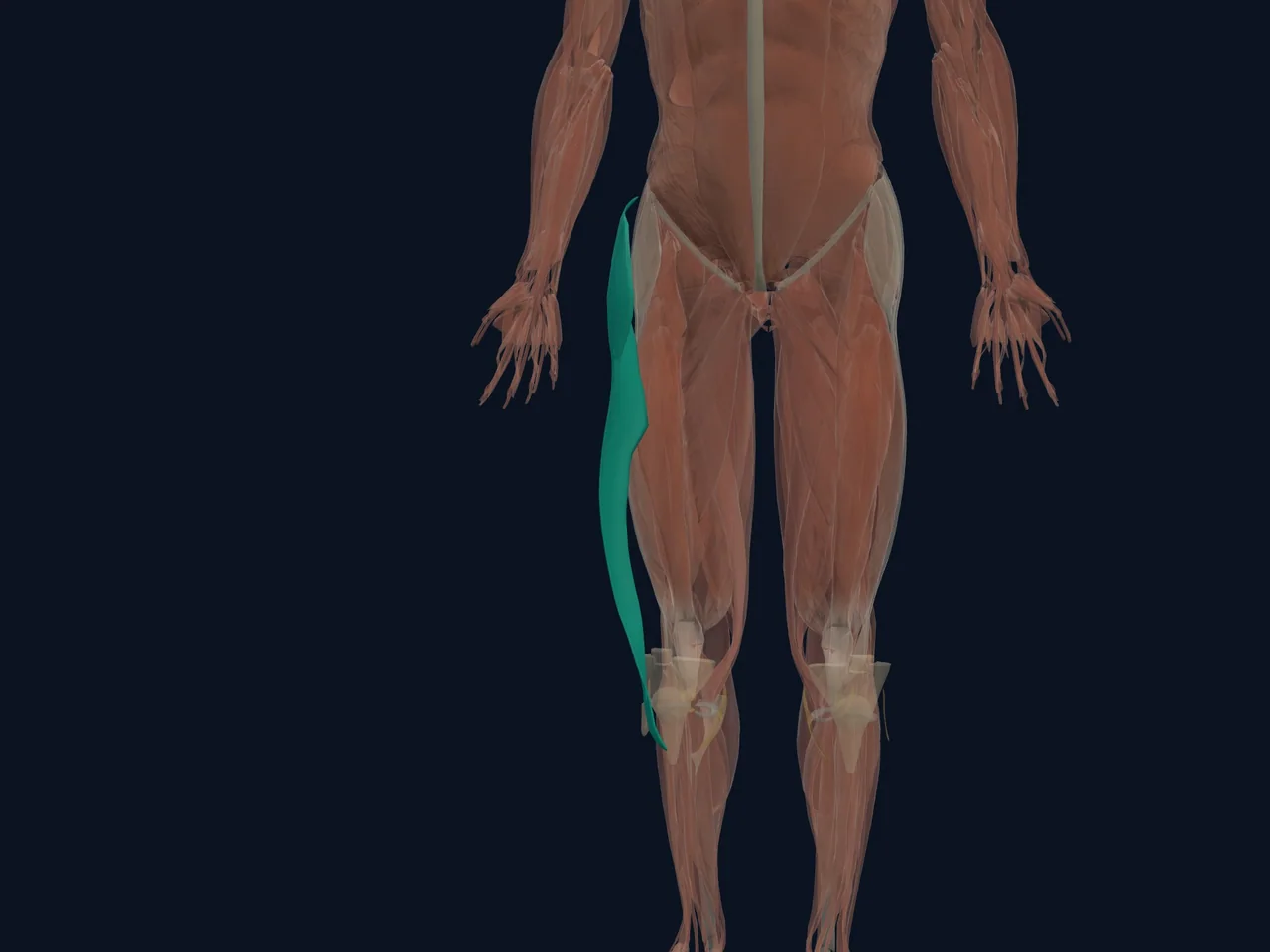
Overview
The iliotibial band (IT band) is a thickened strip of fascia running along the outside of the thigh. It receives fibres from the tensor fasciae latae and gluteus maximus and attaches mainly near the outer upper tibia.
It is connective tissue, not a muscle. That distinction matters: the IT band transmits tension and contributes to stability, but it does not contract by itself.
Location and Connections
- Runs from the outer hip down the lateral thigh
- Attaches near Gerdy's tubercle on the tibia
- Has connections around the lateral femur and patella
- Passes near the lateral femoral epicondyle
- Lies superficial to several thigh muscles
What It Does
The IT band helps transfer force between the hip and knee and supports lateral stability during walking and running. Its relationship to the lateral femoral epicondyle changes as the knee bends.
Common Problems
Load-related pain near the outer femoral epicondyle is often called iliotibial band syndrome. It is common in runners and cyclists, especially after a rapid increase in training. Current explanations include compression and irritation of sensitive tissue beneath the band rather than the IT band simply “rubbing” like a loose cord.
Outer-knee pain can also come from the lateral meniscus, LCL, biceps femoris tendon or joint surfaces.
Clinical Relevance
Management usually examines training load, hip and knee capacity, running or cycling demands and local symptom behaviour. Trying to permanently “stretch” the dense band itself oversimplifies the problem; mobility and strengthening may still help by changing how the surrounding system handles load.
Related Anatomy
References
- StatPearls. "Iliotibial Band Friction Syndrome." https://www.ncbi.nlm.nih.gov/books/NBK542185/
- Fairclough J, et al. "The functional anatomy of the iliotibial band during flexion and extension of the knee." Journal of Anatomy. https://pubmed.ncbi.nlm.nih.gov/16533314/