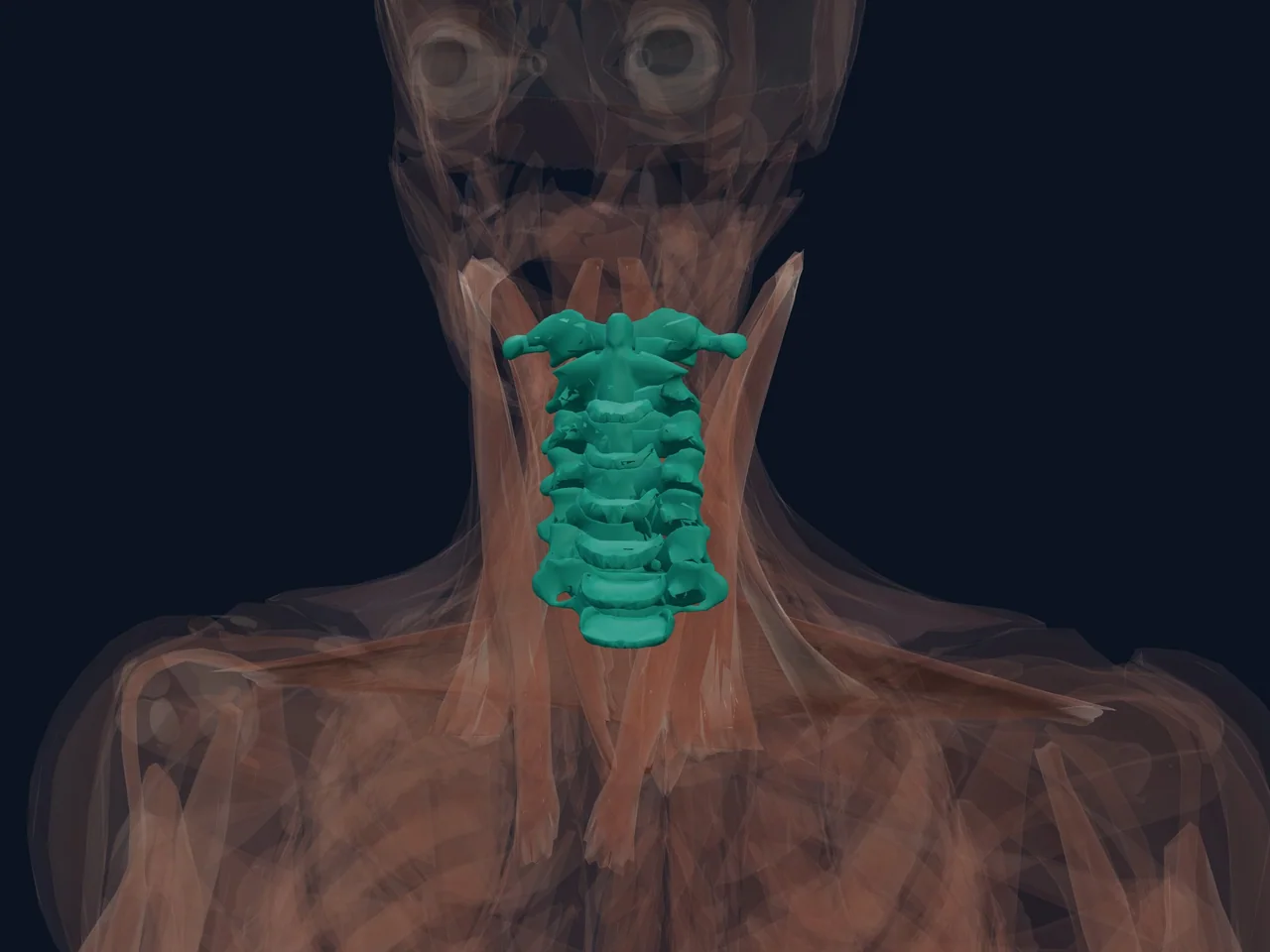
Overview
The cervical spine is the neck — the upper seven vertebrae (C1 to C7) that support the head, allow it to turn and tilt, and protect the spinal cord and nerve roots that travel to the arms.
Between the vertebrae sit the cervical discs, which cushion and spread load. Small facet joints guide movement, and muscles and ligaments wrap around everything to hold the head steady during nearly constant use — the neck moves more than most people realize.
Location and Connections
- Sits between the skull and the upper back (T1)
- Usually seven vertebrae, labelled C1 to C7
- Nerve roots exit at each level and form the nerves of the arms and hands
- Connects down into the thoracic spine and out into the shoulder girdle
What It Does
The cervical spine supports the head, allows turning, tilting and nodding, and protects the spinal cord. Because the head is heavy and the neck is mobile, the muscles of the neck work almost constantly — which is why prolonged postures and stress commonly show up as neck tension.
Common Problems
- Non-specific neck pain, often from muscles and joints
- Neck strain after awkward movement or whiplash
- Disc-related changes and nerve irritation with age
- Cervical spondylosis, more common with age
Most neck pain involves muscles and soft tissues rather than dangerous structural damage. Pain location alone does not identify the exact source.
Clinical Relevance
Assessment matters when neck pain follows major trauma, comes with arm weakness or numbness, or includes changes in walking, balance, bladder or bowel function. Severe trauma with neck pain needs prompt care.
Related Anatomy
References
- Blanpied PR, et al. "Neck Pain: Revision 2017. Clinical Practice Guidelines." Journal of Orthopaedic & Sports Physical Therapy. 2017;47(7):A1-A83. https://www.jospt.org/doi/10.2519/jospt.2017.0302