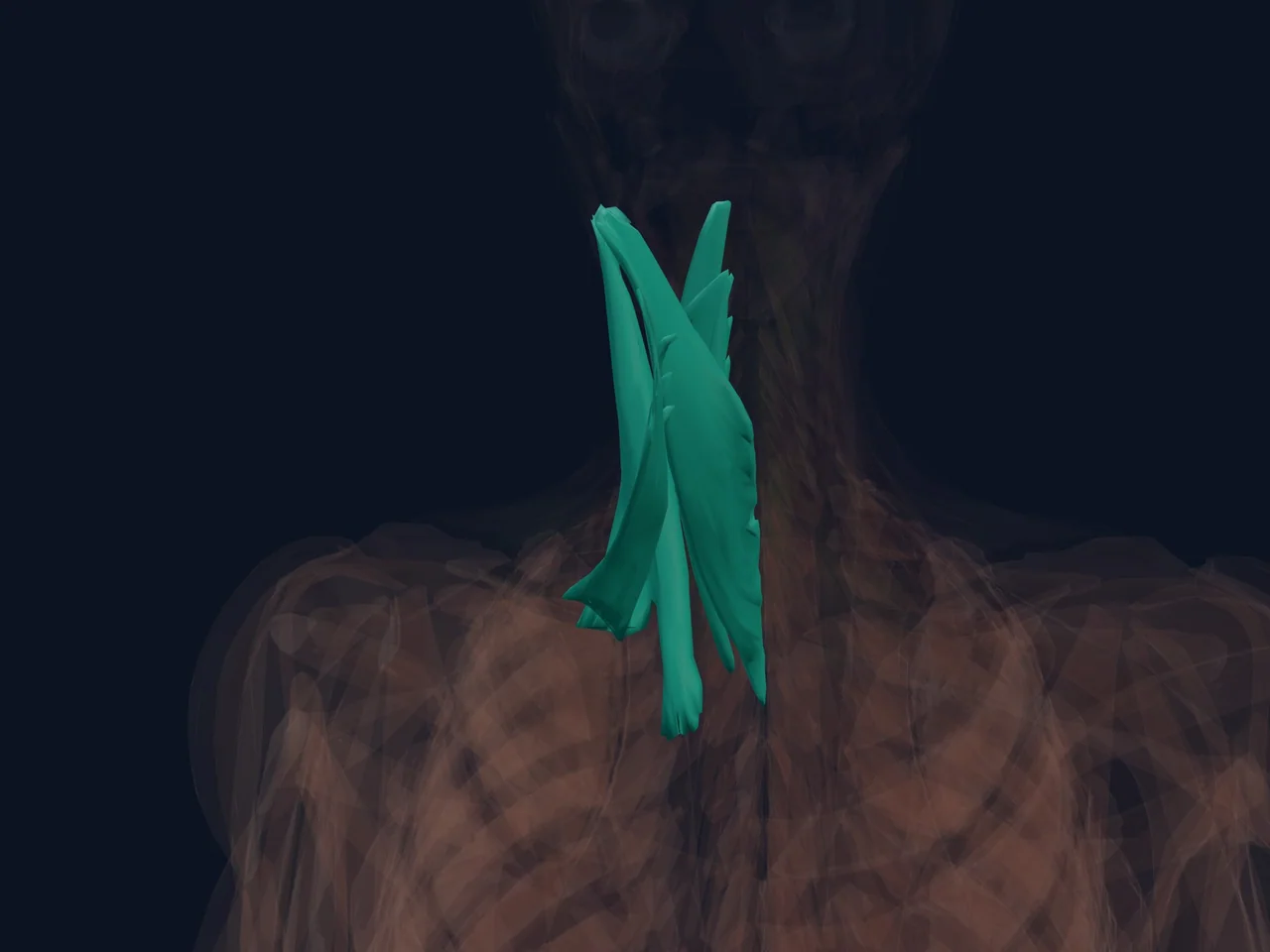
Overview
The neck muscles move the head, hold it upright and protect the cervical spine. They include large superficial muscles, smaller deep stabilizers, and the muscles that connect the neck to the shoulder blade and upper back.
Because the neck works almost constantly — holding the head during screen work, driving, reading and moving — these muscles are a common source of ache and tension.
Location and Attachments
- Superficial muscles like the sternocleidomastoid run from the skull to the collarbone and breastbone
- Deep flexors at the front stabilize the neck during head movement
- Muscles like the levator scapulae connect the neck to the shoulder blade and can refer tension toward the upper back and shoulder
What They Do
The neck muscles turn, tilt and nod the head, keep it upright against gravity, and stabilize the cervical spine during arm use. The deep stabilizers work quietly to keep the head balanced; the larger muscles take over with stronger movements.
Common Problems
- Muscle ache and tension from prolonged postures
- Neck strain after awkward movement, lifting or whiplash
- Weakness of the deep stabilizers, often with prolonged sitting
- Referred tension into the upper back, shoulder or base of the skull
Muscle tension is common and usually settles with movement and load adjustment. Neck pain with arm numbness, weakness or trauma needs assessment.
Clinical Relevance
Strengthening the deep neck flexors and keeping the neck moving are core parts of neck rehabilitation. A clinician can assess whether the problem is muscular, joint-related or involves a nerve.
Related Anatomy
References
- Blanpied PR, et al. "Neck Pain: Revision 2017. Clinical Practice Guidelines." Journal of Orthopaedic & Sports Physical Therapy. 2017;47(7):A1-A83. https://www.jospt.org/doi/10.2519/jospt.2017.0302