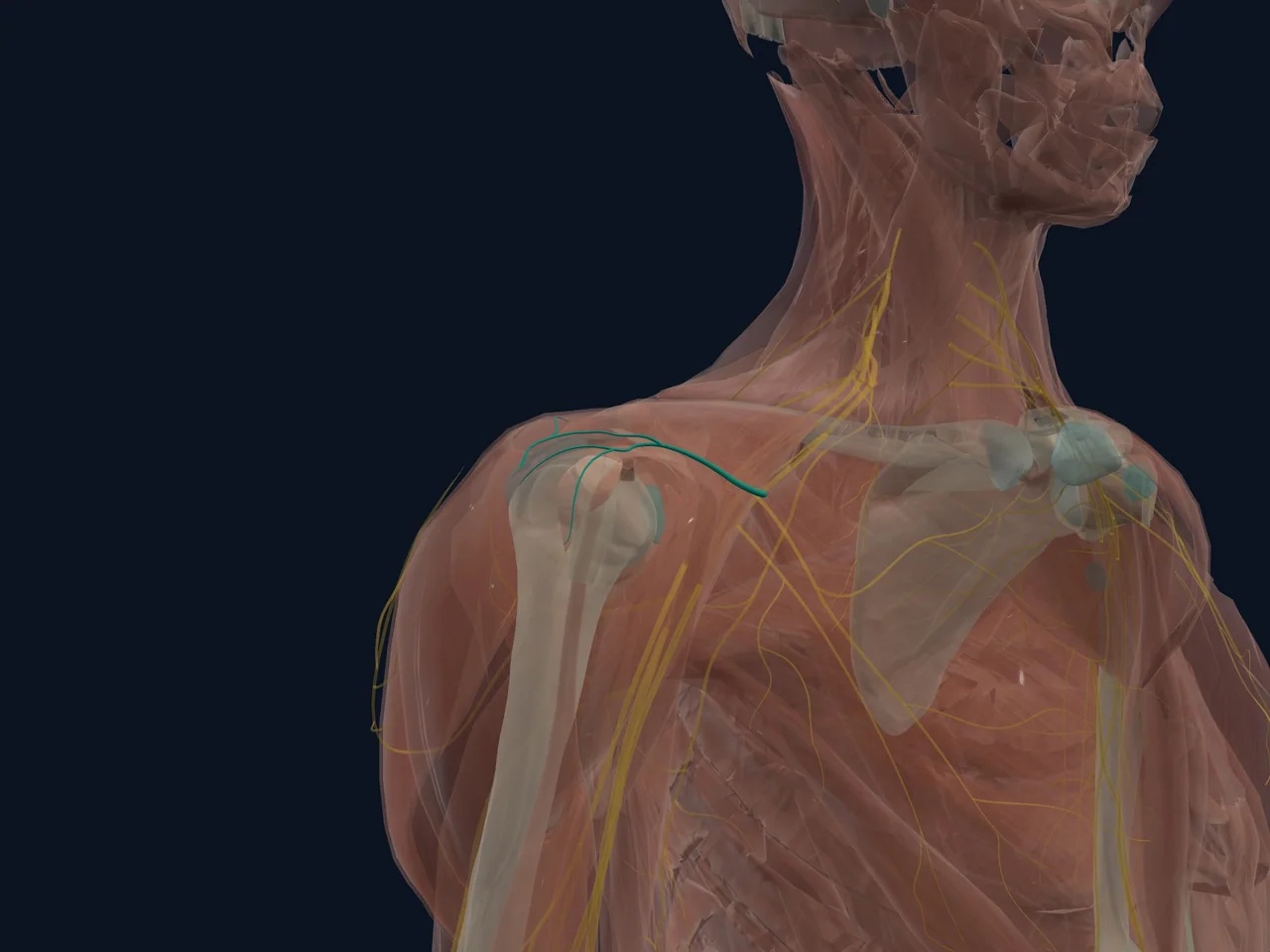
The thoracoacromial artery is a short branch of the axillary artery near the front of the shoulder. After passing through the clavipectoral fascia, it usually divides into branches that supply parts of the chest, clavicular region, acromion and deltoid.
Course and Branches
- Usually begins from the second part of the axillary artery, behind the pectoralis minor
- Passes forward through the clavipectoral fascia
- Commonly divides into pectoral, deltoid, clavicular and acromial branches
- The deltoid branch travels in the groove between the deltoid and pectoralis major, often alongside the cephalic vein
Branching patterns vary. The model highlights the deltoid branch, which helps supply the front portion of the deltoid and nearby tissue.
Function
The thoracoacromial system contributes blood to the anterior shoulder and upper chest. The deltoid also receives substantial blood supply from the posterior circumflex humeral artery, so its circulation is not dependent on one vessel alone.
Why It Matters
This artery is rarely the explanation for ordinary shoulder pain. It matters mainly in surgery, flap planning, vascular access and significant trauma around the clavicle or front of the shoulder.
Seek urgent care after trauma if there is heavy bleeding, a rapidly expanding swelling, a cold or pale arm, loss of pulse, or new major weakness or numbness.
Related Anatomy
- Deltoid — supplied partly by the deltoid branch
- Pectoralis major — lies beside the deltopectoral groove
- Clavicle — an important landmark above the thoracoacromial trunk
References
- Huelke DF. “Variation in the origins of the branches of the axillary artery.” Anatomical Record. 1959;135:33–41.
- Loukas M, et al. “The thoracoacromial trunk: a detailed analysis.” Surgical and Radiologic Anatomy. 2022. https://pmc.ncbi.nlm.nih.gov/articles/PMC9649491/
- StatPearls. “Anatomy, Shoulder and Upper Limb, Axillary Artery.” StatPearls Publishing. https://www.ncbi.nlm.nih.gov/books/NBK482174/