Exercises · IA-UAE-EXE-003

Eccentric Wrist Extension

Learn slow eccentric wrist extension for progressive loading of the wrist extensor tendons.

Browse Arms
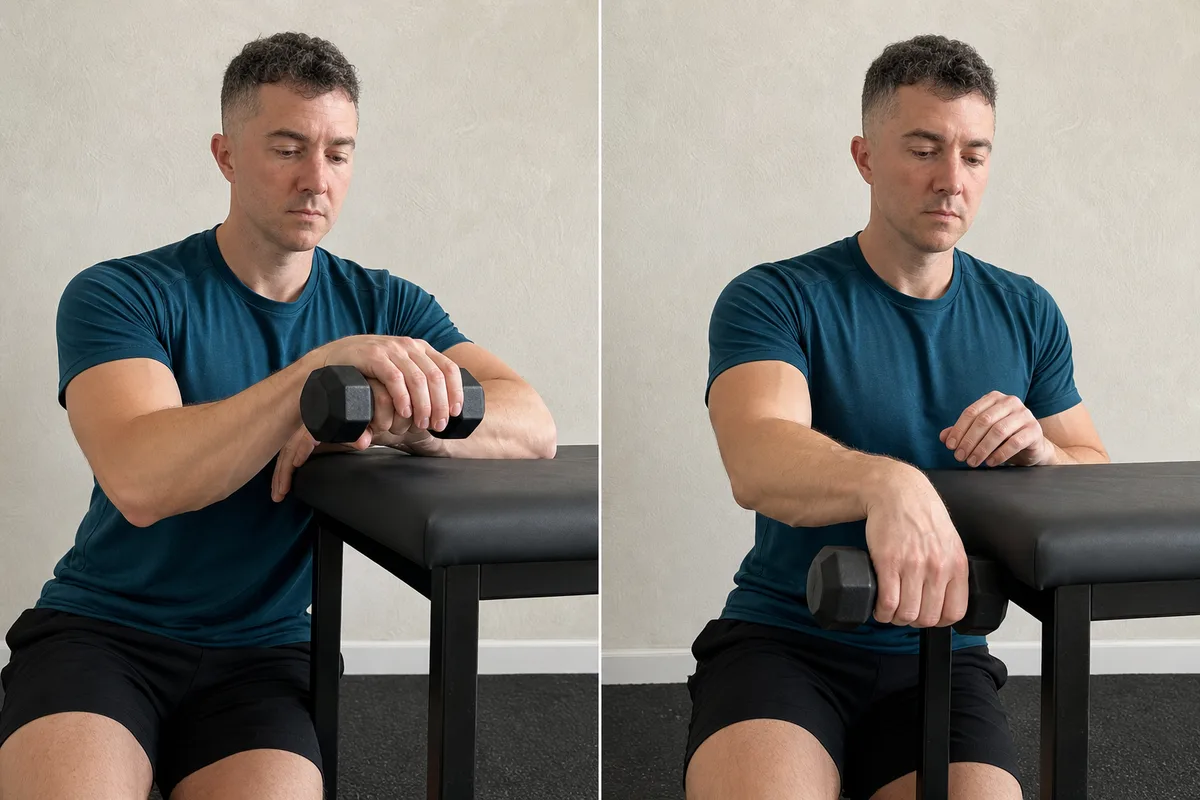
Start and finish demonstration of Eccentric Wrist Extension
Start and finishUse the written steps below for the full technique and safety guidance.

At a glance

Exercise profile

Target muscles
Extensor carpi radialis brevis, Extensor carpi radialis longus
Exercise type
Strength and tendon loading
Equipment
Light dumbbell, Table or bench
Mechanics
Isolation
Movement pattern
Eccentric wrist lowering (unilateral)
Experience level
beginner
Secondary muscles
Extensor digitorum, Extensor carpi ulnaris

Controlled wrist-extensor tendon loading

What this exercise works

The wrist extensors work while lengthening to control the weight as the hand lowers, progressively loading the outer-elbow tendon.

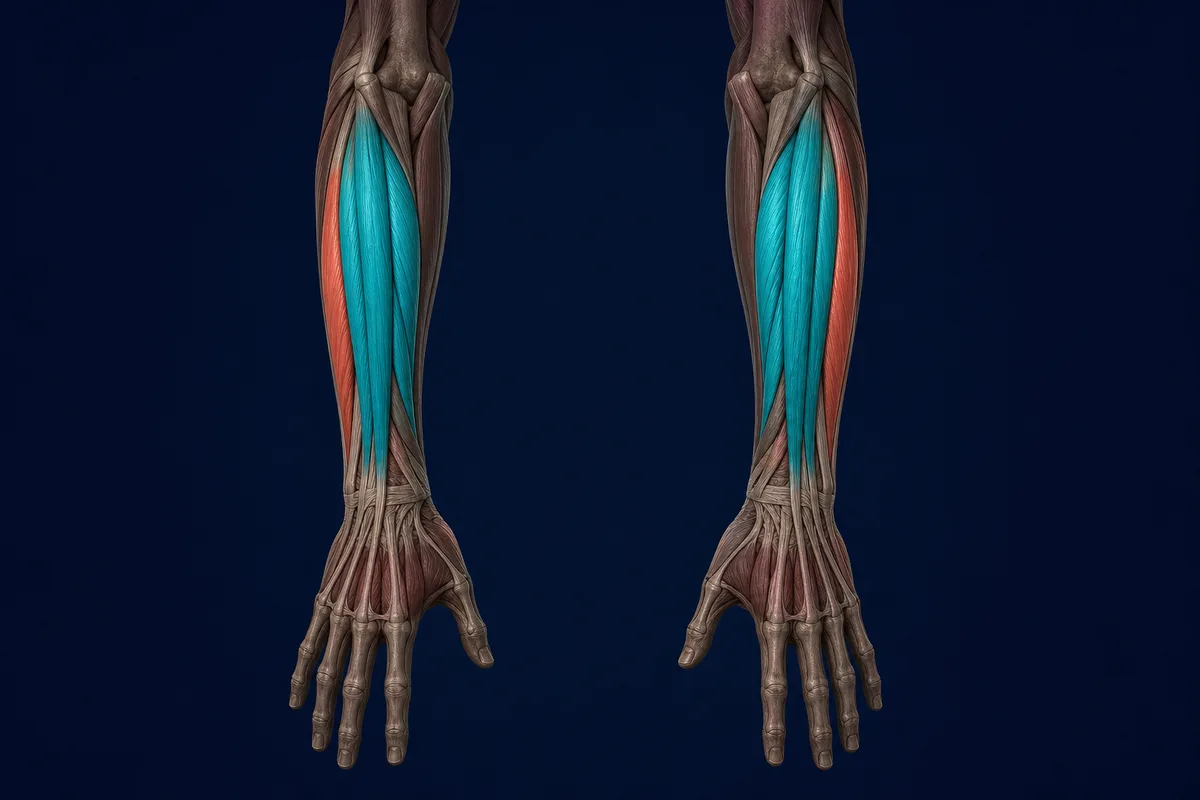
Anatomy highlighting the structures involved in Eccentric Wrist Extension
Teal — primary muscles doing most of the workRed — secondary muscles assistingGrey — stabilizers and surrounding anatomy

Primary emphasis

  • Extensor carpi radialis brevis
  • Extensor carpi radialis longus

Secondary muscles

  • Extensor digitorum
  • Extensor carpi ulnaris

Stabilizers

  • Forearm flexors
  • Grip muscles
  • Brachioradialis

Movement and joint actions

  • Controlled wrist flexion
  • Eccentric wrist-extensor loading

Muscle contribution changes with position, range, resistance and individual technique.

Why it can help

Potential benefits and carryover

Benefits depend on technique, dosage, consistency and whether the exercise suits the person. Sport carryover means supporting the physical demands of the activity—not guaranteeing performance or preventing injury.

Everyday benefits

  • Builds controlled lowering capacity at the wrist
  • Progressively loads the common extensor tendon
  • Allows resistance and range to be adjusted precisely
  • Develops forearm endurance for gripping tasks

Training carryover

  • Supports grip work, rows and loaded carries
  • Builds forearm capacity for dumbbell and barbell training
  • Prepares the wrist for combined lifting and lowering exercises

Sport carryover

  • Supports forearm demands in tennis and racquet sports
  • Builds wrist-control capacity for climbing and paddling

Technique

Eccentric Wrist Extension tips

Use these cues to keep the movement controlled and focused on its intended purpose.

  1. Support the forearm fully and let only the wrist move over the edge.
  2. Use the opposite hand to help the working wrist into the raised position.
  3. Lower for three to five seconds without letting the weight drop.
  4. Adjust load or range if symptoms remain clearly worse the following day.

Overview

Eccentric wrist extension loads the outer-elbow tendon during a slow lowering phase. It is commonly introduced after comfortable isometric loading for lateral elbow tendinopathy.

How to Do It

  1. Support the forearm on a table with the palm facing down and wrist over the edge.
  2. Use the other hand to help lift a light weight into wrist extension.
  3. Remove the helping hand and lower the weight slowly over 3–5 seconds.
  4. Help the wrist back up so the working side focuses on lowering.
  5. Begin with 2 sets of 8–12 repetitions.

What You Should Feel

Mild tendon or forearm effort can be acceptable if it settles after the session. Reduce the weight, range or volume if pain clearly escalates or remains worse the next day.

Common Mistakes

  • Lifting the weight back up with the working wrist
  • Moving the whole forearm instead of the wrist
  • Using a heavy weight that prevents slow control
  • Progressing despite worsening 24-hour symptoms

Progression

First improve control and repetitions. Then add a small amount of weight or progress to lifting and lowering with the same wrist.

References

  • Royal National Orthopaedic Hospital NHS Trust. "Tennis Elbow: Supported Self-Care." https://www.rjah.nhs.uk/our-services/therapy/supported-self-care/tennis-elbow/
  • East Lancashire Hospitals NHS Trust. "Tennis Elbow Pain." https://elht.nhs.uk/services/integrated-msk-pain-and-rheumatology-service/tennis-elbow-pain
This is general education, not a diagnosis. Seek assessment for significant trauma, deformity, progressive weakness, numbness or persistent worsening pain.
Educational information only

This information does not diagnose an injury or replace care from a qualified healthcare professional.