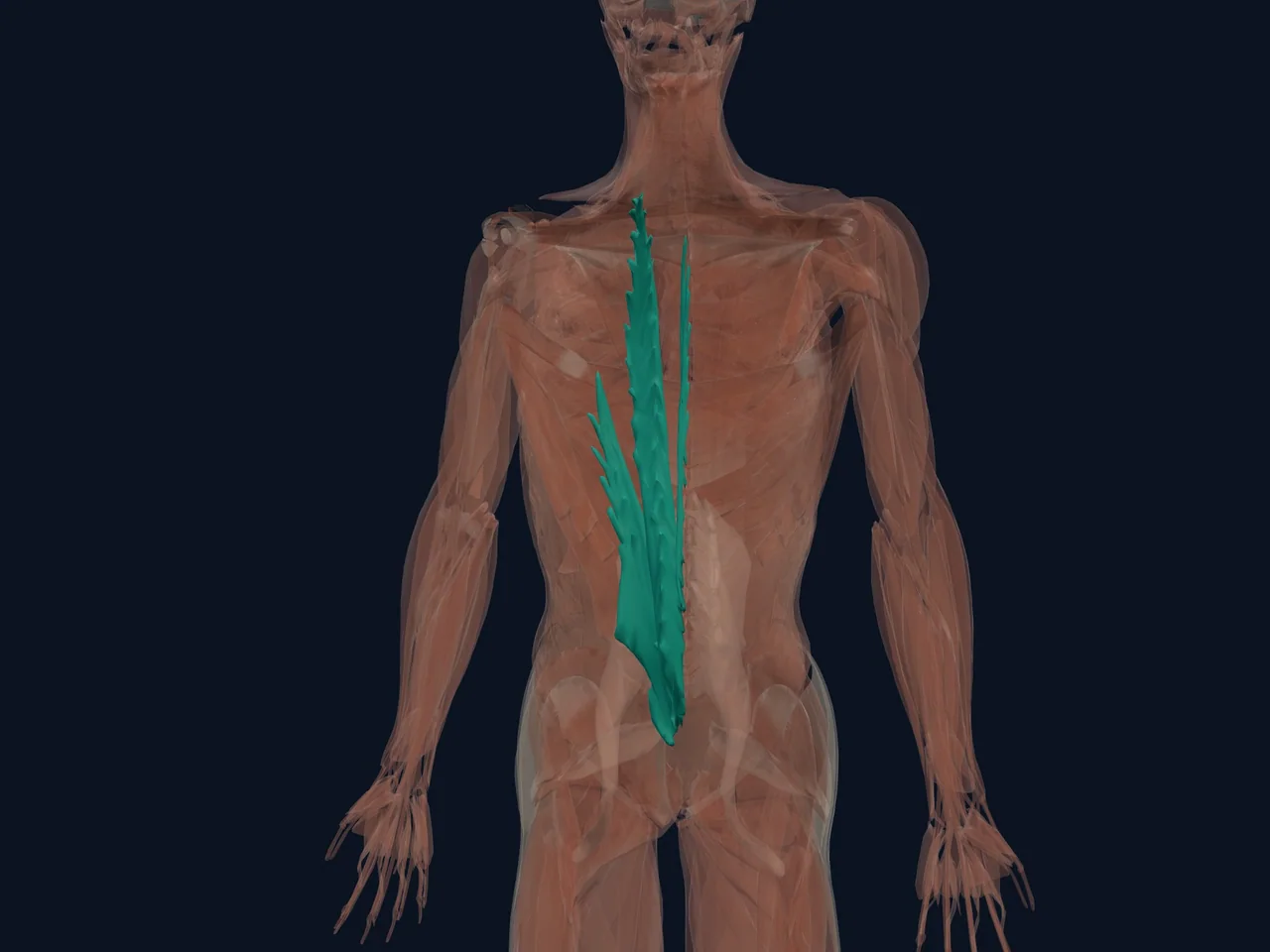
Overview
The erector spinae is a long group of muscles running up both sides of the spine. It is made of three main columns: iliocostalis on the outside, longissimus in the middle and spinalis closest to the spine.
These muscles are not a single isolated strip. Different sections attach across the pelvis, ribs, vertebrae and skull, allowing the group to support several regions of the back.
Location and Connections
- Iliocostalis is the most lateral column and connects the pelvis, ribs and neck
- Longissimus is the largest intermediate column
- Spinalis lies nearest the spinous processes
- The lumbar portions blend into a broad tendon and connective-tissue system over the sacrum and pelvis
What It Does
Working on both sides, the erector spinae helps extend the spine and maintain an upright posture. Working more on one side, it helps side-bend the trunk. During lifting and bending, it also controls the trunk as it moves forward rather than simply pulling it backward.
Common Problems
The erector spinae may feel sore or fatigued after unfamiliar lifting, long periods of standing or a sudden increase in training. Tenderness in this area does not identify one exact damaged structure; several muscles, joints and connective tissues overlap in the lower back.
Clinical Relevance
Rehabilitation usually focuses on restoring comfortable movement and gradually rebuilding tolerance to bending, carrying and lifting. Persistent leg weakness, spreading numbness, saddle numbness or changes in bladder or bowel control need medical assessment.
Related Anatomy
References
- StatPearls. "Anatomy, Back, Muscles." https://www.ncbi.nlm.nih.gov/books/NBK537074/
- StatPearls. "Anatomy, Back, Lumbar Spine." https://www.ncbi.nlm.nih.gov/books/NBK557616/