Overview
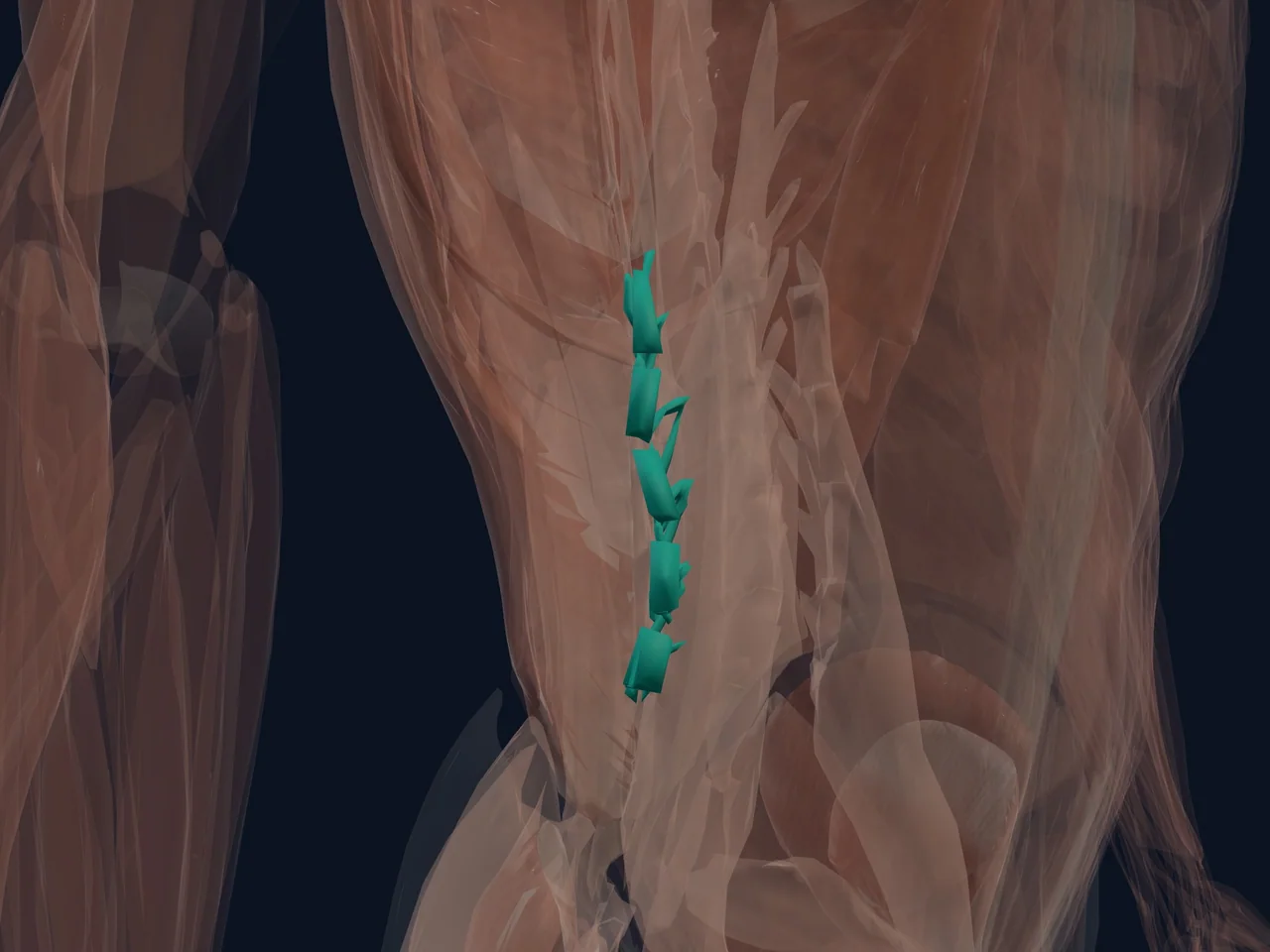
Beneath the larger back muscles is a network of short muscles that connects neighbouring vertebrae. In the lower back, the most recognizable is the multifidus, supported by the smaller interspinales and intertransversarii.
They work as a coordinated system. Their role is less about producing a large visible movement and more about controlling motion between individual spinal segments.
Location and Connections
- Multifidus runs upward and inward across several vertebrae
- Interspinales connect adjacent spinous processes
- Intertransversarii connect neighbouring transverse processes
- These muscles sit deep to the erector spinae, close to the joints of the spine
What They Do
The deep muscles help control extension, rotation and side-bending. They also provide position feedback and fine control while larger trunk and hip muscles produce force.
They do not act like an on-off “core switch.” Normal breathing, walking, lifting and exercise recruit them together with the rest of the trunk.
Common Problems
Pain can reduce normal muscle activity and coordination, but a scan or sore spot cannot prove that one small muscle is the sole cause of back pain. Most rehabilitation uses whole movements rather than trying to isolate a single deep muscle.
Clinical Relevance
Early comfortable movement and progressive trunk, hip and lifting exercises can rebuild confidence and capacity. The exact starting point depends on symptoms and function rather than whether a person can consciously “feel” the multifidus contracting.
Related Anatomy
References
- StatPearls. "Anatomy, Back, Muscles." https://www.ncbi.nlm.nih.gov/books/NBK537074/
- StatPearls. "Anatomy, Back, Lumbar Spine." https://www.ncbi.nlm.nih.gov/books/NBK557616/