Explore Anatomy ↗

Exercises · IA-BAC-EXE-012

Seated Cable Row

Learn seated cable row form, muscles worked, benefits, common mistakes and progressions for back strength.

Browse Lower Back
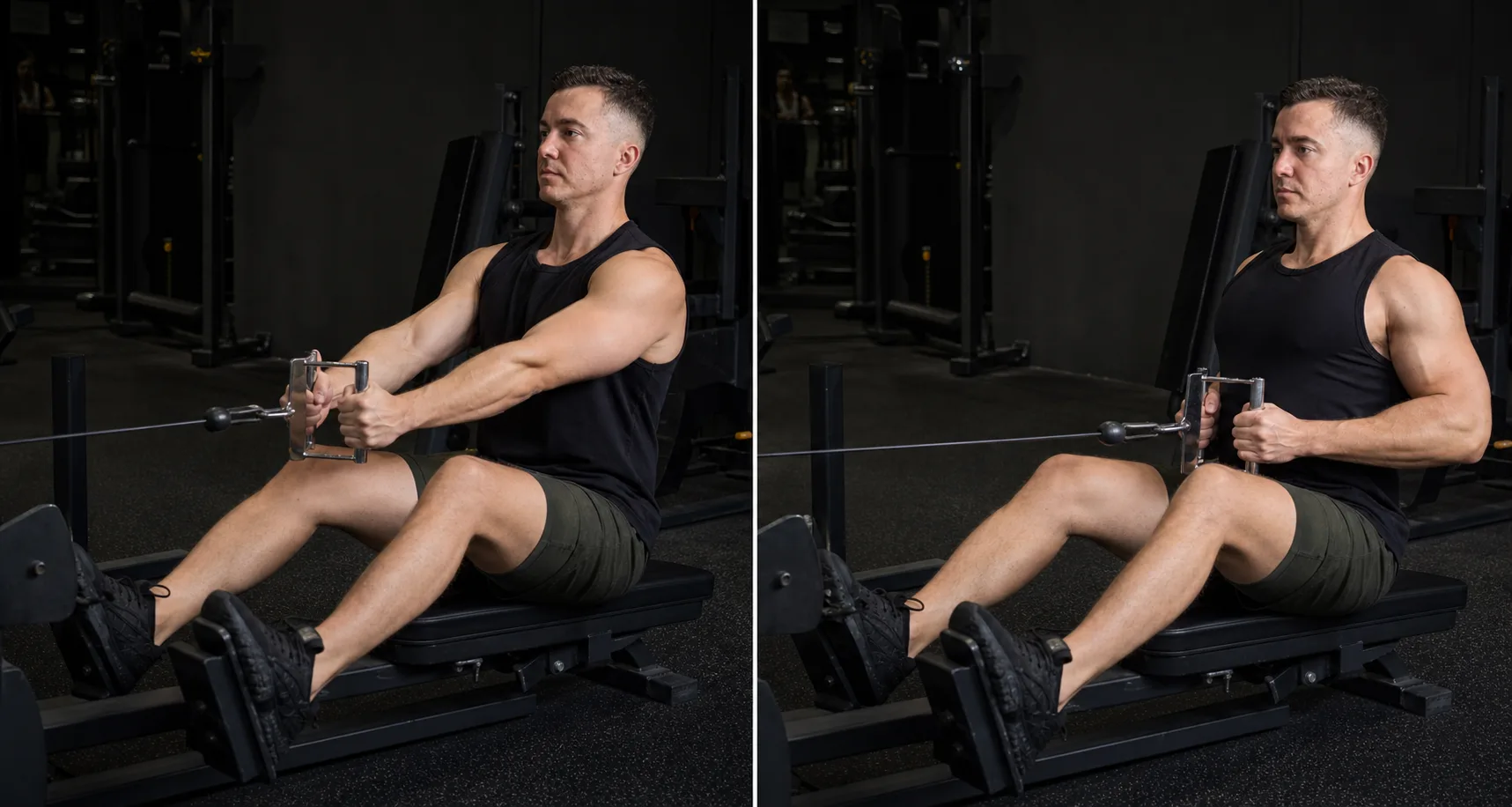
Start and finish demonstration of Seated Cable Row
Start and finishUse the written steps below for the full technique and safety guidance.

At a glance

Exercise profile

Target muscles
latissimus dorsi, rhomboids, middle trapezius
Exercise type
Strength
Equipment
Low cable station and close-grip row handle
Mechanics
Compound
Movement pattern
Pull (bilateral)
Experience level
beginner
Secondary muscles
biceps brachii, posterior deltoid

Horizontal back pulling and shoulder-blade control

What this exercise works

The lats, rhomboids and middle trapezius pull the arms back and organize the shoulder blades while the biceps assist at the elbow.

Primary emphasis

  • latissimus dorsi
  • rhomboids
  • middle trapezius

Secondary muscles

  • biceps brachii
  • posterior deltoid

Stabilizers

  • erector spinae
  • abdominal muscles
  • forearm flexors

Movement and joint actions

  • Shoulder extension
  • Scapular retraction
  • Elbow flexion

Muscle contribution changes with position, range, resistance and individual technique.

Why it can help

Potential benefits and carryover

Benefits depend on technique, dosage, consistency and whether the exercise suits the person. Sport carryover means supporting the physical demands of the activity—not guaranteeing performance or preventing injury.

Everyday benefits

  • Builds mid-back and lat strength with adjustable resistance
  • Lets you practise controlled shoulder-blade movement
  • Works well across moderate to higher repetition ranges

Training carryover

  • Balances pressing volume and supports other row variations
  • Carries into pull-ups, deadlifts and general upper-back strength work

Sport carryover

  • Supports pulling strength for paddling, climbing and contact sports

Technique

Seated Cable Row tips

Use these cues to keep the movement controlled and focused on its intended purpose.

  1. Sit tall with a small knee bend and feet braced.
  2. Reach forward without rounding hard through the lower back.
  3. Pull the handle toward the lower ribs or upper abdomen.
  4. Pause briefly with the shoulder blades controlled, then return slowly.

Overview

The seated cable row trains the back through a horizontal pull. The cable gives a smooth, adjustable resistance path, making it useful for building strength and practising deliberate shoulder-blade control.

How to Do It

  1. Sit at a low cable station with feet braced and a slight bend in the knees.
  2. Reach forward to take the handle while staying tall through the torso.
  3. Pull the handle toward the lower ribs, bringing the elbows back alongside the body.
  4. Pause briefly, then return with control until the arms are long again.

What You Should Feel

Back effort between the shoulder blades and along the side of the ribs, plus biceps work. Reduce load if the lower back is doing most of the movement.

Common Mistakes

  • Rocking the torso far back and forth
  • Shrugging up toward the ears
  • Pulling only with the hands and arms
  • Letting the shoulders collapse forward at the return

Progression

Add repetitions first, then small weight increases. A slower return or a brief pause at the torso makes the same load more challenging without losing control.

Educational information only — not a diagnosis.
Educational information only

This information does not diagnose an injury or replace care from a qualified healthcare professional.