Overview
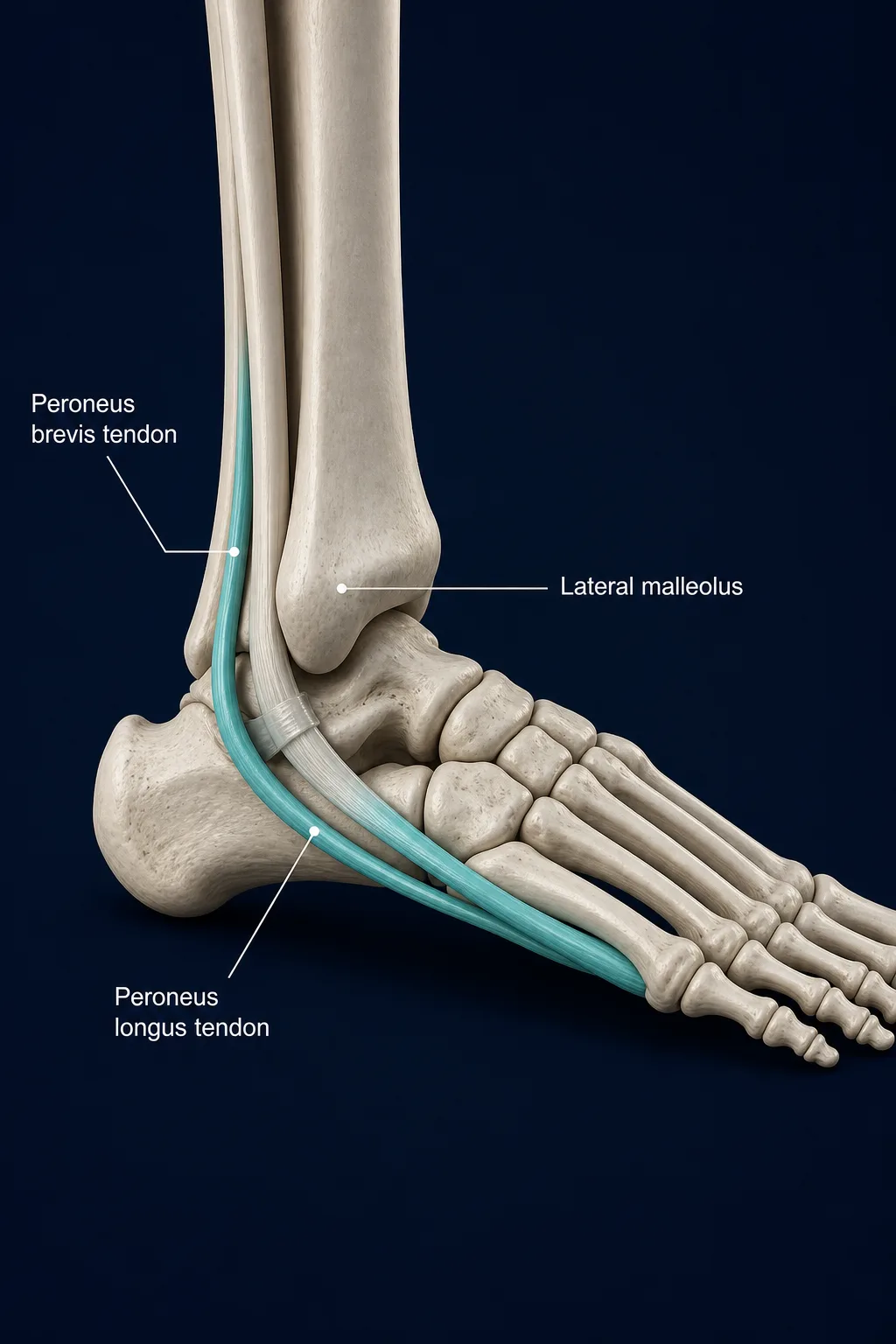
The peroneal muscles — fibularis longus and fibularis brevis in current anatomical terminology — run down the outer side of the lower leg. Their tendons curve behind the outer ankle bone (the lateral malleolus) on their way into the foot, making this the classic spot for peroneal tendon pain.
Location and Connections
- Fibularis longus — the longer, more superficial of the two; starts near the top of the fibula, and its tendon crosses under the sole of the foot to anchor near the base of the first metatarsal and the medial cuneiform
- Fibularis brevis — shorter and deeper; starts lower on the fibula and its tendon attaches to the base of the fifth metatarsal, on the outside of the foot
- Both tendons pass together behind the lateral malleolus, held in place by the peroneal (fibular) retinaculum — a groove and sheath that can either overload a healthy tendon or fail to keep an unstable tendon in place
What It Does
- Everts the foot (turns the sole outward) and assists in pointing the foot down
- Actively resists ankle inversion, the movement that causes a classic rolled ankle — making these muscles a key dynamic stabilizer of the outer ankle
- Fibularis longus also helps support the arch as its tendon crosses under the foot
Common Problems
- Peroneal tendinopathy — irritation and reduced load tolerance of one or both tendons behind the outer ankle, often after an ankle sprain or a jump in running/cutting volume
- Peroneal tendon subluxation — the tendons snapping out of their groove over the outer ankle bone, sometimes felt or even seen as a visible snap
- Strain, usually from a sudden inversion event similar to what causes a lateral ankle ligament sprain
Clinical Relevance
Because these muscles actively resist the same inward-rolling motion that injures the lateral ankle ligaments, they're a common focus of ankle-sprain rehab — building eversion strength and single-leg balance helps both the tendons and the ligaments share load better on uneven ground.
Related Anatomy
- Ankle joint overview — the joint these tendons cross
- Lateral ankle ligaments — the ligaments these muscles work alongside to resist inversion
References
- StatPearls. "Anatomy, Bony Pelvis and Lower Limb, Fibularis Longus Muscle." https://www.ncbi.nlm.nih.gov/books/NBK534856/
- StatPearls. "Peroneal Tendon Syndromes." https://www.ncbi.nlm.nih.gov/books/NBK556161/