Overview
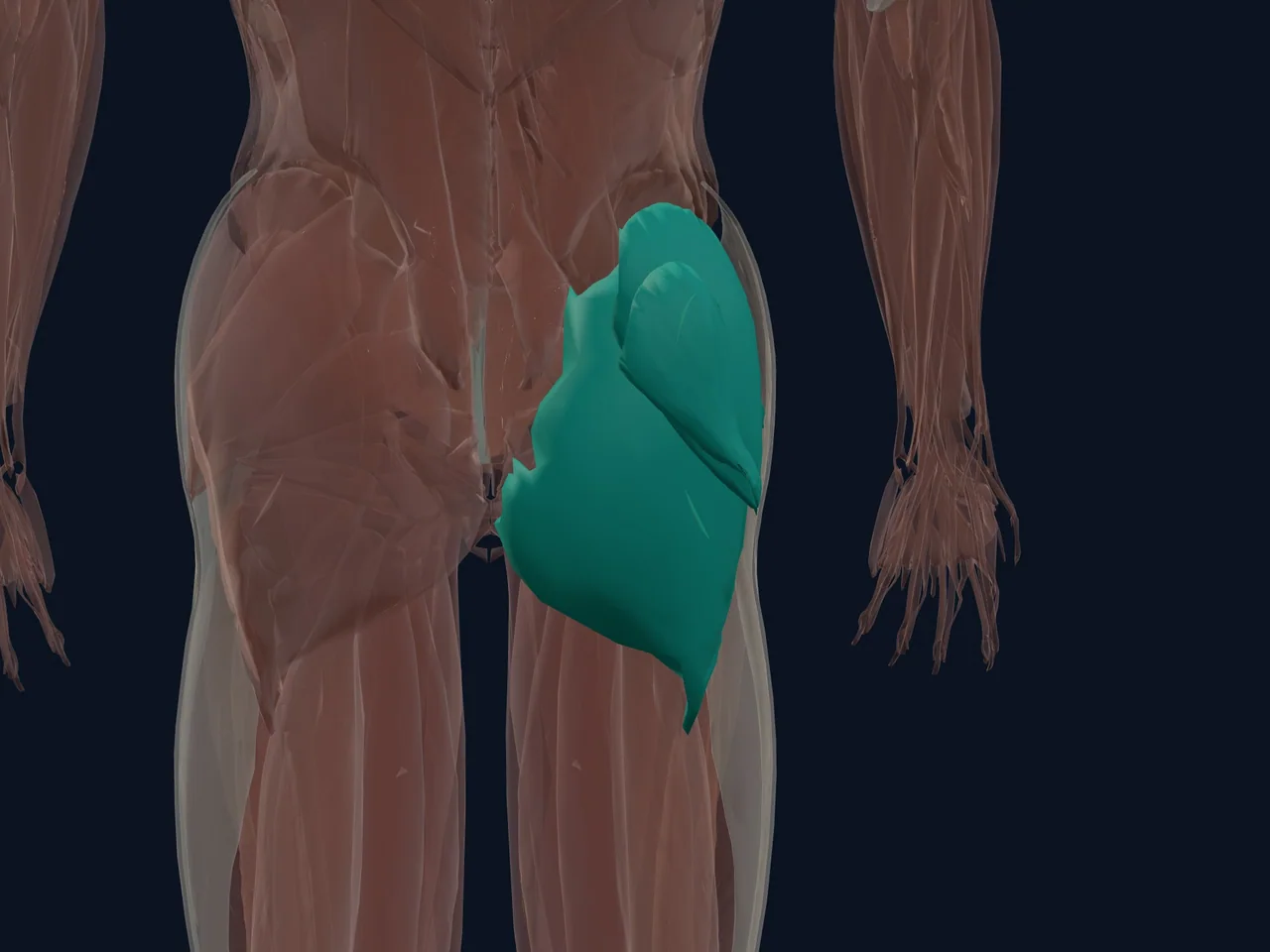
The gluteal muscles are the large muscles that make up the buttocks and the side of the hip. They are the body's biggest power source for hip extension (driving the leg backward) and hip abduction (moving the leg out to the side).
They are not just for shape — they help you walk, run, climb stairs, stand up from a chair and keep your pelvis level when you stand on one leg. Weakness or irritation in these muscles is behind a large share of hip, buttock and even knee complaints.
Location and Connections
- Gluteus maximus — the largest and most superficial muscle of the buttock; it extends the hip powerfully when you climb stairs, sprint or stand up
- Gluteus medius — on the side of the hip, just above the bony bump you can feel; it abducts the leg and steadies the pelvis when you stand or walk on one leg
- Gluteus minimus — the deepest of the three, beneath the medius, with a similar role
- Tendons of the medius and minimus attach to the bony ridge on the outside of the hip (the greater trochanter) — the area involved in gluteal tendinopathy and trochanteric pain
What It Does
The glutes extend and rotate the hip, abduct the leg away from the body, and stabilize the pelvis during weight-bearing. When you walk, the gluteus medius and minimus on the standing-leg side keep the opposite side of the pelvis from dropping. When that control is weak, nearby structures — including the hip joint and knee — take extra load.
Common Problems
- Gluteal tendinopathy — irritation of the gluteus medius or minimus tendon at the outer hip
- Greater trochanteric pain syndrome — the broader term for lateral hip pain in this area
- Gluteal strains — muscle pulls, usually after a sudden sprint, jump or change of direction
- Weakness-related overload — aching hips or knees when the glutes are not switching on during activity
Outer-hip pain is the classic clue that the gluteal tendons are involved. Buttock pain can also be referred from the lower back, so location alone does not settle the diagnosis.
Clinical Relevance
Gluteal strength is a core part of hip, knee and back rehabilitation. Exercises that load the glutes — bridges, side-lying hip abduction and hip hinges — are common starting points. Sharp pain over the outer hip that worsens with pressure or with standing on one leg is worth assessing rather than "pushing through."
Related Anatomy
- Hip joint — the joint these muscles move and protect
- Lumbar spine — a common source of referred buttock pain
References
- StatPearls. "Anatomy, Bony Pelvis and Lower Limb, Gluteus Maximus Muscle." https://www.ncbi.nlm.nih.gov/sites/books/NBK538193/
- StatPearls. "Anatomy, Bony Pelvis and Lower Limb, Gluteus Maximus Muscle." https://pubmed.ncbi.nlm.nih.gov/30855781/