Overview
Athletic pubalgia describes persistent sport-related pain around the lower abdominal wall and its attachments near the pubic bone. It is often called a sports hernia, but there may be no visible bulge and it is not the same as a typical inguinal hernia.
Because several structures overlap in this area, current clinical language may instead describe inguinal-related, adductor-related, pubic-related or hip-related groin pain.
Where the Injury Happens
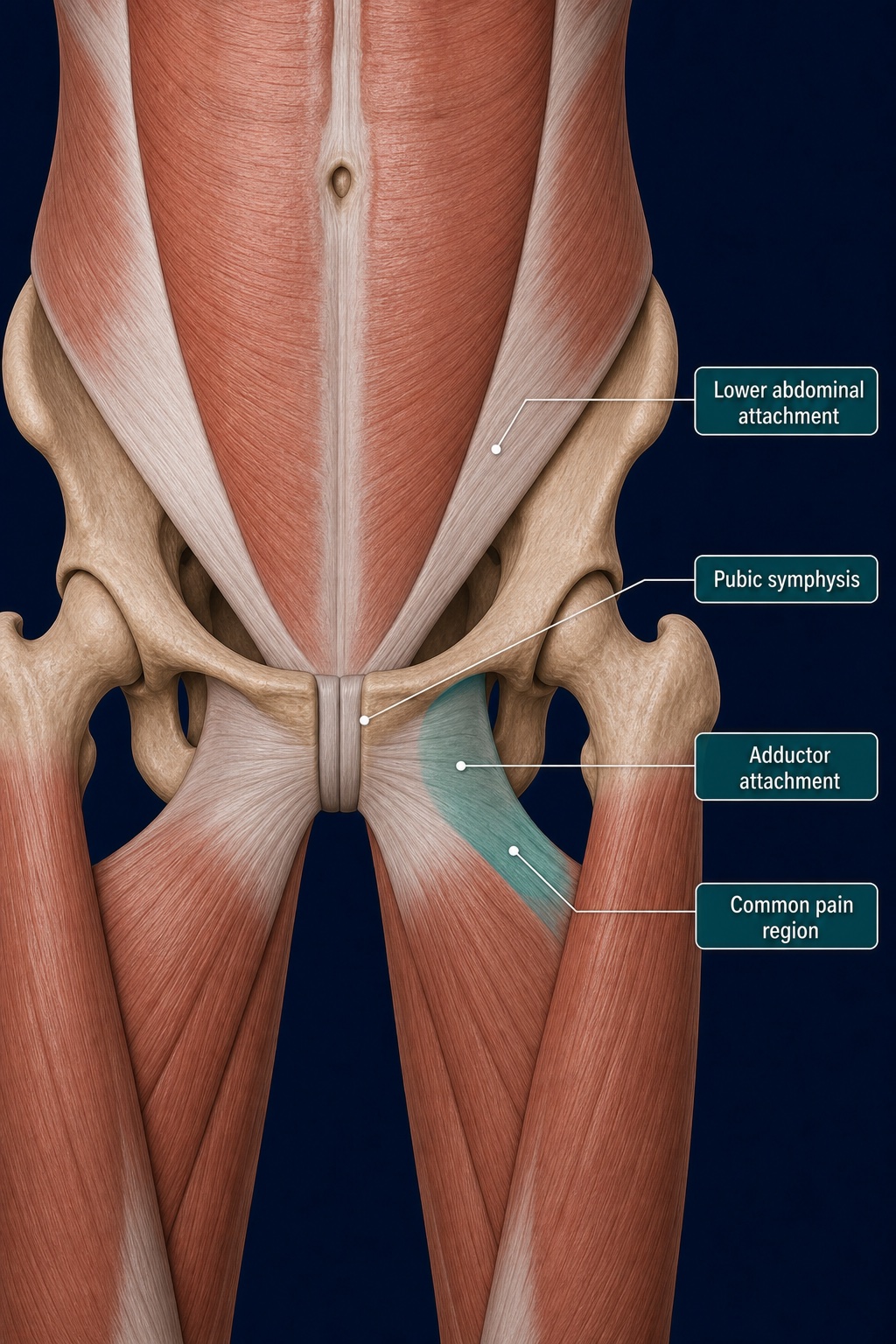
Symptoms usually centre on the shared lower-abdominal and adductor attachment region beside the pubic symphysis, rather than the side of the hip or the middle of the thigh.
Typical Pattern
- Deep groin or lower-abdominal pain during sprinting, cutting or kicking
- Pain with resisted sit-up, coughing or sneezing
- Symptoms that settle with rest but return with higher-speed sport
- Tenderness near the pubic attachment of the lower abdominal wall
- Possible overlap with adductor pain or limited hip motion
What It Is Not
Athletic pubalgia is not one single torn structure that can be diagnosed from pain location alone. Adductor strain, hip impingement, labral injury, stress fracture and a true hernia can create similar symptoms. A new groin bulge, severe abdominal symptoms or testicular pain needs medical assessment rather than a sports rehabilitation assumption.
Recovery Approach
Initial care usually uses progressive rehabilitation rather than immediate surgery. The programme may include trunk control, adductor strength, hip strength, gradual running and planned exposure to acceleration, cutting and kicking. Load should increase only when symptoms remain settled during and after training.
Surgical consultation may be considered when a clear clinical diagnosis persists despite an adequate rehabilitation period, but research uses inconsistent definitions and no single procedure fits every groin-pain pattern.
When to Get Assessed
- Pain that repeatedly prevents sprinting or changing direction
- Symptoms lasting several weeks despite sensible load changes
- Pain with coughing, a groin bulge or abdominal symptoms
- Night pain, fever, significant trauma or difficulty bearing weight
Connected Guides
References
- Weir A, et al. "Doha agreement meeting on terminology and definitions in groin pain in athletes." British Journal of Sports Medicine. 2015. https://bjsm.bmj.com/content/49/12/768
- Elattar O, et al. "Sports Hernia/Athletic Pubalgia: Evaluation and Management." Sports Health. 2014. https://pubmed.ncbi.nlm.nih.gov/24587864/
- Brito J, et al. "Nonsurgical Interventions for the Management of Long-Standing Groin Pain in Athletes." Journal of Clinical Medicine. 2023. https://pubmed.ncbi.nlm.nih.gov/37425562/
This information is for education only and is not a medical diagnosis.