Muscle-growth potentialHow well this movement can be loaded and progressed for building muscle.
Exercises · IA-KNE-EXE-015
Leg Extension
Learn seated leg-extension setup, muscles worked, benefits, common mistakes and practical progression.
At a glance
Exercise profile
- Target muscles
- quadriceps
- Exercise type
- Strength
- Equipment
- Selectorized leg-extension machine
- Mechanics
- Isolation
- Movement pattern
- Knee extension (bilateral or unilateral)
- Experience level
- beginner
- Secondary muscles
- tensor fasciae latae
What the science says
Direct comparison of knee extension and leg press
What it found: A 12-week MRI study found knee extensions and leg presses produced similar growth in the vasti and overall quadriceps, while the leg press also grew the gluteus maximus and adductor magnus.
What that means here: The leg extension is a legitimate quad-building exercise, not merely a warm-up. It is especially useful when you want more quadriceps work without another fatiguing compound lift.
Stable quadriceps isolation
What this exercise works
The quadriceps straighten the knees while the seat, back pad and handles keep the hips and torso stable.
Primary emphasis
- quadriceps
Secondary muscles
- tensor fasciae latae
Stabilizers
- abdominal muscles
- hip flexors
Movement and joint actions
- Knee extension
Muscle contribution changes with position, range, resistance and individual technique.
Why it can help
Potential benefits and carryover
Benefits depend on technique, dosage, consistency and whether the exercise suits the person. Sport carryover means supporting the physical demands of the activity—not guaranteeing performance or preventing injury.
Everyday benefits
- Directly loads the quadriceps without making balance or the back the limiting factor
- Makes load and repetition progression easy to track
- Lets each leg be trained separately when the machine supports unilateral work
- Adds quadriceps volume without the whole-body fatigue of another heavy squat
Training carryover
- Supports stronger squats, leg presses, step-ups and knee-extension strength
- Useful after compound leg work when the quadriceps still need more direct volume
Sport carryover
- Supports running, jumping, stair climbing and deceleration capacity
Technique
Leg Extension tips
Use these cues to keep the movement controlled and focused on its intended purpose.
- Line the machine pivot up with the side of the knee as closely as the machine allows.
- Place the shin pad just above the ankles rather than on the feet.
- Lift smoothly and stop just short of forcefully locking the knees.
- Lower the stack under control until the knees are comfortably bent again.
Overview
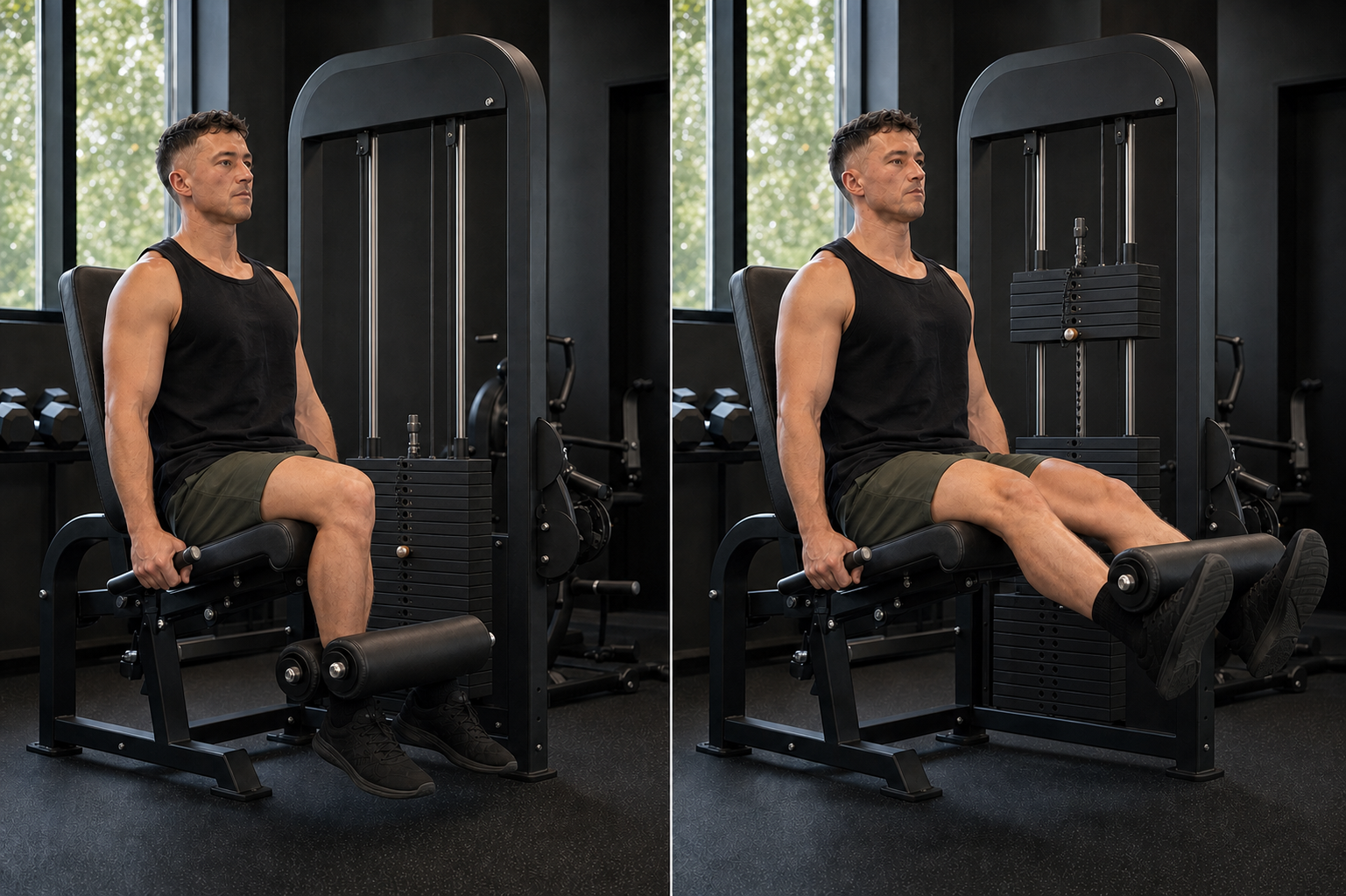
The leg extension is a straightforward quadriceps exercise. Because the machine supports your body, the quads can be trained hard without balance, grip or low-back fatigue ending the set first.
How to Do It
- Adjust the seat so the machine pivot sits close to the centre of your knee joint.
- Set the shin pad just above the ankles and keep your back against the pad.
- Hold the handles, brace gently and straighten both knees with a smooth motion.
- Stop just short of aggressively locking out, then lower the weight under control.
- Use a range that feels strong and comfortable. Start with 2–4 sets of 8–15 repetitions.
What You Should Feel
Expect a strong contraction and gradually building fatigue through the front of the thighs. The movement should not create sharp pain around the kneecap or a sudden pinch inside the knee.
Common Mistakes
- Setting the shin pad over the feet instead of just above the ankles
- Kicking the stack up with momentum
- Letting the hips lift away from the seat
- Dropping the weight quickly into the bottom position
Progression
First add repetitions while every rep remains smooth. Once you reach the top of your chosen range, move the pin one small step and rebuild. Single-leg sets can help expose side-to-side differences, but they are not automatically better.
Educational information only — not a diagnosis. Reduce the range or load if the exercise creates sharp or increasing knee pain.
This information does not diagnose an injury or replace care from a qualified healthcare professional.