Muscle-growth potentialHow well this movement can be loaded and progressed for building muscle.
Exercises · IA-KNE-EXE-016
45-Degree Leg Press
Learn 45-degree leg-press setup, muscles worked, depth, common mistakes and practical progression.
At a glance
Exercise profile
- Target muscles
- quadriceps, gluteus maximus
- Exercise type
- Strength
- Equipment
- 45-degree sled leg-press machine and plates
- Mechanics
- Compound
- Movement pattern
- Push (bilateral)
- Experience level
- beginner
- Secondary muscles
- adductor magnus, hamstrings
What the science says
Training study in the leg press
What it found: Eight weeks of unilateral leg pressing produced quadriceps growth in trained lifters across both a roughly 100-degree knee bend and each participant’s deeper available range.
What that means here: The leg press can build the quads across more than one sensible range. Use the deepest repeatable position that keeps the heels planted and pelvis supported rather than forcing depth for its own sake.
Stable compound leg strength and muscle building
What this exercise works
The quadriceps and glutes extend the knees and hips while the machine supports the torso and guides the sled.
Primary emphasis
- quadriceps
- gluteus maximus
Secondary muscles
- adductor magnus
- hamstrings
Stabilizers
- gluteus medius
- calf muscles
- abdominal muscles
Movement and joint actions
- Knee extension
- Hip extension
Muscle contribution changes with position, range, resistance and individual technique.
Why it can help
Potential benefits and carryover
Benefits depend on technique, dosage, consistency and whether the exercise suits the person. Sport carryover means supporting the physical demands of the activity—not guaranteeing performance or preventing injury.
Everyday benefits
- Loads the quadriceps and glutes with the torso supported
- Makes hard leg training possible without balancing a barbell
- Allows simple progression in repetitions and plates
- Can add lower-body volume with less upper-body and spinal loading than a squat
Training carryover
- Builds leg strength for squats, lunges, stairs and getting up from lower positions
- Pairs well with hamstring curls and calf work in a machine-based leg session
Sport carryover
- Supports jumping, acceleration and lower-body force production while complementing sport-specific training
Technique
45-Degree Leg Press tips
Use these cues to keep the movement controlled and focused on its intended purpose.
- Place the feet where the heels stay planted and the knees can track with the toes.
- Unlock the safeties only after the sled is controlled.
- Lower until the thighs approach the torso without the pelvis rolling away from the pad.
- Press through the whole foot and stop short of forcefully locking the knees.
Overview
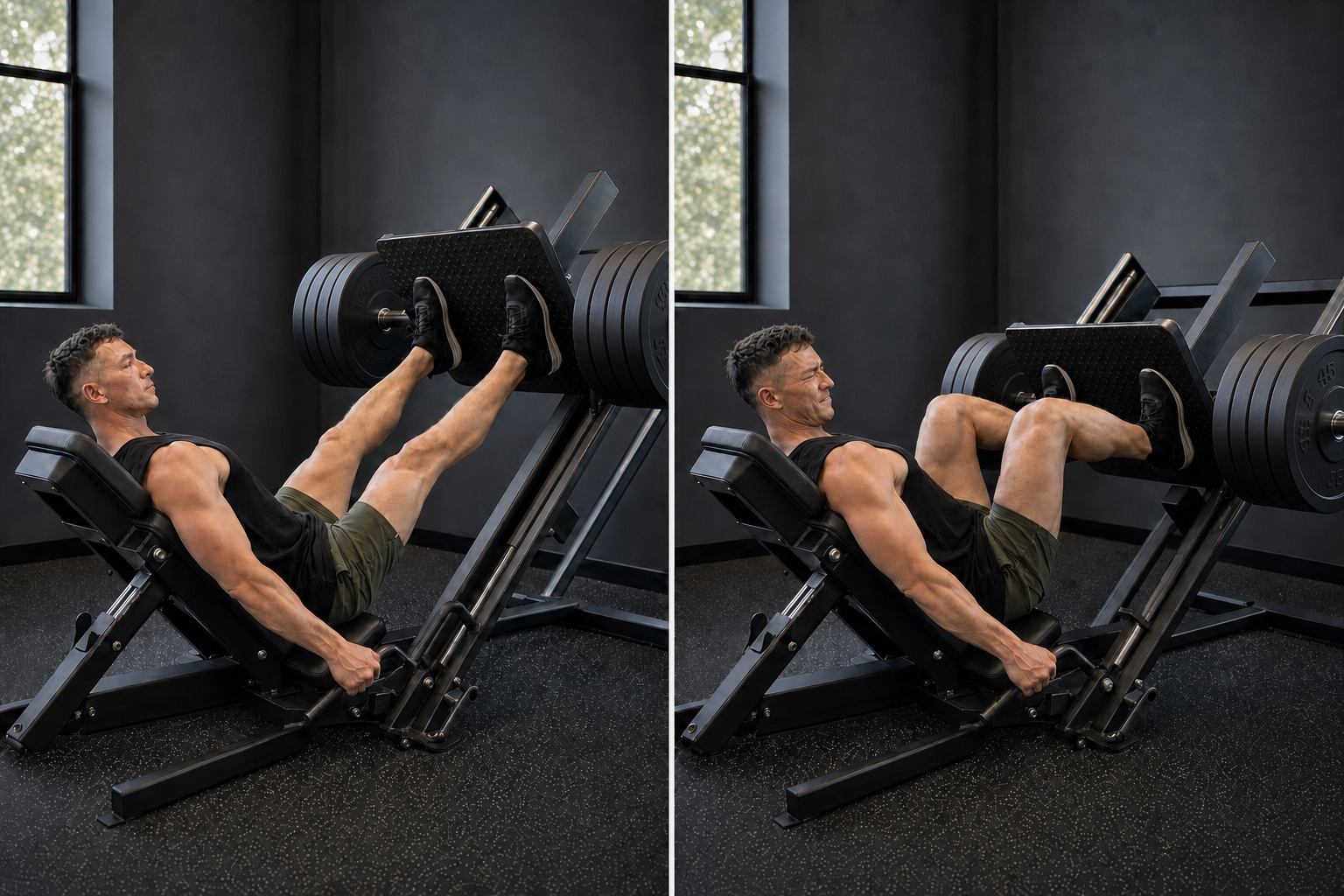
The 45-degree leg press is a supported compound exercise for the quads and glutes. It removes the balance demands of a squat, which makes it easier to take the legs close to a hard effort without the upper back becoming the weak link.
How to Do It
- Sit with the pelvis and low back supported and place the feet around shoulder width on the platform.
- Press the sled up, release the safeties and keep the knees softly unlocked.
- Lower the sled under control while the knees follow the toes.
- Stop before the pelvis rolls away from the pad or the heels lift.
- Push through the whole foot to return. Re-engage the safeties before leaving the machine.
What You Should Feel
The front of the thighs and glutes should do most of the work. A deeper comfortable range may involve more hip and adductor effort. The low back should remain supported rather than rounding away from the pad.
Common Mistakes
- Loading more plates than the available range can control
- Letting the knees collapse inward
- Lowering so far that the pelvis curls off the pad
- Locking the knees aggressively at the top
- Using the hands to push on the knees
Progression
Choose a repeatable depth first. Add repetitions within a range such as 8–15, then add a small amount of load to both sides. The sled itself already weighs something, so there is no prize for turning the machine into plate storage.
Educational information only — not a diagnosis. Use the machine's safeties and stop for sharp knee, hip or back pain.
This information does not diagnose an injury or replace care from a qualified healthcare professional.